




Manas Dasgupta
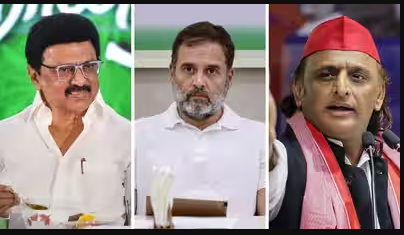
NEW DELHI, Sept 29: With the differences within the opposition INDIA bloc coming to fore, the Tamil Nadu’s erstwhile ruling party Dravida Munnetra Kazhagam (DMK) has decided to skip the INDIA bloc meeting in Delhi on Wednesday asserting that it was no longer a part of the opposition alliance following its break-up with the Congress at the state level after the Grand Old Party extended support to the TVK to form a government in the state.
The DMK spokesperson TKS Elangovan said the party would not participate in the meeting, while claiming that several other parties were also reluctant to attend due to differences with the Congress. He, however, said the parties remained “ideologically” united in their opposition to the BJP.
“Congress had chosen Tamilaga Vettri Kazhagam (TVK) in the state for the sake of two ministerial berths. So, we could not. They have said that they will continue with TVK. They are not in our alliance. How can we support them? How can we go to the meeting called by them,” Elangovan said.
“Many of the parties there do not want to go with Congress, but ideologically, they are united. They share the same view and will oppose the BJP. Therefore, they do not need to attend an INDIA bloc meeting because every party knows the issues and is in line with the Congress. Attending the meeting alone is just a formality,” he added.
The DMK had also skipped the INDIA bloc meeting held in June. However, the party later joined other opposition parties in signing a letter addressed to Chief Justice of India Surya Kant over the Election Commission’s Special Intensive Revision (SIR) of electoral rolls and other election-related issues.
Several parties from southern India are expected to participate in the September 30 meeting.
RSP MP N K Premachandran will attend from Kerala. The Kerala Congress (M) and the Indian Union Muslim League (IUML) will also participate. Both parties are constituents of the Congress-led government in Kerala.
From Tamil Nadu, the Viduthalai Chiruthaigal Katchi (VCK) is also expected to attend the meeting.
Samajwadi Party chief Akhilesh Yadav will also not attend the INDIA bloc meeting. The party has scheduled a state-level farmers’ conference in Lucknow, and a senior SP leader will represent the party at the opposition meeting.
Earlier on Monday, Congress general secretary KC Venugopal had said Yadav had a prior engagement related to Rajya Sabha election nominations. The September 30 meeting comes as opposition parties seek to coordinate on issues of common political interest, despite differences among alliance constituents.
The opposition parties’ INDIA bloc has called a meeting at the Constitution Club of India in New Delhi on Wednesday to finalise its strategy on a removal motion against Chief Election Commissioner (CEC) Gyanesh Kumar. The meeting may collect signatures on the proposed motion. The opposition parties led by the Congress are now expected to step up their demand for Gyanesh Kumar’s resignation and an independent inquiry into the Election Commission’s (EC) decisions, and to draw up a roadmap for a nationwide agitation.
The meeting came after Trinamool Congress founder Mamata Banerjee spoke at length over the phone to Leader of the Opposition (Lok Sabha) and Congress MP Rahul Gandhi and Communist Party of India (Marxist) general secretary MA Baby, who proposed an immediate huddle to frame a strategy, sources said. The developments have brought the TMC and the CPI(M), bitter political rivals in West Bengal, on the same page on the EC issue, though they have earlier sat together as part of the INDIA bloc at least at the national level.
Congress leaders Rahul Gandhi, Sonia Gandhi and Mallikarjun Kharge, TMC’s Mamata Banerjee and Abhishek Banerjee, Shiv Sena (UBT) chief Uddhav Thackeray are among those expected to attend, along with leaders of other constituent parties, sources said. The bloc last met on June 8 at the Constitution Club.
The meeting is likely to have three agenda items. The first is the strategy on the removal motion in Parliament, including collecting signatures. The second is intensifying the demand for Gyanesh Kumar’s resignation and an impartial probe into the EC’s decisions, along with planning further protests. The third is a framework for a nationwide agitation, particularly in the poll-bound states, including Punjab, Uttar Pradesh and Uttarakhand.