



Manas Dasgupta
NEW DELHI, Nov 29: Lady Luck, rather than the political strategy, seems to have favoured the BJP and the Narendra Modi government which looks like all set to turn the table on the opposition INDIA bloc on the Delimitation Bill. A combination of opposition fractures, legislative revisions, and parliamentary arithmetic has brought the Narendra Modi government close to securing the two-thirds majority required to pass the revised Delimitation Bill
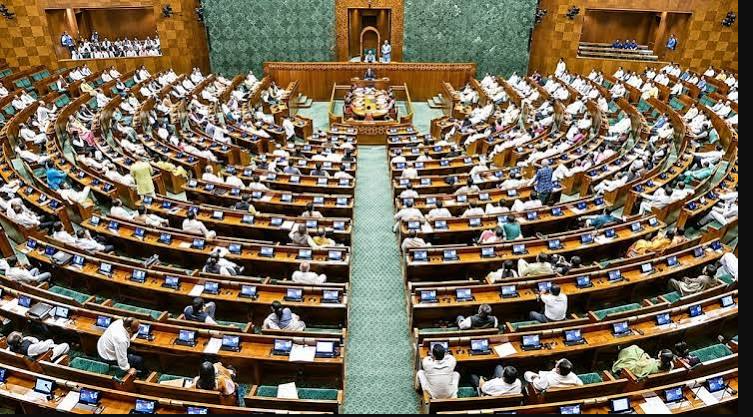
When the Lok Sabha meets for its special sitting on Monday, the Narendra Modi government is likely to present a different picture of where it stands, more confident of getting the measure passed after it was defeated by the same parties in April with 54 votes.
The government had opened channels with the DMK about a year earlier. But, with the Tamil Nadu Assembly elections then approaching, the DMK was not willing to soften its stand.
Through intermediaries, the government conveyed that it was ready to address the DMK’s concerns about Tamil Nadu’s share in the Lok Sabha. The offer was made before the bill was brought in April. The DMK, however, was not prepared to pay the political price for supporting the bill in an election year.
In February, then Chief Minister MK Stalin pushed a resolution against delimitation passed in the Assembly, and on April 16 he burned a copy of the Centre’s bill, calling it a “black law.” This was despite Home Minister Amit Shah telling the Lok Sabha on April 16 and 17 that the government was ready to bring a provision for a 50 per cent increase in seats for all states.
The difference that happened between April and November were the results of the Tamil Nadu and West Bengal Assembly elections. In Tamil Nadu, the DMK lost the election, not to its traditional rival, the AIADMK, but to actor C Joseph Vijay’s new party, the Tamilaga Vettri Kazhagam (TVK). The TVK won 108 of the 234 seats, 10 short of a majority.
The DMK, which was a distant second with 54, was still recovering from the defeat when the Congress, which had fought the election as its ally, broke ranks. The Congress decided to leave the DMK and join the government with Vijay, getting a share of power in Tamil Nadu for the first time in 59 years, with two ministers.
The move angered the DMK, which broke ties with the Congress and the INDIA bloc. It also wrote to the Speaker asking that its MPs be seated away from the Congress in the Lok Sabha. The BJP saw an opportunity in these developments.
In a letter dated May 7, DMK parliamentary party leader Kanimozhi Karunanidhi asked Speaker Om Birla for separate seating “in view of the changed political circumstances and as our alliance with the Indian National Congress has come to an end.” That request has been okayed now.
Similar developments also took place in West Bengal where the ruling Trinamool Congress was trounced by the BJP providing the saffron party first entry into the eastern state. In the wake of the election defeat, the TMC was split with the rebels pledging their support to the BJP governments in the state and at the Centre with 20 of the 28 TMC MPs forming a separate group under the umbrella of the unknown “National Citizens Party of India” and extending support to the Delimitation Bill.
As for Maharashtra’s NCP(SP), this is the party the BJP is accused of splitting when it brought Sharad Pawar’s nephew Ajit Pawar into government with it. Yet the NCP (SP) is now backing the government on the delimitation move.
Between April and now, it was in the Monsoon Session of July that the BJP took steps that can be seen as attempts to woo the DMK and the NCP(SP). While the government kept talking to the DMK about the delimitation move, the party tried to bring about a merger of the two NCP factions, which would then join the NDA.
That merger did not happen because the late Ajit Pawar’s wife, Sunetra Pawar, and son Parth Pawar were not willing. Sunetra Pawar took over as NCP chief after her husband’s death in January. She reportedly told the BJP-led Mahayuti/NDA alliance leaders that she strongly opposes a merger, though the NCP(SP) was welcome in the NDA as a separate party.
The BJP kept talks with Sharad Pawar going. During the Monsoon Session, Pawar met Prime Minister Narendra Modi at Parliament House along with all eight of his party’s Lok Sabha MPs. The stated agenda of the August 10 meeting was the drought situation in Maharashtra, but it was also seen as linked to the government’s effort to win support for the delimitation bill.
When Sharad Pawar, 85, was later admitted to hospital, PM Modi called him to ask about his health. A close aide of the veteran leader later said the PM told him he “should rest now”, and that he (Modi) and Pawar’s daughter Supriya Sule would “together look after the country’s affairs.” This was seen as linked to bringing the NCP(SP) into the NDA and to a possible berth for Sule in the Union Council of Ministers.
Apart from these meetings, the government took other steps during the Monsoon Session that softened the DMK and the NCP(SP). Before that session began, the government had planned to bring several important bills, including ‘One Nation, One Election’, an education-related bill called the Viksit Bharat Shiksha Adhishthan Bill; a bill providing for the removal of a PM, CM or ministers jailed for 30 days; and the Foreign Contribution (Regulation) Amendment Bill that would hit NGO’s finances in particular.
It was then said that the Joint Parliamentary Committees (JPCs) on the first three would report soon, so the government could pass them in the session. The government also intended, at first, to pass the contentious FCRA amendment bill in the same session. But the tenure of every JPC was extended, and none of them submitted a report. The FCRA bill was also sent to a JPC.
The DMK and the NCP(SP) had opposed all of these bills. The DMK was particularly upset about the FCRA bill and had opposed it openly. Its objections to the other bills are also on record. Sources say the government held back on these bills as part of a give-and-take, and in return wanted the two parties’ support on delimitation. Senior ministers stayed in constant touch with DMK leaders. The government was so careful about the DMK that when a Minister of State from an ally party, known for off-the-cuff remarks, visited Chennai, a senior minister called him and warned him not to comment on the DMK’s support for delimitation.
The cabinet decision on Friday, overhauling the bills, completed the process. The government accepted the DMK’s two main demands: that the current share of every state, including Tamil Nadu, in the Lok Sabha be maintained with only a flat 50 per cent increase; and that the number then be frozen for the next 25 years, until 2051. After this was done in writing, the DMK made the big U-turn and decided to support the bills.
On Saturday, after a meeting of the party’s MPs in Chennai, DMK president MK Stalin said the party had “succeeded in our efforts to protect Tamil Nadu’s parliamentary representation for the next 25 years.”
The Congress MP Shashi Tharoor, meanwhile, has questioned the BJP’s intentions behind the Delimitation Bill and wondered if they were working in their “political interests.” Speaking to reporters during an event in Jharkhand’s Jamshedpur, Tharoor said the Centre’s delimitation bill was a “short-term thinking”.
“I am not able to understand what the government’s thinking is. Is this short-term thinking, or are they working on their political interests, or are they thinking about the welfare of the country? For the welfare of the country, will a Lok Sabha with 815 MPs work? Will people get a chance to talk? Will there be a discussion? I don’t know. But I feel that even with 540 MPs, it is very difficult for us to work,” he said. “People are not getting a chance to ask questions to the ministers, to discuss the issues of their constituencies, to speak in zero hour. When 815 will happen, a lot of people will come just to clap,” Tharoor said.
He said in a parliamentary democracy, an institution was needed to hold the government accountable. “But this is not going to happen with this kind of expansion. So what is their intention? What do they want with this expansion? They want to draw lines in every constituency so that they can do whatever benefits their party,” he added.
“If your thinking is only till the next election and you are not ready to think about the long-term future, then are you really thinking about the well-being of India? Or are you only thinking about the well-being of your party for the next two to five years?” he asked.