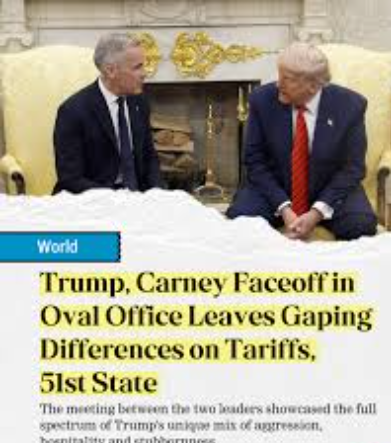
Canada: ‘If you retaliate, tariff will go up beyond 35%,’ Trump warns PM Carney







Virendra Pandit
New Delhi: Clamping a 35 percent tariff on imports from Canada from August 1, US President Donald Trump has warned its Prime Minister that this levy will be increased if Canada retaliates, the media reported on Friday.
In a Thursday (July 10) letter, Trump said he will raise taxes on many imported goods from Canada to 35 percent, further deepening a rift between the two North American border-sharing countries that have suffered a debilitating blow to their decades-old alliance.
The letter to Canadian PM Mark Carney showed an aggressive increase to the top 25 percent tariff rates that Trump first imposed in March after months of threats. The US tariffs aimed to get Canada to crack down on what Trump claimed was fentanyl smuggling despite the relatively modest trafficking in the drug from that country. The US President also expressed frustration with a trade deficit with Canada that largely reflects oil purchases by America.
“I must mention that the flow of Fentanyl is hardly the only challenge we have with Canada, which has many Tariff, and Non-Tariff, Policies and Trade Barriers,” Trump wrote in the letter, according to media reports.
The higher rates would go into effect on August 1, creating a tense series of weeks ahead for the global economy as recent gains in the S&P 500 stock index suggest many investors think Trump will ultimately back down on the increases. For his U-turns, he has already earned the tag of TACO—Trump Always Chickens Out!
While several countries received Trump’s tariff letters this week, Canada — America’s second largest trading partner after Mexico — has become something of a foil to the US President. Ottawa has imposed retaliatory tariffs on US goods and pushed back on the President’s taunts of making Canada the 51st state of the USA. Mexico has also faced 25 percent tariffs because of fentanyl; yet it has not faced the same public pressure from Trump.
Carney was elected Prime Minister in April on the argument that Canadians should keep their “elbows up.” He has responded by distancing Canada from its intertwined relationship with the US, instead seeking to strengthen its links with the European Union and the United Kingdom.
Hours before Trump’s letter, PM Carney posted on X a picture of himself with British Prime Minister Keir Starmer, saying, “In the face of global trade challenges, the world is turning to reliable economic partners like Canada.” Implied in his statement was that the US has become unreliable because of Trump’s haphazard tariff regime, which has gone through aggressive threats and reversals.
When Carney visited the White House in May, the public portion of their meeting was cordial. But Trump said there was nothing the Canadian leader could tell him to remove the tariffs.
“Just the way it is,” Trump said at the time.
Carney indicated he would be willing to be patient in pursuing talks on trade.
“There are much bigger forces involved,” the Canadian PM said. “And this will take some time and some discussions.”
In all, Trump has sent a series of tariff letters to 23 countries so far. Those form letters, however, became increasingly personal with Canada as well as a Wednesday note that put a 50 percent tariff on Brazil for the ongoing trial of its former President, Jair Bolsonaro, for trying to stay in office even after his 2022 election loss. Trump, who was similarly indicted for his efforts to overturn his 2020 election loss, has made a common cause with Bolsonaro.
The letters reflect the inability of Trump to finalise the dozens of trade frameworks that he claimed would be easy to negotiate—“90 deals in 90 days”. Shortly after unveiling his April 2 “Liberation Day” tariffs, a financial market selloff forced him to announce a 90-day pause and negotiating period during which a 10 percent baseline tariff would be charged on most imported goods.
But he indicated that the 10 percent tariff rates are largely disappearing as he resets the rates with his letters.
“We’re just going to say all of the remaining countries are going to pay, whether it’s 20 percent or 15 percent,” Trump said in a phone interview with NBC News.
So far, he announced trade frameworks with the UK and Vietnam, as well as a separate deal with China, to enable continued trade talks. Trump jacked up import taxes on Chinese goods to as much as 145 percent, but after talks he said China faces total tariffs of 55 percent.
In June, Trump said he was suspending trade talks with Canada over its plans to continue its digital services tax, which would hit US technology companies. A few days later, talks resumed when PM Carney rescinded the tax.
Under the current tariff structure, the 2020 United States-Mexico-Canada Agreement (USMCA) has protected eligible goods from Trump’s tariffs. But a review of the pact is scheduled for 2026.