Bangladesh: ‘Loan defaulter’ garment businessman is new central bank chief!

Virendra Pandit
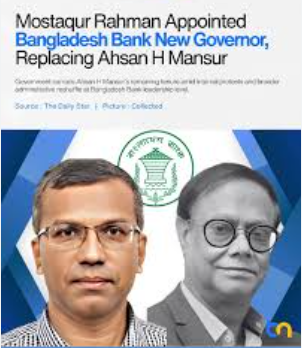
New Delhi: The first major decision by the newly-installed Bangladesh Nationalist Party (BNP) government led by Prime Minister Tarique Rahman kicked off a firestorm on Friday when Dhaka announced the appointment of an alleged loan defaulter garment businessman as governor of the central bank, the media reported.
The Tarique government abruptly ended the tenure of the Muhammad Yunus-era Governor of Bangladesh Bank, Ahsan Habib Mansur, and appointed Mostaqur Rahman, a businessman with no banking experience and a history of defaulting on loans, as his successor, according to reports.
This sparked a fierce criticism from the main Opposition Jamaat-e-Islami, whose chief, Shafiqur Rahman, described the move as “the formal beginning of mob culture backed by the current government.”
“I have not resigned, nor have I been removed. I saw it in the media, so I am going home,” Mansur told reporters on Wednesday as he left the Bangladesh Bank headquarters wading through a mob, reported The Daily Star.
He was then dismissed prior to the completion of his term in 2028, and by his own admission, he learnt of his removal, not through official channels, but through TV news bulletins.
Mostaqur’s appointment marked a break with tradition as, previously, all appointments to the top post at Bangladesh Bank had been practically reserved for central bankers, economists, or senior civil servants. Mostaqur is a businessman in Bangladesh’s extensive garment sector, with no experience of banking to speak of. And he brings with him a history of defaulting on loans, the reports said.
But what made his appointment more controversial is the fact he was brought in after the ‘unceremonious’ dismissal of Mansur, a highly respected economist who stabilised the country’s currency and propped up its foreign currency reserves in the chaotic months after the ouster of the then Prime Minister Sheikh Hasina-led Awami League government in August 2024.
Ahsan Mansur has 27 years of experience working for institutions like the IMF.
Who is Mostaqur?
According to reports, Mostaqur is not a banker at all but merely a Cost and Management Accountant (CMA) by training since the last 33 years, and a garment entrepreneur and businessman by profession. He currently serves as the Managing Director of a company named, Hera Sweaters Ltd.
He served on the BNP’s central election steering committee for the February 12 Bangladesh parliamentary elections, and is a member of the Real Estate and Housing Association of Bangladesh, Association of Travel Agents of Bangladesh, and the Dhaka Chamber of Commerce and Industry.
Mostaqur also worked closely with regulators, including Bangladesh Bank and Chittagong Stock Exchange Ltd, and chaired the Bangladesh Garment Manufacturers and Exporters Association’s (BGMEA) standing committee on Bangladesh Bank.
According to a report by The Daily Star, he is an alleged loan defaulter. A private lender called Mutual Trust Bank rescheduled Tk 89 crore in stressed loans for Hera Sweaters Ltd, months before his appointment as governor of Bangladesh Bank. The loans were restructured in December 2025 under the central bank’s special rescheduling policy, granting a 10-year repayment period with a two-year grace period, instead of the 15 years sought by the company.
“How can someone who rescheduled loans for his own company under special terms work in the interest of the country’s banks, his detractors asked.
Hera Sweaters, under his management, had failed to repay a Tk 860 million loan from Mutual Trust Bank (MTB) on schedule, reported BDNews24.
“Appointing a garment industrialist and BGMEA standing committee chair as central bank governor sends the wrong signal. Regardless of his experience, the conflict of interest is obvious. How can Bangladesh Bank remain independent if it is led by an active business figure from a sector it must regulate,” asked Deen Islam, a former professor of economics at Dhaka University.
Mansur’s dismissal seemed orchestrated as it was preceded by protests from a section of officials demanding his resignation. They accused him of “autocratic behaviour.” He termed the protest a “conspiracy” by vested interests and left the premises of Bangladesh Bank.
Following this, the Financial Institutions Division cancelled the remainder of Mansur’s term, which had originally been scheduled to conclude in August 2028, less than 18 months into his four-year term after his appointment in 2024.
The Jamaat described the situation as “unfortunate and completely unacceptable.” “No one has the right to humiliate respected figures such as the Governor of Bangladesh Bank and his advisers in this manner.”
According to a Daily Star report, when Mansur assumed office, the Bangladesh Bank’s gross foreign exchange reserves were USD 25.92 billion, and reserves as per the BPM6 count were USD 20 billion. By the time he stepped down on Wednesday, gross foreign exchange reserves had risen to USD 35.04 billion, while the reserve was USD 30.3 billion.
Mansur also stabilised the Bangladesh Taka at 122.20 per US dollar, and adopted monetary policy that reduced the country’s inflation from 10.49 percent in 2024 to 8.58 percent in January 2026.