



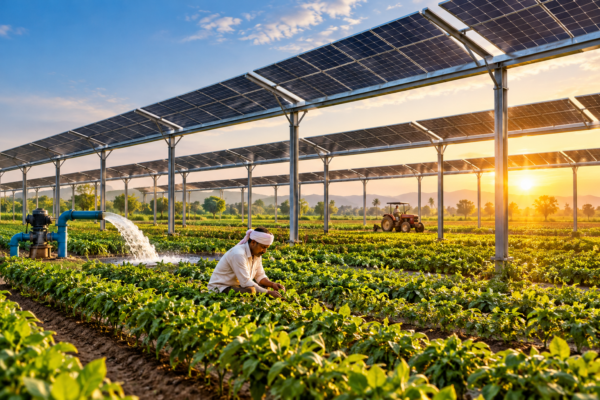

New Delhi: Agrivoltaics, which combines agricultural cultivation with solar power generation on the same land, is emerging as a promising approach to improving land-use efficiency, diversifying farmers’ incomes and advancing India’s clean energy transition.
According to an official release, agriculture provides livelihoods to approximately 46.1 per cent of India’s population. The Gross Value Added (GVA) of the Agriculture and Allied Sector is estimated to reach ₹52.08 lakh crore in 2025-26, highlighting the sector’s importance to the Indian economy.
India’s extensive agricultural land offers significant opportunities to integrate solar energy generation with farming. According to Land Use Statistics for 2023-24, the country’s reported area stood at 306.96 million hectares, of which approximately 55 per cent was agricultural land. The net sown area was 138.99 million hectares, while the gross cropped area stood at 217.88 million hectares.
Agrivoltaic systems involve installing solar panels above or between crop rows, allowing agricultural activities to continue alongside electricity generation. Depending on the crop, panel design and local conditions, partial shading can help reduce soil moisture loss and protect crops from extreme heat.
The electricity generated can be used to operate irrigation pumps and meet other farm requirements. Farmers may also earn additional income by supplying surplus electricity to the grid, while reducing dependence on conventional electricity and diesel-powered pumps.
India’s Agrivoltaic Potential
As of August 2025, India had 36 operational agrivoltaic projects with an installed capacity of 37.54 megawatts, while another 10 pilot projects were under development, according to the PIB backgrounder.
The country’s estimated agrivoltaic potential ranges from 3,000 gigawatts to nearly 14,000 gigawatts, indicating substantial scope for combining agricultural production with renewable energy generation.
The release also notes that, in some cases, annual farmer earnings could increase from around ₹60,000 per acre to more than ₹1 lakh per acre through income diversification. Actual returns would depend on local conditions, crop selection, system design and project economics.
A GIS-based national screening exercise identified 47.35 million hectares of “restricted cropland” as suitable for agrivoltaic development after applying environmental, agronomic and technical filters.
Fruits, vegetables, spices and medicinal plants are among the crops identified as promising options for cultivation alongside solar installations.
Maharashtra, Rajasthan, Andhra Pradesh, Madhya Pradesh, Karnataka and Uttar Pradesh have been identified as high-potential states. Together, they account for nearly 50 per cent of India’s estimated AgriPV power generation potential, supported by cropland availability, solar resources and favourable agro-climatic conditions.
Odisha, Tamil Nadu, Kerala, Telangana, Bihar and West Bengal have moderate potential, while the southern, western and central regions offer favourable conditions for wider deployment.
Government Initiatives to Promote Agrivoltaics
The Government is promoting solar energy adoption in agriculture through policy measures, research, pilot projects and financial support.
The Pradhan Mantri Kisan Urja Suraksha evam Utthaan Mahabhiyan (PM-KUSUM), launched in February 2019, encourages solar energy adoption in agriculture, solarisation of irrigation pumps and decentralised power generation. The scheme envisages central financial assistance of approximately ₹34,422 crore and aims to reduce dependence on diesel while creating opportunities for farmers to diversify their income.
The National Institute of Solar Energy, in collaboration with the Indian Council of Agricultural Research’s Indian Agricultural Research Institute, has also established a Centre of Excellence on Agrivoltaics for research, demonstrations and capacity building. Its initiatives include a 100-kilowatt agrivoltaic system at the Indian Agricultural Research Institute.
The India Agrivoltaics Alliance, launched in 2023 and anchored by the National Solar Energy Federation of India, has grown to more than 40 members. The alliance works with government ministries and industry stakeholders on policy advocacy, research, pilot projects and scalable business models.
Several states are also pursuing solar energy initiatives in agriculture. Maharashtra’s Mukhyamantri Saur Krushi Vahini Yojana 2.0 envisages 16,000 megawatts of solar projects across approximately 35,000 acres of government and private land to support electricity supply to agricultural consumers.
Gujarat’s Kisan Suryoday Yojana aims to expand daytime electricity supply for agricultural activities, with a planned supply window of up to 16 hours daily, from 5 AM to 9 PM, through the phased commissioning of solar and other non-conventional energy generation plants.
Karnataka’s Surya Raitha Scheme promotes solar-powered irrigation pumps and enables farmers to earn from surplus electricity.
Global Conference on Agrivoltaics
The 7th AgriVoltaics World Conference is being held in New Delhi from October 21 to 23, 2026, under the theme “Powering the Global South.” The conference brings together stakeholders from industry, research, policy and finance to explore opportunities for integrating solar energy generation with agriculture.
Agrivoltaics offers India a pathway to combine food production with clean energy generation while improving land productivity and potentially strengthening rural livelihoods. Its wider adoption will depend on scientific research, crop-specific designs, suitable land selection and farmer participation to ensure that solar installations complement rather than compromise agricultural productivity.
[DD news]