



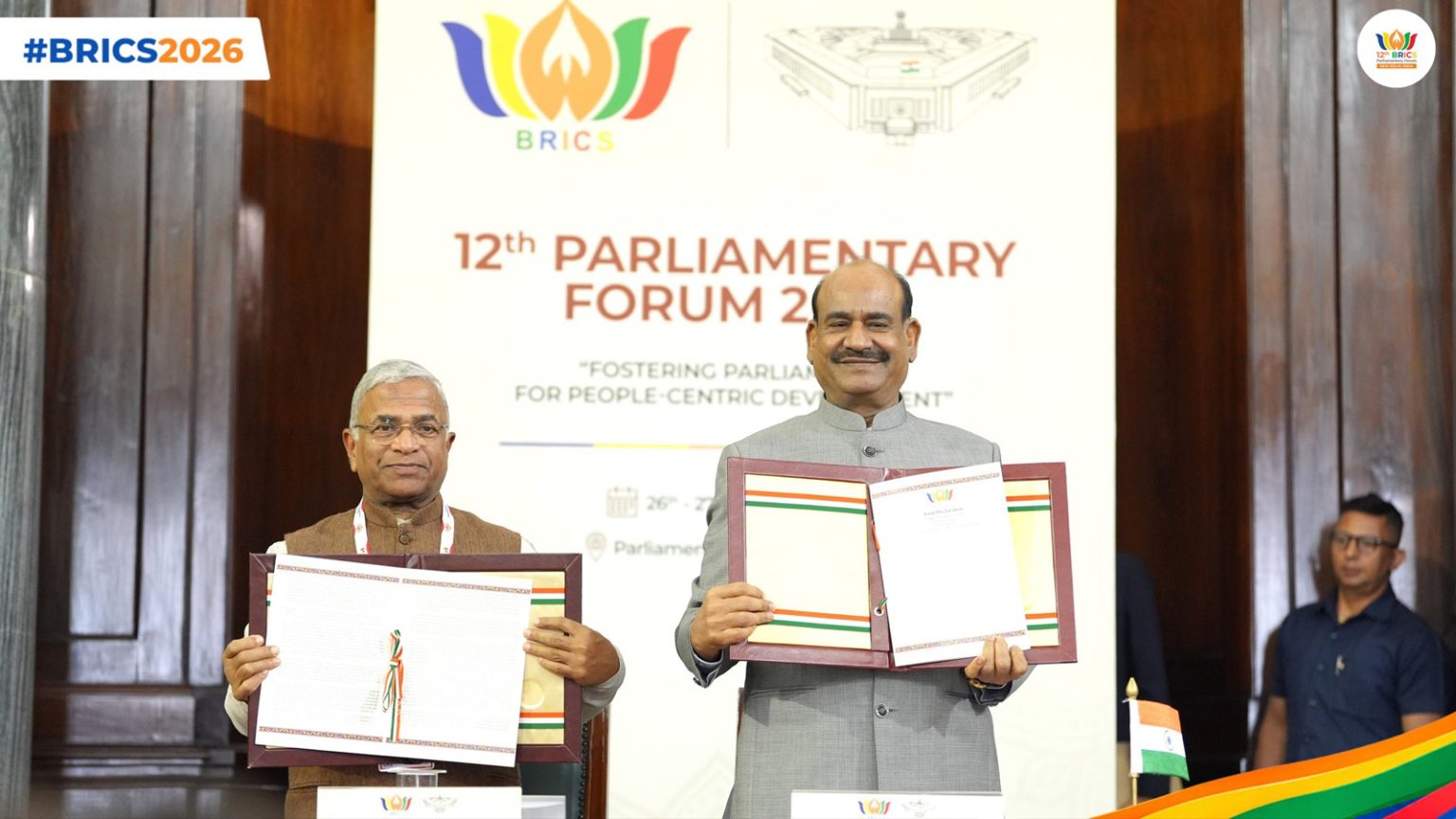

New Delhi: The two-day conclave of the BRICS Parliamentary Forum on Tuesday adopted a joint declaration strongly condemning the 2025 Pahalgam attack and all acts of terrorism as it pledged to combat the menace in all its forms and manifestations and also stressed on non-intervention in the internal affairs of any country.
The joint declaration, announced by Lok Sabha Speaker Om Birla, also condemned the imposition of unilateral economic and secondary sanctions saying such coercive measures have far reaching negative implications on human rights, including the right to development, health and food security of people.
The BRICS Parliamentary Forum supported a comprehensive reform of the United Nations, including its Security Council, saying this reform should make it more just, equitable, democratic, representative, effective, and efficient, better reflecting contemporary realities and the needs of the international community.
“We express strong condemnation of any acts of terrorism as criminal and unjustifiable, regardless of their motivation, whenever, wherever and by whomsoever committed. We condemn in the strongest terms the terrorist attack in Jammu and Kashmir (in Pahalgam) on 22 April 2025, during which 26 people were killed and many more injured.
“We reaffirm our commitment to combating terrorism in all its forms and manifestations, including the cross-border movement of terrorists, terrorism financing and safe havens,” the declaration read.
The Forum said terrorism should not be associated with any religion, nationality, civilisation or ethnic group and that all those involved in terrorist activities and their support must be held accountable and brought to justice in accordance with relevant national and international law.
“We urge to ensure zero tolerance for terrorism and reject double standards in countering terrorism. We emphasise the primary responsibility of States in combating terrorism and that global efforts to prevent and counter terrorist threats must fully comply with their obligations under international law, including the Charter of the UN…,” it read.
The Forum said it looks forward to further deepening counter-terrorism cooperation and calls for an expeditious finalisation and adoption of the Comprehensive Convention on International Terrorism in the UN framework and concerted actions against all UN-designated terrorists and terrorist entities.
“We reaffirm our adherence to the principles of sovereign equality, mutual respect, non-intervention in internal affairs, and the peaceful settlement of international disputes, as enshrined in the United Nations Charter, as essential foundations for global stability, peace and development,” it said.
The Forum reaffirmed its unwavering support for the peaceful resolution of the Israeli-Palestinian conflict based on the two-state solution, with the two States living side by side, in peace and security, in accordance with international law and relevant United Nations resolutions.
It asserted the right of the Palestinian people to self-determination, freedom, and an independent, sovereign State.
The Forum expressed deep concern over the continued escalation of tensions in West Asia and, recalling the respective national positions, called for exercising maximum restraint, as well as avoiding actions that could further aggravate the situation.
It strongly condemned all violations of international humanitarian law, including deliberate attacks against civilians and civilian infrastructure, including in BRICS member states, as well as the denial or obstruction of humanitarian access and the targeting of humanitarian personnel.
Iran and United Arab Emirates, which are directly involved with the West Asia conflict, are members of the BRICS. Apart from India, other member nations of the BRICS are: Brazil, Russia, China, Egypt, Ethiopia, Indonesia and South Africa.
The Forum underlined the need to address accountability for all violations of international humanitarian law.
“We recognise international efforts undertaken by BRICS members to promote respect for, adherence to, and effective implementation of international humanitarian law,” it said.
Recognising the urgency of addressing climate change, the BRICS parliamentary body called for intensifying efforts, through dialogue and international cooperation, to implement nationally determined contributions, strengthen mitigation and adaptation efforts, with a view to achieving the objectives of the UNFCCC and the goals of its Paris Agreement as applicable.
The Forum acknowledged the transformative potential of emerging technologies, including artificial intelligence (AI) and information and communication technologies (ICTs).
“We emphasise the necessity of ensuring the open, safe, secure, stable, equitably accessible, peaceful and interoperable use and development of ICTs environment while respecting sovereignty and national security of each country.
“In addition, promoting energy efficiency of AI systems, fostering AI science and innovation, leveraging AI for economic growth and social good and mitigating potential risks would be essential for promoting a just, fair, equitable and prosperous future of all countries, especially those of Global South,” it said.