




Manas Dasgupta
NEW DELHI, Oct 26: The Supreme Court on Monday dismissed a plea against six AIADMK MLAs who voluntarily resigned from their seats after voting against the party whip and subsequently joined the ruling Tamilaga Vettri Kazhagam (TVK).
A bench comprising Chief Justice Surya Kant, Justice Joymalya Bagchi and Justice V Mohana rejected a plea filed by Advocate K Suthan challenging a Madras High Court order dismissing his plea. “Somebody resigns and becomes minister, it’s part of political process,” the bench said while rejecting the plea.
The High Court on September 24 had dismissed the PIL seeking framing of an “Election Expenditure Security” mechanism and five-year disqualification of the six AIADMK defectors, observing that the right to resign a legislative assembly seat was a facet of the constitutional scheme and cannot be burdened with extra-statutory conditions by judicial order.
The petition had sought a direction to the Election Commission and the Tamil Nadu Chief Electoral Officer to frame an “Election Expenditure Security” mechanism under which a sitting MLA who resigns voluntarily from a seat and later wants to contest the by-election necessitated by the resignation, must first deposit an amount equal to the public money spent on holding the by-election.
The Madras High Court on October 13 upheld the decision of Tamil Nadu Assembly Speaker JCD Prabhakar accepting the resignations of six AIADMK MLAs, who later joined the ruling TVK. The High Court had directed the speaker to decide on the petition from AIADMK whip Krishnamurthy seeking disqualification of S Jayakumar, Maragatham Kumaravel, P Sathyabama and Esakki Subaya from the assembly within two months.
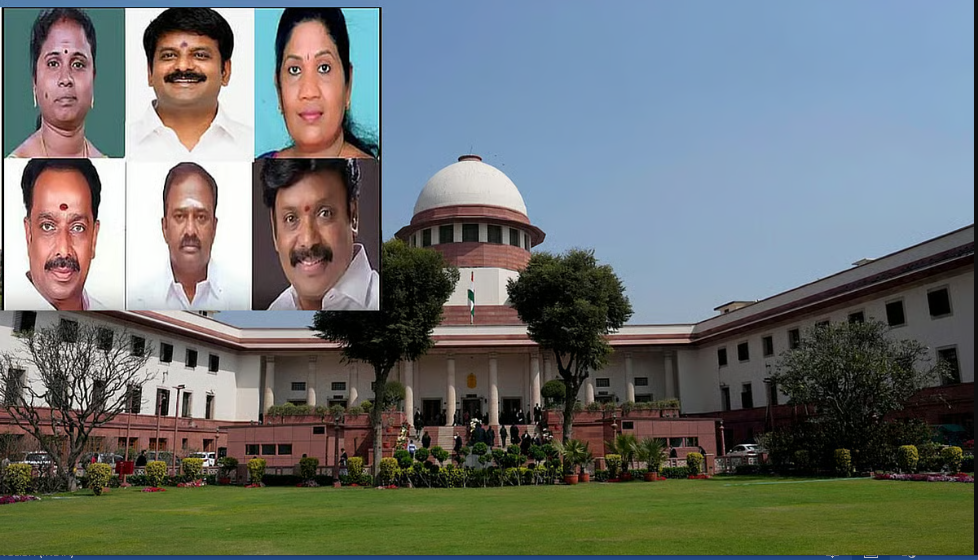
S Jayakumar, Maragatham Kumaravel and P Sathyabama, elected from Perundurai, Madurantakam and Dharapuram assembly constituencies, respectively, resigned as members on May 25, 2026. Esakki Subaya, elected from the Ambasamudram constituency, resigned the following day. C Vijayabhaskar (Viralimalai) and M R Vijayabhaskar (Karur) resigned on June 16 and 29, respectively.
All of them had been elected on AIADMK ticket in the April Tamil Nadu assembly polls. After resigning, they joined the ruling TVK led by Chief Minister C Joseph Vijay. Maragatham Kumaravel and Sathyabama won the bypolls — as TVK candidates — held on October 6 for the Madurantakam and Dharapuram assembly segments, respectively. The bench passed the order on the petition by Krishnamurthy, besides a PIL plea filed by Desiya Makkal Sakthi Katchi.
The bench said the resignations tendered by the MLAs were genuine and voluntary, and in keeping with provisions under the 10th Schedule of the Constitution. The speaker was not required to undertake a roving or detailed inquiry into the alleged motives behind them. Accordingly, their acceptance and the consequential declaration of vacancies were constitutionally valid, the bench said.
It said the AIADMK’s whip was defied by 25 MLAs on May 13, in pursuance of which, immediately, disqualification proceedings were instituted by the AIADMK before the speaker. However, the petitions were withdrawn unconditionally against 14 MLAs, including C Vijay Bhaskar and M R Vijay Bhaskar. The bench said pendency of a plea seeking disqualification did not constitutionally bar the speaker from accepting the resignations, as resignation and disqualification are distinct constitutional processes.
The speaker was, therefore, competent to accept the resignations notwithstanding the pending petition seeking disqualification, the bench added. The bench said the acceptance of resignations does not render the pending disqualification proceedings infructuous. The speaker shall still finally adjudicate and decide on the plea seeking disqualification.
The bench said the High Court possesses the power under Article 226 to intervene where the speaker fails to decide on the disqualification plea within a reasonable period of time. “In the peculiar circumstances, a time-bound mandamus is being issued directing the speaker to conclude the disqualification proceedings finally within a period of two months,” the Madras High Court had said in its order.
In his petition, Mr Suthan had submitted that “a seat in the Legislature does not belong to the person who sits in it.” “It belongs to the people who sent him there. The vote is the citizen’s only voice in governance, and it is given for a full term of five years. When a Member abandons that vote within weeks, not for any compelling cause but to change sides, he does not merely leave a seat. He breaks the trust on which representative democracy rests,” the petition said.
The petition asked the Supreme Court whether the Constitution permitted the severing of public trust at will by legislators, leaving the “people to be billed for the breach.” The petitioner said a few days after the declaration of the Tamil Nadu Legislative Assembly election in May this year, members of the AIADMK voted on the confidence motion against the direction of their party whip.
Though petitions seeking their disqualification under the Tenth Schedule (anti-defection law) were filed and pending before the Speaker, the AIADMK MLAs resigned from their seats. Their resignations were accepted on the same day and they were also inducted into the ruling party.
“The design is plain. MLAs are facing disqualification under the Tenth Schedule. They resign even before the Speaker decides the disqualification petitions and walk out free. They then walk straight back in through a by-election under a new banner. What the Tenth Schedule forbids by the front door is achieved through the side door of resignation,” the petition said.
The plea said the MLAs who resigned from Dharapuram and Madurantakam were, in fact, announced as the ruling party’s candidates for the very seats they had vacated. The by-election that followed was a “luxury election.”
“The people did not seek it. No death or disability made it necessary. No law compelled the Members to resign. Its only purpose is to launder a defection through a fresh poll. Yet every Rupee of its cost comes from the public exchequer, and the electorate is made to pay twice for the same seat. The Member who caused it bears no cost and suffers no consequence,” the petition said.
The injury was not to the exchequer alone, the petition noted. During the Budget session, the voice of the people of the six constituencies were muted, as the MLAs they had elected had quit. “Representation is the very condition on which people consent to the spending of their money. That condition tailed, not by any act of nature or operation of law, but by the deliberate choice of those whom the people had elected. The foundation of representative democracy was thereby defeated,” the petition said.
The plea said the dangers of such resignations were not limited to just six seats. “The 2026 elections returned a hung Assembly in Tamil Nadu. No party secured the 118 seats needed for a majority, and the Government rests on the support of allies and of Members drawn from other parties. In such a House, every vote is a prize. If a Member may defect, resign before the Speaker can disqualify him, and return through a by-election under the banner of the ruling party, the Tenth Schedule becomes a dead letter,” it said.