




Manas Dasgupta
NEW DELHI, Oct 23: The situation in the India-China border areas “gets disturbed from time to time when Chinese forces diverge from established patrolling patterns,” the Ministry of External Affairs (MEA) said on Friday after the Indo-Tibetan Border Police (ITBP) earlier in the day disclosed about confrontations with Chinese troops at multiple sites along the border in Arunachal Pradesh.
The MEA asserted that both sides continue to use “existing diplomatic and military mechanisms” to resolve outstanding issues and “avoid misunderstanding and miscalculation along the Line of Actual Control (LAC).” “As we have noted in the past, the situation in the India-China border areas gets disturbed from time to time when Chinese forces diverge from established patrolling patterns,” Randhir Jaiswal, the official spokesperson of the MEA, said.
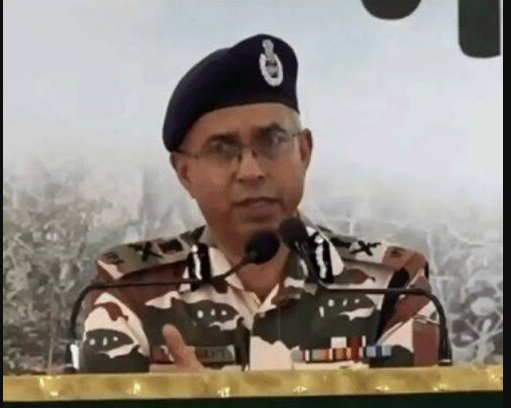
The MEA reaction came after being questioned on the earlier statement by the ITBP director general Shatrujeet Kapur who revealed that “in the past few-days, a situation arose where face-off happened at several locations in Arunachal and it still continues.” This is the first official confirmation of the scale of the rising tensions on the north-eastern border since July this year.
Mr Kapur said ITBP commandos have been active in the continuing confrontations on the Arunachal border. “Our newly raised Shaurya commandos played an exemplary role in this. ITBP was raised as a mountain guerilla force and we were given border guarding duty along China in 2004,” he said. “We need not leave our original function, and a specialised high altitude mountain fighting force is being set up, distinct than the army. We will soon have one full battalion of Shaurya commandos; high-altitude [deployment] is our strength,” Mr Kapur added.
Speaking at the bi-weekly media briefing, Mr Jaiswal also said the two sides have agreed to discuss ways to “improve understanding of LAC in appropriate areas” for better border management.” He emphasised that the “maintenance of peace and tranquillity” in the border areas was essential for the “overall development of the bilateral relations.” “Insofar as the specifics are concerned, I would refer you to the Ministry of Defence,” he added.
The government sources have also confirmed that since late July, India and China have been engaged in a stand-off at Asaphila near Taksing in Arunachal Pradesh. The Chinese People’s Liberation Army (PLA) have pitched their tents at an elevation, within 6 km to 7 km of India’s perception of the Line of Actual Control (LAC), near the Maja company operating base in Taksing circle of Upper Subansiri district, sources said.
“Sometime in July, during routine patrolling, Indian and Chinese troops came face to face near Maja. After brief confrontation, both sides returned but the Chinese PLA came back in larger number few days later and pitched tents, around 6-7 kms within India’s perception of the LAC,” the source said. India has also increased deployment along the border.
The situation has persisted even though Chinese President Xi Jinping attended the 18th BRICS Summit hosted by India from September 11 to 13, and the two nations have held three high-level border talks since July.
The 36th WMCC (Working Mechanism for Consultation and Coordination on India-China Border Affairs) meeting on India-China border affairs was held on August 6. This was followed by the 25th round of talks between the Special Representatives (SR) on the Boundary Question on August 26 in Beijing, where India was represented by National Security Adviser (NSA) Ajit Doval. On September 6, the first-ever Corps Commander-level meetings between the two armies was held in the Eastern Sector at the Vacha-Damai Border Personnel Meeting Point in Arunachal Pradesh.
Such meetings have so far largely been held at the Chushul-Moldo Border Meeting Point in eastern Ladakh, particularly after the Galwan Valley clashes in June 2020. The Army and the ITBP force are deployed along the China border and long range patrols are regularly sent to the forward areas. Due to the weather conditions, such patrols are sent between June and October in Arunachal Pradesh.
The weapons used by the ITBP are 50-years old and modernisation is required, said Mr Kapur, who is set to retire on October 31. Stressing on the need to invest and develop drone and counter-drone technology, the ITBP chief said it may not be possible to face China through traditional methods as it has invested a lot in the modernisation of its weapons and infrastructure.
“Drones are something through which even a small country can challenge a big country. We saw how Ukraine has challenged a superpower like Russia. The war was supposed to be over in few days, but 10,000 to 15,000 Russian soldiers are being killed, they are suffering. Look at Iran, how, without even a Navy, they, with the help of drones, challenged America,” he said.
“We have to go towards drones and anti-drone systems. We spent 70% of ₹400 crore modernisation funds on drones. There is one drone platoon in all border guarding battalions, we have started training drone pilots, we are making drones in-house. Out of another modernisation scheme of ₹3,500 to ₹4,000 crore, ₹1,000 crore have been earmarked for drones,” said Mr Kapur.
Mr Kapur added that a decision has been taken to build as many underground shelters as those above the ground along the China border, over the next three years. “Underground shelters are key to new warfare. Anything overground can be a target. In hot-war situations, underground shelters are a priority,” he said.
“All companies have started pilot projects on building underground structures, which will act as permanent defences. They should be comfortable, with adequate bathrooms, ventilation, drainage. Once the design is final through a pilot project, every border outpost will have the same number of overground and underground structure in the next three years. It will protect us in any war situation,” he said.