



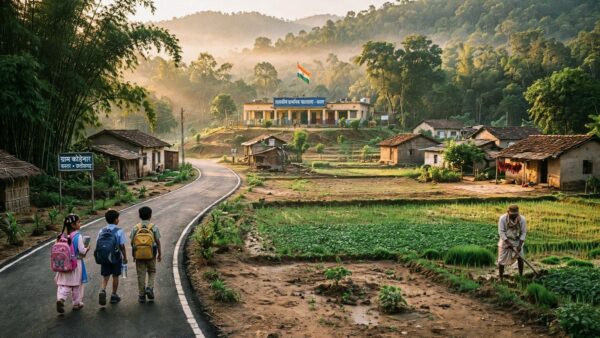

Dantewada: There was a time when the picture of dense forests, difficult roads and Maoist violence would come to mind as soon as the name of Bastar was heard. As evening fell, there was silence on the streets. It was not easy for people in many villages to reach schools, hospitals, banks and markets. Amidst the sound of guns, the lives of ordinary people and their dreams were left behind. But today the picture is changing in many areas of Bastar. Roads are reaching the hills, children are going to school, farmers are adopting new farming methods and women are trying to increase their income through self-help groups. At the same time, some people, who were once part of Maoist organizations, are now on the way to return to normal life after learning skills.
Ground picture of change in Dantewada
The DD News team recently visited Dantewada in Bastar Division of Chhattisgarh to witness this change closely. The stories here show that establishing peace in a region does not just mean a reduction in violence. Real change comes when people get opportunities for education, employment, health and a dignified life along with security.
Declaration of major achievement against Naxalism on March 31, 2026
The Government of India on 31st March 2026 announced the historic achievement of effectively freeing the country from Left Wing Extremism i.e. Naxalism. This was considered an important milestone in the fight against this challenge that has been going on for almost six decades. However, to understand this achievement, it is important to know how the strategy against Naxalism has changed, how development has been integrated with security operations and how its impact is visible on the ground.
Journey from the beginning of Naxalism to Naxal-free India
Naxalism started in the Naxalbari region of West Bengal in the year 1967. The movement, which began amid land disputes, socio-economic inequality and dissatisfaction with the system, gradually morphed into armed Maoist militancy. Its ideological basis was the idea of gaining power through armed revolution. Over time, its influence spread to remote and tribal dominated areas of many states. For years, the local people bore the brunt of the violence. Security forces personnel and civilians lost their lives, schools and roads were affected and in many areas it was difficult to reach the benefits of government schemes.
Strategy based on trust, build and public welfare
In order to combat Naxalism, the Central Government approved the National Policy and Action Plan on Left Wing Extremism in 2015. Under this, security action, intelligence sharing, coordination between states, development and rehabilitation were included in a comprehensive strategy. The strategy had three key pillars – trust, construction and public welfare. The purpose of Vishwas was to win the trust of the locals. Under construction, emphasis was laid on providing roads, mobile networks, schools, banks and other basic facilities to remote areas. At the same time, the goal of public welfare was to bring the benefits of development to the weaker sections of the society and to create better life opportunities for them. Better security paved the way for development, roads and communication facilities increased access to government services, and education, employment and rehabilitation opportunities gave people the option to start a new life away from violence.
Violence and decrease in affected areas shown in the data
The decade from 2004 to 2014 was one of the most violent phases in the history of Left Wing Extremism. According to government data, the violence peaked in 2010. That year, 1,936 incidents were recorded and 720 civilians died. Throughout the decade, there were 17,542 violent incidents and 5,019 civilian deaths. This was followed by a strategy based on security, coordination, development and rehabilitation. According to the Government of India, 126 districts of the country were affected by Left Wing Extremism in the year 2014, while by the year 2026, their number has come down to two. The number of most affected districts also came down from 35 to zero. There was a decline in incidents related to violence. In the year 2014, there were 870 incidents related to Naxal, while in the year 2025, this number came down to 234. These figures show a significant reduction in the impact of Naxalism and the intensity of violence.
Roads, mobile and banking facilities have changed the picture.
Lack of roads and communication facilities in Naxal-affected areas has been a major challenge for a long time. Many villages were difficult to reach due to inhospitable geographical conditions, which affected education, health, business, and government schemes. According to the government, more than 12,249 km of roads have been constructed in Left Wing Extremism-affected areas since 2014. More than 9,600 mobile towers were installed to expand mobile connectivity. Between April 2015 and March 2026, 1,804 bank branches, 1,321 ATMs and 6,025 post offices were set up in these areas. These facilities have an impact on the lives of common people. With the construction of roads, farmers can take their produce to the market, mobile network gives students access to digital education and essential information, and expansion of banking services makes it easier for villagers to avail financial facilities and government schemes.
Education and skill development will lead to new opportunities for the youth
Emphasis has also been laid on expansion of education and skill development in naxal affected areas. According to government data, 259 Eklavya Model Residential Schools were approved, of which 179 were developed. 46 Industrial Training Institutes and 49 Skill Development Centres were also established in these areas. According to the government, more than 90,000 youth and women have been given skill training. These efforts are aimed at providing employment, self-employment and dignified livelihood opportunities to the youth so that they can better their future by staying away from violence.
Dantewada’s Livelihood College: From Guns to Skills
DD News team reached Livelihood College in Dantewada to understand the picture of change in Bastar. Here I met young people who have decided to leave the path of violence and return to normal life. The college offers training in various trades such as electrician, welding, sewing-embroidery, computer, driving, plumbing and mason. Residential skill training facilities are also available to make the rural youth of Naxal affected areas self-reliant. In the training center, someone is learning to connect electrical wires, then someone is practicing working on a welding machine. At the same time, in the sewing room, women are learning the skill of cutting and sewing clothes. These activities show that the purpose of rehabilitation is not only to get out of violence, but also to give people practical livelihood options.
The story of Pudiya Telam: Learning to Weld by Leaving Violence
The story of Pudiya Telam, who is training at a livelihood college, is particularly noteworthy. Pudia spent nearly 22 years in the forests of Bastar. He was just 14-15 years old when he left home. Later, he was the Commander-in-Chief of the West Bastar Divisional Committee and a reward of eight lakh rupees was declared on him. Today, he is undergoing welding training at Livelihood College in Dantewada. Under the rehabilitation scheme, he also gets financial assistance of Rs 10,000 per month. Pudia’s story suggests that the decision to break out of violence is just a fresh start. This is followed by skills, livelihoods and opportunities to re-enter society to return to normal life.
Return to normal life from surrender and rehabilitation
According to the Government of India, 2,337 Naxalites surrendered in the year 2025. The total number of surrenders between 2024 and March 2026 was 3,927. These figures underscore the importance of rehabilitation policy. However, in order to turn the process of surrender into a lasting success, it is imperative that those who leave the path of violence have a practical and dignified future choice. Skill training, employability and social acceptance play an important role in this. The Livelihood College of Dantewada provides an example in this direction, where efforts are being made to make ex-Naxalites and other rural youth self-reliant through training.
Hope returning to the fields: Farmers looking for a new path
The story of change in Dantewada is not limited to training centres, but also reaches the farms. During a conversation with farmers in Kasoli village of Geedam block, it was revealed that farming is not only a means of livelihood for them, but also a hope for the future of the family. Farmers Suresh Nag and Baliram Yadav are exploring the possibility of increasing their income through farming. His interest in alternatives such as organic farming is an indication that farmers are also looking at new experiments with traditional methods. For Netam, a farmer from Dantewada, farming is also the basis for a better future for the family. He is hoping to increase his income on the basis of government support and hard work. According to the experiences of local farmers, during the Maoist violence, there were many obstacles in availing the benefits of government schemes and continuing agricultural activities smoothly. Now, with better security and access to government support, new opportunities are opening up for farmers.
Education: New avenues opening up for Bastar’s children
The future of any region is decided by its next generation. This is even more important in Bastar, where violence and insecurity affected children’s education and their opportunities for a long time. Aastha Residential School located in Education City, Dantewada is important in this context. Here children get an opportunity to connect with computers, libraries, sports and other activities along with studies in a safe environment. Children studying in classrooms, students reading books in the library and students learning technology in the computer lab paint a picture of the changing aspirations of Bastar. Education here is not limited to textbooks, but children also get the opportunity to recognize their potential, learn discipline, and set goals for the future. The importance of such facilities for the children of families affected by Maoist violence is even greater. Safe housing and education can help them navigate their lives out of unstable situations.
Children’s dreams are getting flight in Education City
Aastha residential schools are a medium of access to educational facilities like big cities for children coming from remote areas of Dantewada. Free facilities including hostels and education are provided here. Children from families affected by Naxal violence from different districts of Bastar are studying here and dreaming of their future. For these children, education is not only a way out of the present circumstances, but also the foundation for a better future. Their dreams suggest that the greatest measure of change is not only peace in the present, but also the opportunities that open up for future generations.
Women are also writing a new story of self-reliance.
The story of change in Bastar cannot be complete without the participation of women. The story of Meena Koropi in Gadmiri village of Kuakonda block of Dantewada is an example of this. Meena joined the self-help group and started doing things like poultry and vegetable farming. The income from these activities helped in strengthening the financial condition of his family. The earnings from the sale of chickens showed her the way to become a ‘Lakhpati Didi’. Self-help groups connect women with economic activities through savings, small businesses and collective support. Through these, women can learn from each other’s experiences and explore opportunities to further their work. Economic self-sufficiency also strengthens the potential for increased participation of women in family decisions and improving children’s ability to spend on education and health. The stories of Meena Koropi and other women show that development is not just about big projects or new roads. When a woman has her own means of earning, new options open up for her family and community as well.
Action on financial networks with security measures
The role of security forces has been important in the fight against Naxalism. The government expanded the security structure, deployed specialised forces and strengthened the use of intelligence and technology. According to government data, there were 66 fortified police stations in the country before 2014, which increased to 597 in the subsequent years. The number of police stations registering Naxal incidents also came down from 333 to 16. In the last seven years, 408 new Central Armed Police Forces camps were set up. Along with this, surrender and rehabilitation were also made part of the strategy. Till December 2025, the National Investigation Agency had seized assets worth over Rs 40 crore in Naxalism-related cases. The Enforcement Directorate and state agencies also cracked down on the financial network. These steps were aimed at weakening armed activities and striking at the systems from which militant organizations were resourced.
Trust of local people is essential for lasting peace
To establish lasting peace in an area, it is necessary to maintain the trust of the local people along with security action. Easy access to government entities, timely resolution of grievances, tailored schemes to local needs, and community involvement strengthen this process. The challenges of development in Bastar are not limited to geographical conditions only. It is equally important to deliver regular services to remote villages, increase livelihood opportunities, and connect people with government schemes. Therefore, in order to sustain the success achieved against Naxalism, it is imperative that there is a synergy between security and development and local communities are made partners in the process of change.
From Naxal-free to developed and self-reliant Bastar
Cultural activities are also being promoted along with roads, education, skill training and livelihood related initiatives in Bastar, Chhattisgarh. Events like Bastar Pandum and Bastar Olympics are becoming platforms to bring out local art, sports and tribal identity. The Shaheed Veer Gundadhur Seva Dera initiative, launched in May 2026, also aims to convert the gains made from security into civic amenities. Under this, about 70 Central Armed Police Forces camps have been planned to be converted into service centers. Through these centers, the goal is to provide services related to health, banking, agricultural assistance, skill development and government schemes to the people. Such initiatives are important because the enduring presence of development gives people the confidence that roads, schools and hospitals are not part of a temporary campaign, but a permanent basis of their everyday life.
The story of Bastar continues
Former Naxals learning skills at a livelihood college in Dantewada, farmers toiling in the fields of Kasoli, children studying in Education City, and women trying to become self-reliant in Gadamiri – all have different stories, but the thread that connects them is the same: hope for a better future. The achievement of 31st March 2026 marks a significant milestone in India’s long fight against Naxalism. However, the real meaning of this achievement will be most visible in those areas where violence once limited normal life and today people are looking for new opportunities. A visit to Bastar shows that peace does not come only from guns going silent. To make it sustainable, education, employment, development, good governance and people’s trust are necessary. The hands that once saw the path of violence are learning the skill today. In fields where there was once concern of insecurity, farmers are hoping for better yields and incomes. Children who had limited opportunities are now shaping their dreams through books and computers. The story of Bastar is not yet complete, but a picture of change is clearly visible – here life is now moving beyond the fear left behind and preparing for tomorrow.
[DD news]