




Virendra Pandit
New Delhi: Amid fast-changing geoeconomics and a “structurally-changed world,” India’s Economic Survey 2026 has projected an impressive growth of 6.8% to 7.2% in the next financial year (2026-27), and laid down a strategic vision for the country.
The Indian economy will be driven by a series of regulatory reforms and strong macroeconomic fundamentals, it said, laying out a strategy to navigate a global economy roiled by upended trade tariffs.
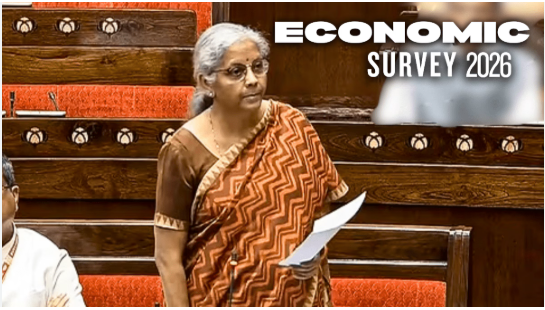
The Economic Survey 2026, which Finance Minister Nirmala Sitharaman tabled in Parliament, says India is better placed than many economies due to strong macro fundamentals, but warns these buffers will not fully insulate it from global volatility.
It emphasized private sector investment, infrastructure development, and self-sufficiency in key areas to navigate global trade pressures, the media reported on Thursday.
Inflation remains benign thanks to supply side conditions and rationalisation of the goods and services tax (GST), it added.
Overall, the outlook is “one of steady growth amid global uncertainty, requiring caution, but not pessimism.”
Reforms in recent years may have lifted the economy’s medium-term growth potential closer to 7%. “With domestic drivers playing a dominant role and macroeconomic stability well anchored, the balance of risks around growth remains broadly even. Taking these considerations together, the Economic Survey projects real GDP growth in FY27 in the range of 6.8-7.2%.”
The document, prepared by Chief Economic Adviser V. Anantha Nageswaran and his team in the Union Finance Ministry, highlights reform measures undertaken in the current financial year, including income tax and GST relief, a new simplified direct tax law to take effect from April 2026, and changes to foreign direct investment (FDI) and bankruptcy frameworks.
The Survey also presents a roadmap for how India’s manufacturing sector can emerge stronger from current global trade pressures through diversification, improved product quality and deeper economic partnerships, while developing self-sufficiency in key areas such as semiconductors.
Its FY27 growth projection comes on the back of a 7.4% expansion estimated for the current fiscal year (FY26) in the first advance estimates released this month.
The International Monetary Fund (IMF) has projected 7.3% growth for India in the current fiscal, while the World Bank has pegged it at 7.2%. The two multilateral agencies expect the economy to grow 6.4% and 6.5%, respectively, in FY27, slightly more conservative than the projections by the Economic Survey.
The Union Ministry of Statics will release a second advance estimate for FY26 on February 27, based on a new GDP series that shifts the base year from 2011-12 to 2022-23. While GDP base will change, economists expect minimal impact on growth rates.
Inflation
The Survey pointed out that domestic inflation dynamics in FY26 (April-December) reflected a broad-based easing in price pressures, led by a sharp disinflation in food prices. Inflation, based on the Consumer Price Index (CPI) declined to 1.7%, driven primarily by a fall in prices of vegetables and pulses, supported by favourable farm conditions, supply-side interventions, and a strong base effect.
It said that core inflation has exhibited persistence, largely influenced by price spikes in precious metals. Adjusting for these, underlying inflation pressures appear materially softer, indicating limited demand-side overheating, the survey said.
“Looking ahead, the inflation outlook remains benign, supported by favourable supply side conditions and the gradual pass-through of GST rate rationalisation. However, the trajectory of core inflation will need to be closely monitored in the context of monetary policy easing and potential upward pressures from global base metal prices.”
In December 2025, the Reserve Bank of India (RBI) estimated CPI inflation at 2% for the year, below its 4% target, as food price corrections kept price pressures moderate. It projected inflation of 0.6% for the third quarter and 2.9% for the fourth quarter (Jan-March 2026).
Subdued inflation has weighed on nominal GDP growth which is measured at current prices and does not adjust for inflation. The first advance estimates pegged nominal GDP growth at 8% for the current fiscal year, below the budgeted assumption of 10.1%.
Investment, job creation
The latest survey calls on the private sector to scale up investment and prioritize job creation, at a time when technology and generative artificial intelligence (AI) are disrupting labour market.
Earlier this month, the IMF, in its World Economic Outlook 2026, warned of “re-evaluation of productivity growth expectations about AI,” an AI bubble. It cautioned that this bubble could lead to a decline in investment and trigger an abrupt financial market correction, spreading from AI-linked companies to other segments and eroding household wealth.
The Survey said that India needs more private participation in building infrastructure, along with more data about investments and assets in the sector, instead of relying primarily on public expenditure as the country seeks to become a developed nation by 2047.
It said that India’s push for infrastructure has led to an unprecedented increase in the government’s capital expenditure (capex), while reducing the central government’s fiscal deficit as a share of nominal GDP. The Centre’s capex had increased substantially over the last few years, from Rs. 5.93 trillion in FY22 to Rs. 11.21 trillion in the FY26 budget estimates. As a share of GDP, capex support has increased from 2.5% in FY22 to 3.1% in FY26.
Global volatility
The survey called out how “heightened uncertainty in global trade and the imposition of high, penal tariffs created stress for manufacturers, particularly exporters, and affected business confidence”.
The next fiscal year is “expected to be a year of adjustment, as firms and households adapt to these changes, with domestic demand and investment gaining strength,” it added.
The government’s annual exercise of taking stock of the country’s economic performance has offered more than a review of growth in the past year. The Survey has not attempted to predict how the global economy will evolve over the next year. Instead, it has laid out a risk map, all of which assume that the old, rules-based global order has already fractured. The central premise, the document makes clear, is that uncertainty is no longer cyclical or temporary, but a permanent feature of the global economic landscape.
Rather than offering a single baseline, the Survey has outlined three possible worlds for 2026, where the central differentiations are the intensity of geopolitical conflict, financial stress and policy fragmentation. What unites them is the assumption that coordination is weaker, trust is lower, and economic policy is increasingly shaped by security and strategic considerations.
India’s buffers
Across all three possible outcomes for 2026, the direction of change is the same: volatility will be normalised, capital will remain cautious, trade will be politicised, and predictability eroded. The difference between the scenarios is one of degree, not direction. Hence, the Survey’s message is that the world has structurally changed.
Against this backdrop, the Survey says India is relatively better placed than many economies due to its large domestic market, less financialised growth model, strong foreign exchange reserves and a degree of strategic autonomy. However, it cautions that these strengths will not provide complete insulation.
Across all three global scenarios, India’s core risk is disruption to capital flows and pressure on the rupee. “Only the degree and the duration will vary. In a world of geopolitical turbulence, this may not be confined to a year but could be a more enduring feature,” the Survey cautioned.
It suggested that policy credibility, predictability and administrative discipline are becoming strategic assets, and in an uncertain global environment, India will need to maximise growth while simultaneously strengthening buffers, liquidity and shock-absorption capacity, effectively running a long-distance race at sprint speed.