Russian crude: Trump aide hints at likely US tariff relief for India









Virendra Pandit
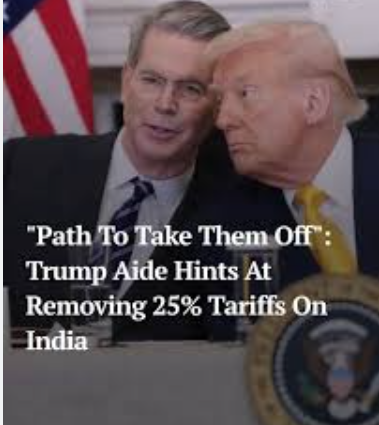
New Delhi: Indicating a ‘thaw’ in the frosty America-India bilateral relationship, US Treasury Secretary Scott Bessent on Friday signalled the potential withdrawal of an additional 25 percent penalty on India following a sharp reduction in Indian imports of Russian oil, the media reported on Saturday.
His remarks come amid heightened pressure from US President Donald Trump, who earlier warned that tariffs could increase further unless India curtails its Russian oil purchases.
Trade tensions escalated in August 2025 when Trump doubled tariffs on Indian goods to 50 percent, including a 25 percent levy in response to India’s imports of Russian crude.
“Indian purchases by their refineries of Russian oil have collapsed. So that is a success. The tariffs are still on, 25 percent tariffs for Russian oil are still on. I would imagine there is a path to take them off,” Bessent said in an interview with Politico at the World Economic Forum (WEF) Annual Meeting which concluded on Friday at Davos, Switzerland.
Bessent said that although the tariffs remain in place, reductions in Indian purchases of Russian crude offer a basis to reconsider punitive duties introduced under the Trump administration. “I would imagine there is a path to take them off,” he said, describing the shift as a success of the tariff policy.
He said the Trump administration had imposed the 25 percent tariff to discourage India from buying Russian oil after the Ukraine invasion. According to him, Indian refiners had significantly increased their intake of discounted Russian crude, but those purchases have since “collapsed.”
“We put twenty-five percent tariffs on India for buying Russian oil, and the Indian purchases by their refineries of Russian oil have collapsed. So that is a success,” he said, adding that the tariffs could now be reconsidered.
Before the Ukraine war, he said, the Russian crude accounted for just two to three per cent of India’s refinery intake. Following Western sanctions, heavily discounted Russian oil pushed that share into the high teens, boosting refinery margins.
However, after Washington’s tariff move, Indian refiners began cutting back Russian supplies and diversifying their crude basket, sourcing more oil from West Asia, Africa and Latin America.
Bessent also criticised European countries, accusing them of indirectly financing Russia’s war effort. He pointed out that while European governments publicly opposed Russian energy, they continued buying refined products made from Russian crude processed in Indian refineries.
Calling it an “act of irony and stupidity”, he said Europe was effectively funding the very conflict it claimed to oppose.
India, however, has restated its consistent position on energy sourcing, noting that decisions on oil imports are driven by its national requirements, global market conditions, and current circumstances.
India’s Russian oil imports in December 2025 dropped to their lowest in two years, lifting OPEC’s share of Indian oil imports to an 11-month high.
Removing this 25 percent penalty could also accelerate the ongoing negotiations on the proposed bilateral trade agreement (BTA) between the US and India.
Bessant’s remarks assume importance also in the light of reports that India and the 27-member European Union (EU) could sign a trade agreement as early as January 27.