




Virendra Pandit
New Delhi: Hardly has any of US President Donald Trump’s half-a-dozen peace-broking claims survived. The latest to prove him wrong came when Thailand launched fresh air strikes on Monday on its neighbour, Cambodia, with both sides trading blame for renewed fighting on their disputed border that has killed four Cambodian civilians and a Thai soldier.
Around 35,000 people in Thailand have been evacuated from border areas, the country’s Second Army Region said in a statement, according to media reports.
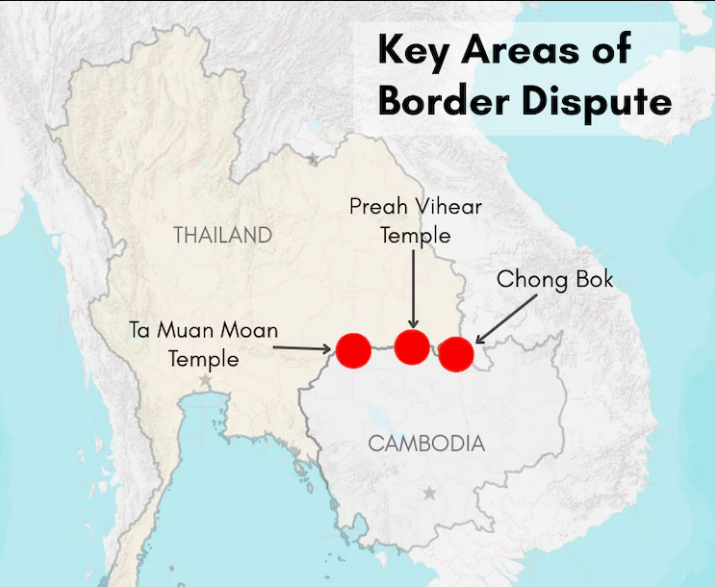
The two neighbours have long been warring over who controls a disputed piece of border land where an ancient Shiva temple complex exists and attracts a large number of devotees each year. The conflict centres on a century-old disagreement over borders mapped during France’s colonial rule in the region, with both sides claiming a smattering of boundary temples.
On July 24, 2025, heavy fighting broke out again along the Thailand-Cambodia border, the most intense in over a decade, on a long-running dispute over ownership of ancient temples and their surrounding land, particularly the temples of Preah Vihear and Ta Muen Thom.
Five days of combat between Thailand and Cambodia in July 2025 left 48 people dead and displaced around 300,000 on both sides of the border before a truce took effect, for which Trump took credit, as he did in several others.
In November, Thailand paused a follow-on Trump-backed deal to wind down hostilities, saying a landmine blast at the border had wounded several soldiers.
Since then, Cambodian and Thai officials have reported sporadic skirmishes along their frontier, which reignited on Sunday and Monday, sending thousands of civilians on both sides fleeing their homes.
Cambodia’s Information Minister Neth Pheaktra told reporters at least 1,157 families had evacuated to safety in the border province of Oddar Meanchey.
Both sides reported a brief skirmish on Sunday, which Thailand’s military had said left two soldiers wounded. The fighting escalated early Monday morning.
Thai Army spokesman Winthai Suvaree told reporters on Monday that one soldier was killed and eight were wounded in attacks by Cambodian troops near the border. Thailand had launched air strikes against its neighbour in an act of self-defence, he said.
“The Thai air power is being used only against Cambodian military targets, which allows damage to be contained and halts Cambodia’s supporting fire that caused Thai casualties,” he said.
“The air strikes are highly precise and aimed solely at military objectives along the clash line, with no impact on civilians.”
Cambodia’s defence ministry spokeswoman Maly Socheata, however, said Thai forces attacked Cambodian troops in Preah Vihear and Oddar Meanchey provinces early on Monday, accusing Thailand of “firing multiple shots with tanks at Tamone Thom temple” and other areas near Preah Vihear temple.
She said Cambodia did not retaliate, and that Thai military attacked Cambodian forces in Preah Vihear with an F-16 jet at around 9:00 am.
The Thai military fire in the two provinces wounded some civilians and burned their homes, while forcing others to flee.
The Thai army also accused Cambodian forces of firing BM-21 rockets towards civilian areas in Buri Ram province, with no casualties reported.
The United States, China, and Malaysia, as chair of the regional bloc ASEAN, brokered the cessation of fighting in July.
In October, Trump co-signed a follow-on joint declaration, touting new trade deals with Thailand and Cambodia after they agreed to prolong their ceasefire.
But Thailand suspended the agreement in November, and the two sides traded accusations of renewed clashes in which Cambodia said a civilian was killed.
Malaysian Prime Minister Anwar Ibrahim urged both sides on Monday to halt the fighting and utilise diplomacy.
With Thailand and Cambodia back at each other’s throats, the cycle of confrontation has restarted. The latest wave of airstrikes launched by Thailand came after a Thai soldier was killed and four others were injured in a Cambodian shelling.
According to the Royal Thai Army, Cambodian forces fired shells and rockets at Thai military and civilian areas around 7 am in the Chong Bok area of Nam Yuen district. Thai troops returned fire and later used fighter jets to strike Cambodian locations to halt the incoming attacks.
Amid the fighting, both countries are accusing each other of starting attacks along their disputed border. Thailand said that around 8:30 am, rockets fired from Cambodia hit a village in Buri Ram province.
Cambodia, however, said Thailand was the one that started Monday’s violence. The Cambodian army claimed Thai forces carried out several provocative actions for days and fired the first shots early in the morning.
Cambodia’s Defence Ministry also said Thai troops launched “brutal and inhumane” attacks in Preah Vihear province, which they believe violated the peace agreement signed at the Asean summit in Kuala Lumpur.
Border tensions between Thailand and Cambodia are rooted in disputes over colonial-era maps and have been going on for decades. However, the tensions flared earlier this year, killing numerous civilians and displacing almost 300,000 residents.
This year, the clashes began on May 28 when a Cambodian soldier was killed in a brief gunfight. Tensions rose again in July after a Thai soldier was hurt by a landmine, leading both countries to recall ambassadors. Heavy fighting broke out late in July, with airstrikes, artillery attacks and rocket fire, killing at least 48 people and forcing thousands to flee.
In October, Trump and Malaysia’s Prime Minister Anwar Ibrahim hosted the prime ministers of Thailand and Cambodia to sign the ‘Kuala Lumpur Peace Accords,’ aimed at ending border tensions between Thailand and Cambodia.
According to the deal, Thailand was supposed to release 18 Cambodian soldiers detained since July. Cambodia and Thailand promised to stop fighting, solve problems peacefully and respect each other’s borders. They agreed to remove heavy weapons from the border and allow ASEAN observer teams to monitor the ceasefire.
Both sides also agreed not to spread false or harmful information, to rebuild trust and to work toward better diplomatic relations. They agreed to settle border issues legally and prevent crimes along the border.
However, Thailand paused its commitments to the agreement in November after a landmine blast injured two of its soldiers.
Unlike Cambodia, Thailand has a well-trained air force and larger navy. Cambodia’s military is much smaller, with 1,500 air force personnel, no fighter jets, around 16 multi-role helicopters and a navy of about 2,800 people with 13 patrol vessels.
In contrast, Thailand has 46,000 air force personnel, 112 combat aircraft, nearly 70,000 navy personnel, an aircraft carrier, seven frigates and 68 patrol ships, making it far more powerful. Thailand is also classified as a major non-Nato ally by the US.