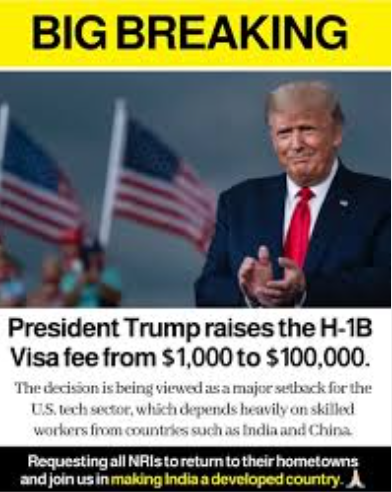
Roving Periscope: Trump’s order may shrink US talent pool, and empower other countries!






Virendra Pandit
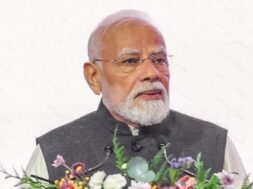
New Delhi: In his first remarks amid the uncertainty caused by US President Donald Trump’s H-1B visa fee hike to USD 100,000, Prime Minister Narendra Modi on Saturday reiterated that “Our biggest enemy is the reliance on other countries.”
The PM emphasised India’s need for self-reliance as President Trump increased the H-1B visa fee to USD 100,000 (approximately Rs. 88 lakh) annually. This US visa is used extensively by high-tech workers, especially from India.
In his first remarks after the H-1B visa fee hike, PM Modi said India’s biggest enemy is dependence on other countries.
“Today, India is moving forward with the spirit of ‘Vishwabandhu’. Duniya mein koi hamara bada dushman nahi hai. Agar hamara koi dushman hai toh woh hai dusre deshon par hamari nirbharta (We have no major enemy in the world. Our biggest enemy is our dependence on other countries)” the media quoted him as saying.
“This is our biggest enemy, and together we must defeat this enemy of India, the enemy of dependence. We must always reiterate this,” PM Modi said.
With this fresh Trump terror tactic, Indian IT firms could be hit hard. The move will likely impact smaller Indian IT firms, GCC companies, and US startups that rely on H-1B talent, while benefiting big tech firms hiring high-salary specialists.
President Trump on Friday signed a proclamation imposing USD 100,000 annual fee on H-1B visas. Companies employing foreign skilled workers on H-1B visas must now pay the additional fee for the entry of such workers in the US.
“…The entry into the United States of aliens as non-immigrants to perform services in a specialty occupation under section 101(a)(15)(H)(i)(b) of the INA… is restricted, except for those aliens whose petitions are accompanied or supplemented by a payment of $100,000,” it read.
“The Secretary of Homeland Security shall restrict decisions on petitions not accompanied by a USD 100,000 payment for H-1B specialty occupation workers,” the proclamation added.
In effect, no H-1B visa holder will now be able to enter the United States beginning Sunday (September 21, 2025), including current visa holders, unless they pay USD 1,00,000 to enter, the media reported.
The order noted the measure will ensure only “extraordinarily skilled” individuals will enter the country and will discourage companies from using foreign professionals to replace American workers.
“The high numbers of relatively low-wage workers in the H-1B program undercut the integrity of the program and are detrimental to American workers’ wages and labour opportunities, especially at the entry level, in industries where such low-paid H-1B workers are concentrated,” the proclamation read.
IT Industry analysts said the move will discourage hiring of H1-B workers for lower salaries from foreign countries but will not be too much of an adverse impact for American big tech majors or MNCs, who typically hire foreign workers for highly-skilled and higher salary roles.
Major Indian IT services players have, over the last 5 to 7 years, reduced their dependence on H-1Bs, but small and mid-sized Indian IT still depends largely on either H-1Bs or subcontractors in the US.
As part of the Proclamation, the White House said that IT firms in particular “have prominently manipulated the H-1B system, significantly harming American workers in computer-related fields.” The share of IT workers in the H-1B program grew from 32 percent in 2003 to an average of over 65 percent in the last 5 fiscal years, it added.
Some analysts also noted that businesses will temporarily pause new H-1B filings while litigation is pending. “Some work will shift offshore, and lobbying and lawsuits will also be ramped up,” an analyst said.
Meanwhile US based IT major Cognizant said in a statement that it is reviewing the potential implications of the order. “At this point, we do not have details to respond accurately. Cognizant has established a resilient business model that creates flexibility to hire the best candidates for open roles, including robust local recruiting and hiring infrastructure,” a company spokesperson said.