



Virendra Pandit
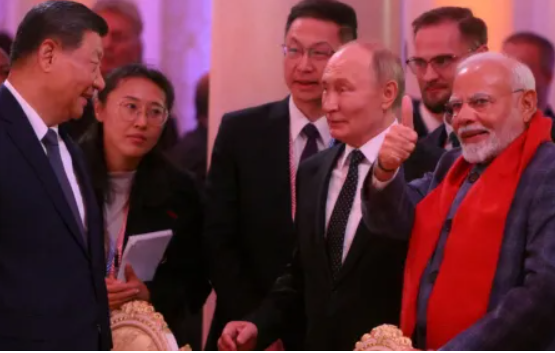
New Delhi: Prime Minister Narendra Modi will hold bilateral meetings with Chinese President Xi Jinping on August 31 and Russian President Vladimir Putin on September 1, in Tianjin on the sidelines of the upcoming Shanghai Cooperation Organisation (SCO) Summit, the media reported on Thursday.
Their engagements will be closely watched by the world, at a time when India’s economic partnership with the United States has been jolted by President Donald Trump’s sweeping unilateral tariff hikes on Indian goods over New Delhi’s continued purchase of Russian oil, which Washington claimed is funding the ongoing war in Ukraine.
The US recently raised duties on a wide range of Indian exports with tariffs as high as 50 percent in some cases.
In contrast, New Delhi’s ties with Beijing, though still fragile, have shown signs of cautious improvement after years of confrontation. Relations between India and China nosedived following the deadly Galwan Valley clashes in June 2020, but a series of military and diplomatic dialogues have led to mutual withdrawal from key friction points along the Line of Actual Control (LAC).
This will be PM Modi’s first visit to China in over seven years. He last met Xi in Wuhan for an informal summit in 2018.
His meeting with President Putin is equally significant. Russia, facing Western sanctions over the war in Ukraine, has sought to reinforce its traditional partnership with India while simultaneously deepening its strategic embrace with China.
Russia has recently hinted at the possibility of trilateral discussions involving India and China, an idea likely to feature in Putin’s talks with Modi in Tianjin for the resurrection of the triad called RIC—Russia, India, and China—as a potential bulwark against the USA.
The two-day SCO Summit in Tianjin will bring together more than 20 leaders from Central Asia, South Asia, the Middle East and Southeast Asia. For China, the gathering is a chance to showcase its leadership of the Global South—vis-à-vis India!—and offer diplomatic cover for Russia.
For India, it provides an opportunity to signal its continued commitment to multilateral forums and position itself as a balancing force amid shifting global alignments.