




Virendra Pandit
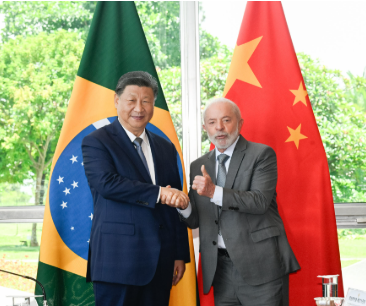
New Delhi: As efforts to revive the proposed Russia-India-China (RIC) bloc pick up, and the BRICS group expands to meet America’s geopolitical and geoeconomic challenges, Chinese President Xi Jinping on Monday said Beijing and Brasilia could become models of ‘self-reliance’ for the Global South.
The move to draw in Brazil came amid fast-changing geopolitical scenarios in recent weeks. While US President Donald Trump and his Russian counterpart Vladimir Putin are meeting in Alaska on Friday (August 15) on the Ukraine issue, the Russian leader is expected to visit New Delhi in the coming weeks. Prime Minister Narendra Modi will be in Japan and then visit China to participate in the upcoming Shanghai Cooperation Organization (SCO) Summit.
The 17th BRICS Summit was held in Rio de Janeiro, Brazil, on July 6-7, 2025. Its theme was “Strengthening Global South Cooperation for a More Inclusive and Sustainable Governance.”
Amid speculations that the BRICS bloc may float its own currency for mutual trading as part of a global dedollarization attempt, President Trump had threatened to impose significant tariffs on participating countries. Last week, an angry Brazilian President Lula turned down Trump’s offer for a telephonic conversation on trade and tariff, and instead spoke with PM Modi.
On Monday, President Xi Jinping suggested that China and Brazil should set an example of “unity and self-reliance” in the Global South.
In a phone call on Monday, Xi told Brazilian President Luiz Inacio Lula da Silva that China was ready to work with Brazil to be a model for other countries and build a “more just world and a more sustainable planet”, China’s state-run Xinhua news agency said.
Xi told Lula that China-Brazil ties were “at their best in history” and the “alignment” of the two countries’ development strategies was making “smooth progress.”
“Xi also said that China backs the Brazilian people in defending their national sovereignty and supports Brazil in safeguarding its legitimate rights and interests, urging all countries to unite in resolutely fighting against unilateralism and protectionism,” Xinhua said.
Lula’s office said the two leaders agreed on the role of the Group of 20 (G-20) and BRICS in “defending multilateralism”, discussed efforts to negotiate peace between Russia and Ukraine, and committed to expanding cooperation to sectors such as health, oil and gas, the digital economy and satellites.
“Both presidents also emphasised their willingness to continue identifying new business opportunities between the two economies.”
Lula reiterated the importance of China for the success of the COP30 world climate conference in November in Belem, Brazil, his office said.
The two leaders held the discussion as President Trump’s trade salvoes are spurring calls for greater cooperation among emerging economies, including China and Brazil.
Last week, Lula said he planned to contact the leaders of the 10-member BRICS group, which includes India and China, to discuss the possibility of a coordinated response to US tariffs.