




Virendra Pandit
New Delhi: Using an Elon Musk company’s innovation, a quadriplegic woman ‘wrote’ her name for the first time in 20 years using her mind, thanks to a Neuralink brain chip implant, the media reported on Monday.
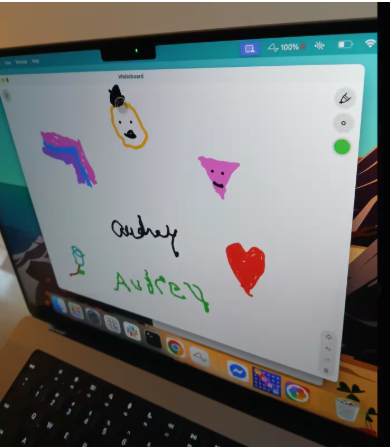
The woman, Audrey Crews, paralysed since she was 16, shared the breakthrough in a post on X (formerly Twitter, also owned by Musk): “I tried writing my name for the first time in 20 years. I’m working on it. Lol #Neuralink.:
A photo accompanying the post showed her name, “Audrey,” scrawled in violet on a digital whiteboard, controlled entirely by her mind using the microchip.
“She is controlling her computer just by thinking,” Elon Musk, founder of the brain-chip company, wrote on X. “Most people don’t realise this is possible.”
Founded by Musk in 2016 to develop advanced brain-computer interfaces (BCIs), Neuralink uses a coin-sized brain chip, implanted surgically beneath the skull, with ultra-thin threads inserted into the brain’s motor cortex. The chip reads and interprets brain activity, allowing users to control digital devices, such as a computer cursor or keyboard, using only their thoughts.
Audrey Crews, who recently underwent surgery at the University of Miami Health Center, described the BCI implant in another post. “Here’s more information about how my BCI, brain computer interface, implant works and my surgery,” she wrote. “They drilled a hole in my skull and placed 128 threads into my motor cortex. The chip is about the size of a quarter. The staff… treated me like a VIP.”
She clarified that the technology is not meant to restore her ability to walk. “It’s strictly for telepathy only,” she said. “The BCI lets me control my computer using my mind. I’ll be able to control more electronic devices in the near future.”
Asked about what’s next, she replied, “Hopefully write a book about my journey. I’ve been a quadriplegic since the age of 16 so I have lots to tell.”
Neuralink implanted its first chip in a human last year after receiving regulatory approval for human trials. This uses a surgical robot to insert the chip into the part of the brain that controls the intention to move. The company at the time said their goal was to allow patients to control a cursor or keyboard with their thoughts.
Elon Musk has long promoted Neuralink as a frontier technology that could ultimately treat conditions such as obesity, depression, autism, and schizophrenia.
He also revealed the company intended to launch a vision-restoring chip called Blindsight, which has been tested on monkeys but not yet in humans.
Neuralink aims to roll out Blindsight by 2030 and projects up to USD 1 billion in annual revenue from its suite of neural devices by 2031.