




Virendra Pandit
New Delhi: Two weeks after the 14th Dalai Lama celebrated his 90th birthday on July 6 in the presence of Union Minister Kiren Rijiju at Dharamshala, Himachal Pradesh, China has started the construction of the world’s largest dam project on the Brahmaputra’s source in Tibet, the media reported on Monday.
Earlier this month, Arunachal Pradesh Chief Minister Pema Khandu warned that the mega-project would become a ‘water bomb’ for India.
The great river, which flows downstream through India and Bangladesh, has worried the two South Asian countries, fearing sudden floods whenever China chooses to release excess water.
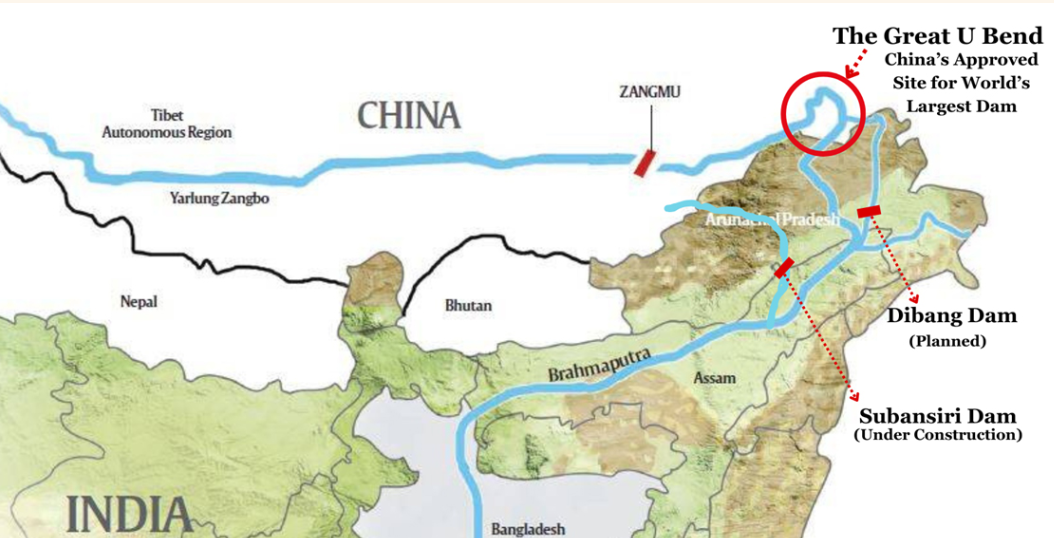
Estimated to cost USD 170 billion, the dam, spanning five cascade stations, will be built on what China calls the Yarlung Zangbo River in Tibet, which South Asia calls the Brahmaputra as it flows into India via Arunachal Pradesh and Assam, and then into Bangladesh.
China claims the dam will generate 300 billion kilowatt-hours of clean hydro-energy annually and support power needs in Tibet and beyond, the reports said.
China’s Premier Li Qiang announced that construction had begun on the world’s largest hydropower dam, located on the eastern rim of the Tibetan Plateau, the official Xinhua news agency said.
The dam is China’s most ambitious hydropower project since the Three Gorges Dam on the Yangtze, with operations expected to begin in the 2030s.
Made up of five cascade hydropower stations, the dam will be located in the lower reaches of the Yarlung Zangbo. A section of the river falls a dramatic 2,000 metres (6,561 feet) within a short span of 50 km (31 miles), offering huge hydropower potential.
India and Bangladesh raised concerns about its possible impact on the millions of people who live downstream, while NGOs have warned of the risk to the environment, one of the richest and most diverse on the plateau.
According to Beijing, the dam will help meet power demand in Tibet and the rest of China without having a major effect on downstream water supplies or the environment.
The Chinese premier described the dam as a “project of the century” and said special emphasis “must be placed on ecological conservation to prevent environmental damage,” Xinhua said on Saturday.
China has not given any estimate on the number of jobs the project is likely to create, nor the number of the people to be displaced, nor its impact on the local ecosystem.
The Three Gorges Dam, which took almost two decades to complete, generated nearly a million jobs, state media reported, although at least a similar number of people were displaced by the massive project.
NGOs, including the International Campaign for Tibet, say the dam will irreversibly harm the Tibetan Plateau and that millions of people downstream will face severe disruptions to their livelihoods.
The mega-project was announced after Chinese Premier Li Keqiang visited the border region in 2021.
Khandu said, because of this potential ‘water bomb’, after discussions with the Government of India, the Arunachal Pradesh government conceived the Siang Upper Multipurpose Project as a defence mechanism and ensure water security, the media reported.
China’s mega-dam being built near the Arunachal Pradesh border will be an existential threat and a bigger issue than anything else apart from the military threat, Khandu said.
The is a matter of grave concern as China is not a signatory to the international water treaty that could have forced it to abide by international norms.
“The issue is that China cannot be trusted. No one knows what it might do,” said Khandu.
This dam is to be built at a huge gorge in the Himalayan reaches where the river makes a sharp U-turn from west to east to flow into Arunachal Pradesh.
Had China signed the international water treaty, Khandu said, it would have been mandatory for it to release a certain amount of water downstream for the basin, for aquatic and marine life.
In fact, if China were a signatory to international water-sharing agreements, this project could have been a blessing for India, he said.
For one, it would have prevented the summer flooding of Arunachal Pradesh, Assam, and Bangladesh where the Brahmaputra flows.
“But China is not a signatory, and that is the problem… Suppose the dam is built and they suddenly release water, our entire Siang belt would be destroyed. In particular, the Adi tribe and similar groups… would see all their property, land, and especially human life, suffer devastating effects,” he said.
For India’s water security, he said, if the government can complete its project as planned, it will be able to meet the water requirements from its own dam.
In the future, if China releases water, there will definitely be flooding, but it can be controlled, he said.
“Who will make China understand? Since we cannot make China see reason, it is better that we focus on our own defence mechanisms and preparations. That is what we are fully engaged in at the moment,” he said.