




Virendra Pandit
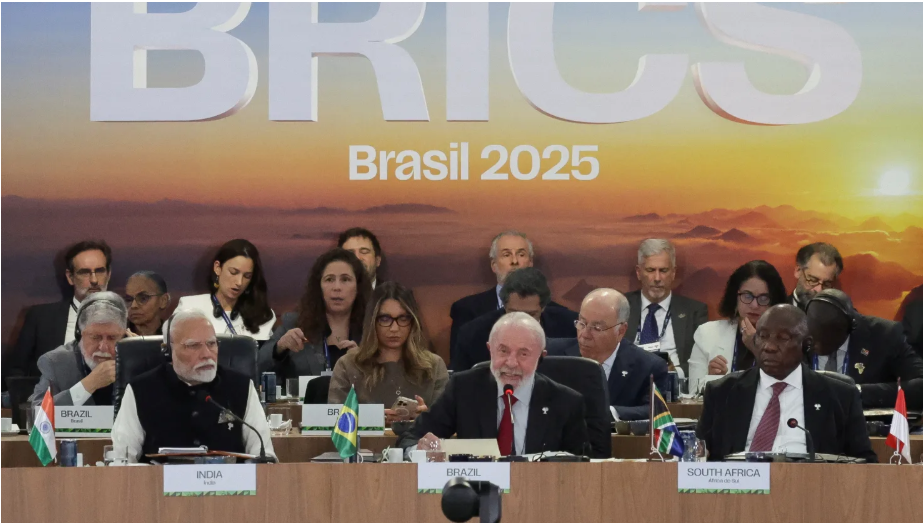
New Delhi: As the just-concluded 17th BRICS Summit at Rio de Janeiro, Brazil, tried to navigate delicate geopolitical scenario, in the absence of the Russian and Chinese Presidents, India became the focal point of the event which condemned the Pahalgam massacre, and passed several resolutions, but a livid US President Donald Trump threatened to punish “anti-American” countries with an additional 10 percent tariff.
Vladimir Putin skipped the Summit, fearing likely arrest in Brazil, a signatory to the International Criminal Court (ICC), which in 2023 issued an arrest warrant against the Russian President and others for ‘genocide’ in Ukraine. Chinese President Xi Jinping also skipped this Summit, for the first time in over a decade, as rumours about his possible ‘overthrow’ circulated on the social media for days, the media reported on Monday. In his place, Chinese Premier Li Qiang attended the event.
The US President’s “anti-American” jibe at BRICS and an extra 10 percent tariff warning came as Trump prepared to send tariff letters to dozens of countries in the coming days, with his administration’s 90-day pause on higher duties set to expire on Wednesday.
Addressing the Summit, Prime Minister Narendra Modi denounced the Pahalgam terror attack of April 22, and urged all the countries for a unified stance against terror and sanctions on terrorists. The BRICS nations also condemned the attack as criminal and unjustifiable, declaring zero tolerance on terrorism.
During the two-day Summit (July 6 and 7, 2025), where the hosts Brazil had invited PM Modi as the Chief Guest, India emerged as a key architect of the BRICS agenda—driving local-currency trade, global governance reform, green investments, and digital regulation.
These developments offer strong tailwinds for sectors spanning finance, infrastructure, technology, agriculture, and clean energy. With India set to assume BRICS Chairmanship in 2026, its businesses are well-positioned to capitalise on newfound opportunities, the media reported.
BRICS leaders, including India, endorsed increasing trade settlements in national currencies, aiming to reduce reliance on the US dollar. While the idea of a common BRICS currency is still a nonstarter, discussions around payment systems such as BRICS Pay and national-currency settlement frameworks are gaining momentum, the reports said.
A new BRICS Multilateral Guarantee (BMG) mechanism, backed by the New Development Bank (NDB), was unveiled to help mobilise private investment, mainly in infrastructure, climate-related, and sustainable projects. This is expected to lower financing costs and stimulate capital inflows into India. The NDB also reaffirmed its commitment to strengthening its regional presence, with existing projects in India and plans to expand its office in Gujarat. India’s infrastructure, climate, and manufacturing sectors are likely beneficiaries.
India joined other BRICS members in renewing calls for reforming global institutions like the IMF, World Bank, and UN Security Council to provide greater representation for emerging economies. This agenda closely aligns with India’s longstanding diplomatic goals. PM Modi emphasised the importance of diversity and multipolarity in shaping a new world order, suggested setting up a science and research repository within BRICS, and stressed the need for greater support for sustainable development in developing countries
India’s green energy and agricultural-technology sectors are expected to benefit from a collective push toward climate action and sustainable development. Member nations called on developed countries to finance the Global South’s climate transition and expressed support for initiatives such as the Tropical Forests Forever Facility and the BRICS Grain Exchange.
The Summit also focused on digital regulation, including the need to address the unauthorized use of artificial intelligence and to strengthen data protection rights. These discussions are relevant for India’s fast-growing digital and AI industries. Enhanced frameworks for e-commerce and data privacy are likely to support continued growth in the domestic tech sector, the reports said.
India also advocated dismantling export restrictions among BRICS countries to promote more seamless trade and supply chains. This complements India’s broader push for deeper South–South economic collaboration.
The BRICS joint statement also included a firm condemnation of terrorism and a call for enhanced intelligence-sharing. India, facing persistent cross-border threats, stands to benefit from stronger security cooperation within the bloc.
The new guarantee fund and the shift toward local-currency trade could reduce borrowing costs and mitigate currency risks for Indian exporters and infrastructure developers. Initiatives like the grain exchange, forest protection funding, and clean economy programs will likely boost India’s agri-tech and clean-tech industries. With AI governance and data protection now part of the BRICS agenda, Indian tech firms gain greater clarity on regulatory direction, which should support their expansion across software, AI, and e-commerce markets.
Improving India–China ties may ease supply-chain constraints and open the door to more stable cross-border collaboration. More importantly, India’s leadership on global institutional reform, climate finance, and the expansion of the BRICS bloc enhances its international standing. According to global economic analysts, this could attract further foreign investment and reinforce the goals of Atmanirbhar Bharat (Self-Reliant India).
Still fearing the de-dollarization move, however, President Donald Trump said he would put an additional 10 percent tariff on any country aligning themselves with “the Anti-American policies of BRICS,” injecting further uncertainty into global trade as the US continues to negotiate levies with many trading partners, including India.
“Any Country aligning themselves with the Anti-American policies of BRICS, will be charged an ADDITIONAL 10% Tariff,” Trump said on Sunday night in a Truth Social post. “There will be no exceptions to this policy.”
The BRICS leadership also condemned US and Israeli attacks on Iran and called on Prime Minister Benjamin Netanyahu’s government to withdraw troops from the Gaza Strip. They urged a “just and lasting” resolution to conflicts across the Middle East.
Trump’s post didn’t specify which policies he considers “Anti-American,” nor did it provide details on when any of those tariffs might be imposed. He has previously threatened to slap 100 percent levies on BRICS if they ditch the US dollar in bilateral trade. The pushback, in turn, has spurred interest in developing local payment systems and other instruments that can facilitate commerce and investment between the nations.
On Sunday, BRICS leaders agreed to continue talks on a cross-border payment system for trade and investment – a project they’ve been discussing for a decade, though progress has been slow.
Chinese Premier Li on Sunday said BRICS countries should take the lead in advancing reforms in global governance and championing the peaceful resolution of international disputes.
“Today’s world is more turbulent, with unilateralism and protectionism on the rise,” Li said. “China is willing to work with BRICS countries to promote global governance in a more just, reasonable, efficient and orderly direction.”