




Virendra Pandit
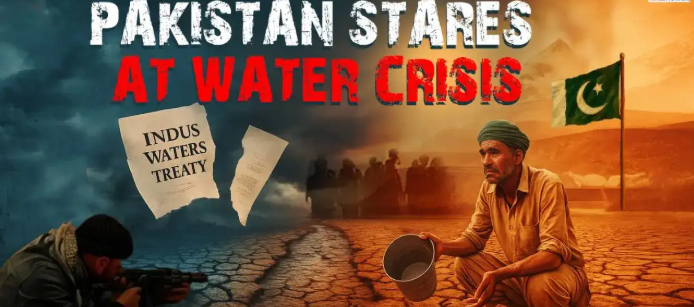
New Delhi: A day before India conducts the second round of Operation Shield (mock drills) on Saturday in the states bordering Pakistan, as part of preparations during the ongoing Operation Sindoor, Congress MP Shashi Tharoor slammed Islamabad for betraying India’s goodwill on the Indus Water Treaty (IWT) with state-sponsored terror.
The media reported on Friday that General Asim Munir, Pakistan’s army chief who crowned himself as his country’s second “Field Marshal” after tasting a crushing defeat early this month, warned the victor New Delhi that the Indus water is a ‘red line.’
The IWT, brokered by the World Bank in 1960, governed water distribution between India and Pakistan from the Indus River system.
Declaring that India no longer has time for acting based on goodwill unilaterally, Tharoor said in Bogota, Colombia, that New Delhi offered the IWT to Pakistan in a “spirit of goodwill and harmony” but it was “repeatedly betrayed.”
The veteran Congress MP, who is leading an all-party delegation to multiple countries to explain the Operation Sindoor’s coordinated military action against terror infrastructure in Pakistan, asserted that India is only exercising its right of self-defence and, despite terrorism and conflict inflicted by Pakistan, it ensured that the IWT remained operational so far.
“The IWT was offered by India to Pakistan in the early 1960s in a spirit of goodwill and harmony. Those words occur in the Preamble of the Treaty; sadly, that goodwill has been repeatedly betrayed by Pakistan’s terrorist actions of the last four decades. Even though we have had terrorism and war inflicted on us, the Treaty remained in place.
“But this time our government has placed the Treaty in abeyance, which means it is in effect suspended. Its operations are suspended until we get satisfactory indication from Pakistan that they’re prepared to conduct themselves in that spirit of goodwill that is provided for in the Preamble of the Treaty.
“We are very conscious that we have been a generous neighbour when it comes to the operation of the Treaty. We are in an upper riparian state. We have given Pakistan very generously the waters that they are entitled to under the Treaty, and we have not even used all the waters we are entitled to. But the time for acting based on goodwill unilaterally is frankly no longer with us,” said Tharoor.
The IWT was suspended last month after Pakistan-sponsored terrorists massacred 26 Hindu-only tourists at Pahalgam, Jammu and Kashmir, on April 22. Responding to it, India quickly downgraded diplomatic ties with Pakistan and announced a series of punitive measures, including the IWT’s suspension.
Tharoor reiterated India’s stance against terrorism, adding that the fresh terror attack cannot go unpunished. “India suffered a grievous terrorist attack on the 22nd of April… When this happened, of course, the world rose to condemn the terrorist attack, but that was as far as it went. There was no action taken, not even by the country where these people had emerged from, Pakistan. Nobody was arrested, and there was no attempt at any prosecution. India decided that this kind of outrage could not go unpunished. On May 7, India chose to strike against known terror bases and launch pads.”
India launched coordinated missile strikes on terrorist infrastructure at nine locations in Pakistan and Pakistan-occupied Kashmir (PoK) on May 7 under the code name Operation Sindoor.
With India relentlessly firing on all cylinders against Pakistan, a boastful General Asim Munir said in Pakistan on Thursday that no deal on Kashmir was possible. His remarks came after India reiterated that any talks with Pakistan would only be on regaining Pakistan-occupied Kashmir, and terrorism.
He also said Islamabad would “never compromise” on the water issue, adding “Water is Pakistan’s red-line, and we will not allow any compromise on this basic right of 240 million Pakistanis.”
The IWT was an agreement between India and Pakistan to share the waters of the Indus River system, which flows through both countries. Accordingly, Pakistan got control over the three western rivers (Indus, Jhelum, and Chenab), while India could use the three eastern rivers (Ravi, Beas, and Sutlej) for its needs like farming and electricity, but in limited ways on the western rivers.