




Manas Dasgupta
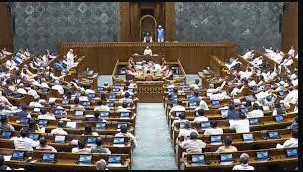
NEW DELHI, Apr 17: The much-awaited women’s reservation bill linked with delimitation of constituencies to increase the strength of the Lok Sabha and state Assemblies failed to secure the required two-thirds majority and the remaining two bills “intrinsically linked” to women’s quota were dropped in an anticipated development in the Lok Sabha on Friday evening.
The Constitution (One Hundred and Thirty-First Amendment) Bill on Friday failed to pass the Lok Sabha test, with 298 members voting in favour and 230 against. Notably, the bill could not secure the required two-thirds majority, leading to its defeat in the House. Other two bills such as the Delimitation Bill 2026, the Union Territories Law (Amendment) Bill 2026 were dropped. NDA leaders started protesting in Parliament premises as the Constitution (One Hundred and Thirty-First Amendment) Bill, 2026 failed in the Lok Sabha.
The special session of Parliament, which was scheduled to end on Saturday, was adjourned after the defeat of the women’s quota bill.
Soon after the defeat of 131st Constitution Amendment, Union Minister Kiren Rijiju termed the outcome “unfortunate” and said two related bills on Union Territories and delimitation, which were intrinsically linked to the constitutional amendment, have also been stalled. He further added that the government would continue to strive on the issue.
“It’s a defeat for half the country’s population; Opposition abandoned us; women will never forgive them”, says BJP MP Aparajita Sarangi, while the opposition termed it the defeat of the attempt to attack the constitution. “This was not about women’s reservation but democracy. We can never agree to linking delimitation with women’s reservation. It was not possible that this bill would pass. This is a big win for democracy in our country,” Priyanka Gandhi Vadra said. “Those who did not take any action in Hathras, Unnao and Manipur are talking about an anti-women mindset,” she said.
The Lok Sabha debate, which went on past midnight on Thursday and continued on Friday, saw the Centre making a forceful pitch for the reservation of 33% of seats in the lower house of parliament and state assemblies for women.
Leading the charge for the government, Prime Minister Narendra Modi sought to allay a key fear of the Opposition parties and said he was personally guaranteeing that no injustice would be done to the southern states with the increase in seats in the Lok Sabha. “Let all of us not miss this important opportunity to give reservation to women. I have come to appeal to you – do not see this from a political lens, this is in national interest,” PM Modi had said.
Union Home Minister Amit Shah also assured the House on both days that the current representation of southern states would be preserved, or increase slightly, once the seats in the Lok Sabha were increased from the current 543 to roughly 816. Both PM Modi and Shah also accused the Congress and other opposition parties of manufacturing issues to oppose the bill and deprive women of reservation. These parties, the BJP leaders said, would have to pay a price at the hustings for blocking the bill.
Opposing the linking of the bill with delimitation, Leader of the Opposition Rahul Gandhi said the government was using the issue of women’s reservation as a smokescreen and was actually attempting to redraw the country’s electoral map in its favour.
“This is not a women’s bill as it has nothing to do with empowerment of women. This bill is an attempt to change the country’s electoral map, using and hiding behind India’s women,” he alleged. Gandhi also claimed that the government was attempting to bypass the caste census. “They are trying to avoid giving power, representation to my OBC brothers and sisters, and instead take power away from them,” he said.
After the legislation failed to clear the Lok Sabha, Parliamentary Affairs Minister Kiren Rijiju said the two other bills were “intrinsically interrelated” with it. “It is a matter of regret that the Opposition did not support such a historic and important bill meant to give respect and representation to the people of the country. You had an opportunity and you squandered it. The Modi government’s efforts and struggle to give rights to women will continue,” he said. BJP MPs also protested in the Parliament complex.
Speaking to reporters, Rahul Gandhi reiterated that the legislation was an attack on the Constitution. “As I said in the House, this bill was an attack on the Constitution, and we are glad that we have defeated it. This was not a Women’s Reservation Bill, but an attempt to change the electoral map for India. I want to tell the Prime Minister that if the government wants to implement the bill on women’s quota that was passed in 2023, the opposition will support it 100%,” he asserted.
Gandhi also took to X minutes later and called the Centre’s plan an “unconstitutional trick” that failed because the opposition INDIA alliance stayed together. “Bharat has seen it. INDIA has stopped it,” he wrote.
The Lok Sabha earlier in the day resumed discussion on the Constitution (One Hundred and Thirty-First Amendment) Bill, 2026, the Union Territories Laws (Amendment) Bill, 2026, and the Delimitation Bill, 2026.
While motions for the introduction of Constitution Amendment Bills are adopted by simple majority, a majority of the total membership of the House and a majority of not less than two-thirds of the members present and voting is required for adoption of effective clauses and motions for consideration and passing of these Bills.
Constitution Amendment Bills affecting vital issues as enlisted in the proviso to article 368(2) of the Constitution after having been passed by the Houses of Parliament, have also to be ratified by not less than one-half of the State Legislatures.
Earlier, Home Minister Amit Shah replied to the marathon debate on three bills and slammed the opposition parties over their stance on the bills to implement women’s reservation from the 2029 general elections and said that when they fight the next elections, they will face the wrath of women.
It has been alleged by several DMK and Congress MPs that southern states will be disproportionately impacted if the bill is passed in its current form. Leaders such as Manickam Tagore and A Raja have argued that states like Telangana, Tamil Nadu, and Kerala may not see a proportional increase in seats compared to northern states.
Union home minister Amit Shah sought to allay concerns raised by opposition members about southern states losing influence due to the increase in seats. He said that while there would be around a 50% increase in seats, the relative share of southern states in the total would also rise.
The Congress said the bill was against the integrity of the country, while AIMIM chief Asaduddin Owaisi strongly opposed the introduction of the Women’s Reservation Bill and the Delimitation Bill. He said if these bills become law, “the opposition’s voice will be reduced to nothing in this House.”
Samajwadi Party chief Akhilesh Yadav also criticised the BJP-led government, alleging that it was delaying a caste-based census because conducting it would require releasing the data and implementing caste-based reservations for backward communities.
“Samajwadi Party is in favour of the Women’s Reservation Bill. We have always worked towards women’s empowerment. But the Bharatiya Janata Party is trying to turn women into a slogan. The BJP must answer: out of the 21 states it governs, how many have women chief ministers? Even your Delhi CM does not have full powers; she is a ‘half Chief Minister’. Why is there such a hurry?” he asked.