Weather: Over 1,000 killed by two cyclones in Indian Ocean; third building up










Virendra Pandit
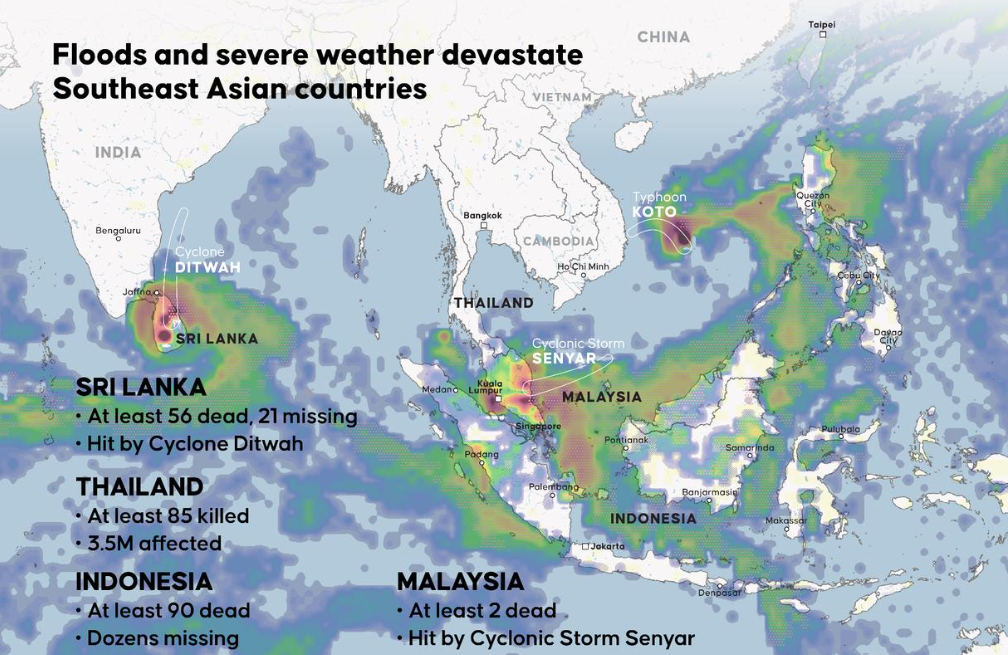
New Delhi: Two cyclones and monsoon rains combined last week to leave behind more than 1,000 dead, hundreds of thousands homeless, and a trail of devastation in the Indian Ocean countries like Sri Lanka, Thailand, and Indonesia, new details about the natural calamity suggested.
The third cyclone is currently forming near Vietnam, according to media reports on Monday.
As the fury of these cyclones abated, the death toll continued to mount, amid hectic relief and rescue operations.
According to media reports, two back-to-back storms–Cyclones Senyar and Ditwah–left more than 1,000 dead and hundreds of thousands out of homes in Indonesia, Thailand, and Sri Lanka. Ditwah also affected southern Indian coastal states like Tamil Nadu and Andhra Pradesh.
The twin storms carved a trail of devastation across the Indian Ocean region.
A deep depression over the Strait of Malacca first turned into Cyclone Senyar last week, and later dissipated over the South China Sea, according to the Hong Kong Observatory. Immediately after Senyar weakened, another cyclonic storm—Ditwah—brewed over the southwest Bay of Bengal, heading towards Sri Lanka and southern India.
The Senyar cyclone posed no major threat to India as it built over the Strait of Malacca – connecting the Andaman Sea of the northeastern Indian Ocean and the South China Sea of the western Pacific Ocean. It moved away from the Indian coast and towards Indonesia as well as Malaysia.
Cyclone Ditwah, formed on November 27, after hitting Sri Lanka, headed towards Tamil Nadu, Puducherry and Andhra Pradesh coast by November 30 but stopped short of devastating the Indian coast, except causing heavy rains in the regions.
In Indonesia’s Sumatra Island, a week of torrential rains intensified by a ‘rare cyclone, Senyar, has left at least 500 people dead. The death toll from floods and landslides in Indonesia also rose to 502 with 508 missing.
Rescue and relief efforts in Indonesia were hit by cut-off roads and downed communication networks, the head of country’s National Disaster Mitigation Agency, Suharyanto, the Jakarta Post reported.
The storm left behind extensive damage to infrastructure in Indonesia, cutting off access to several villages and prompting officials to deploy helicopters and navy ships to transport supplies after floods and landslides. Several houses remained submerged up to their rooftops.
The Indonesian government also carried out aerial cloud seeding operations to reduce rainfall over areas that were affected the most, the national weather bureau said in a statement.
Cyclone Senyar was the first tropical cyclone to form in the Strait of Malacca since the destructive Typhoon Vamei made passage there in 2001.
Tropical cyclones rarely form this close to the Equator, in part because of a weaker rotational force, known as the Coriolis effect, at low latitudes, the media reported. Officials attributed the formation of Senyar to a combination of factors – including warm water temperatures in the Strait of Malacca.
Petron Malaysia halted operations at a crude oil refinery following damage from storm Senyar, the company said in a filing.
Cyclone Senyar also left Thailand devastated as flooding triggered by the torrential rains in southern part of the country claimed at least 176 lives and affected more than two million households.
According to preliminary estimates, the total losses in Thailand so far amount to 23.6 billion baht (USD 734 million/Rs. 6,560 crore), with hotels and restaurants among the hardest hit.
Cyclone Ditwah, which came ashore in the island nation on Friday last week, led to red alert for north Tamil Nadu, Puducherry and Andhra Pradesh coasts by the India Meteorological Department (IMD) for extremely heavy rain over the weekend. There was no major rain warning for Monday.Three people died in rain-related incidents triggered by cyclone Ditwah in Tamil Nadu over the last 24 hours.
The storm left Sri Lanka facing its “largest and most challenging natural disaster,” President Anura Kumara Dissanayake said in a national address on Sunday night.
In Sri Lanka, fatalities from heavy flooding rose sharply on Sunday, almost doubling to 334 dead and another 370 missing.
The storm’s passage has left Sri Lanka facing its “largest and most challenging natural disaster,” President Anura Kumara Dissanayake said in a national address Sunday night.
A third storm, Typhoon Koto, is expected to remain offshore to the east of Vietnam, slowly losing strength over the coming days. However, it is still likely to bring additional rainfall to central and north-central parts of the country, which have already suffered severe storms and historic flooding that caused at least USD 3 billion in damage in recent weeks.