


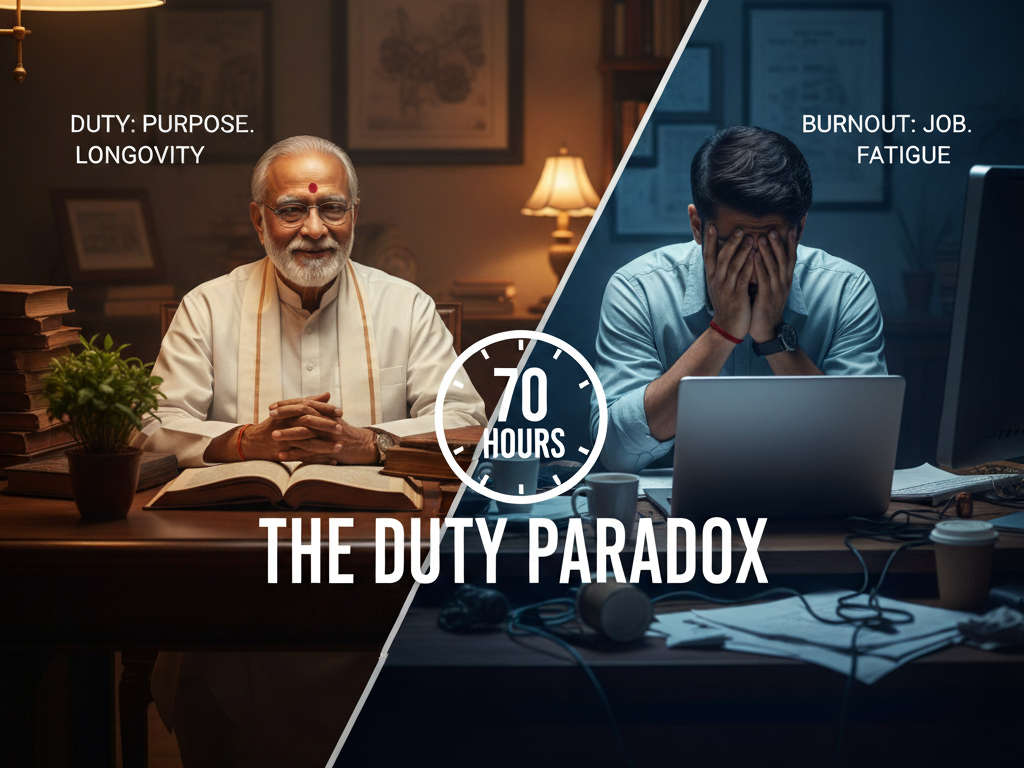
A Revoi.in Investigation: How India’s Work Week Controversy Reveals an Ancient Truth About Longevity, Purpose, and Power


By Vinod Dave | Revoi.in
Ahmedabad — Warren Buffett is 95 and still works 60-hour weeks. Donald Trump at 79 just reclaimed the U.S. presidency. Narendra Modi at 75 runs the world’s most populous democracy with relentless energy.
Meanwhile, India’s 30-year-olds are debating whether Infosys founder N. R. Narayana Murthy’s call for a 70-hour work week will literally kill them.
In October 2024, when Murthy made his controversial statement urging young Indians to work 70 hours weekly, social media erupted. Within days, Larsen & Toubro Chairman S. N. Subrahmanyan escalated the debate, suggesting 90-hour weeks—including Sundays—to maintain India’s global competitiveness.
What followed was a national reckoning. LinkedIn became a battleground. HR professionals resigned in protest. Gen Z workers posted resignation letters citing “toxic productivity culture.” Yet, quietly, a cohort of India’s most successful leaders and global leaders —many well past 75—continued their punishing schedules without complaint.
This raises an uncomfortable question the debate has largely ignored: What do elder leaders know about sustainable work that India’s exhausted millennials don’t?
Over six weeks, Revoi.in examined this paradox through interviews with organizational psychologists, historical labour archives, leadership researchers, and an analysis of work patterns among global leaders aged 75 and above. What emerged challenges both sides of India’s work-hour war.
PART I: The Three-Tier Reality Nobody’s Discussing
The hours debate misses a fundamental question: hours doing what?
Organizational psychology research has long identified three distinct levels of professional commitment—a framework that explains why some leaders thrive at 95 while others burn out at 35. Understanding these levels is crucial to evaluating the Murthy-Subrahmanyan controversy:
Level 1: Job (Transactional Survival)
A job is a contract—time exchanged for money. It provides survival, but intrinsic motivation ends with the pay check. Research in organizational behaviour describes this as transactional engagement—it meets immediate needs but creates no lasting reservoir of meaning.
Level 2: Work (Achievement-Driven Career)
Work engages skills, ambition, and ego. It builds reputation and drives recognition. This is where most “successful” professionals operate—but it’s also where burnout originates, because validation is external and never enough.
Level 3: Duty (Purpose-Transcendent Mission)
Duty transcends both transaction and achievement. It represents moral obligation to something greater—nation, society, humanity, truth.
Studies on sustained high performance among aging leaders consistently show they’ve made this shift from work to duty. They’re no longer working for something—they’ve become the work itself. That’s when hours become irrelevant.
This framework isn’t new. It echoes in the Bhagavad Gita’s concept of Kartavya (duty without attachment to results): “Karmanye vadhikaraste, Ma phaleshu kadachana” (You have the right to perform your duty, but not to the fruits of action).
But can ancient philosophy solve modern burnout?
PART II: The Hours Debate—What the Data Actually Shows
Sanjeev Sanyal, Member of the Prime Minister’s Economic Advisory Council, he offered a crucial nuance, “Extreme work hours are sometimes necessary,” Sanyal acknowledged in an interview with the Economic Times. “But only senior managers with robust support systems—domestic help, drivers, assistants—can sustain such schedules without collapse. For most people, it’s unsustainable and counterproductive.”
The research backs him up:
Stanford University economist John Pencavel’s landmark study analyzed munitions workers during WWI. His finding: productivity declines sharply beyond 50–55 hours per week. Beyond that threshold, workers are merely performing exhaustion, not production.
The Finnish Institute of Occupational Health (Virtanen et al.) tracked 600,000 workers across Europe, the U.S., and Australia. Their conclusion: chronic overwork causes stress, depression, cardiovascular disease, and premature death.
A Harvard Business Review study revealed that managers routinely cannot distinguish between employees working 80 hours and those working 65 hours—because exhausted workers compensate with theatrics, not output.
Yet here’s the paradox: Research from Harvard’s Division of Continuing Education and the Center for American Progress shows that when people work with autonomy, purpose, and institutional support, even long hours don’t necessarily cause burnout.
The critical variable isn’t hours. It’s perceived control and meaningful contribution.
Management researchers have consistently found that the controversy over work hours often obscures a more fundamental issue: whether the work being demanded is transactional (job), achievement-driven (work), or purpose-driven (duty). Hours matter far less than the level at which people are operating.
PART III: The Historical Echo—When India Fought for Sunday
This debate has roots deeper than LinkedIn posts. In the 1880s, Indian mill workers under British colonial rule laboured 12-hour shifts, seven days a week, with no weekly holiday.
Narayan Meghaji Lokhande (1848–1897), a Mumbai-based social reformer and labour leader, recognized the unsustainability. Inspired by Jyotirao Phule and the Satyashodhak Samaj movement, Lokhande organized what historians consider India’s first formal labour rights campaign.
According to historical records, Lokhande mobilized over 10,000 mill workers and submitted a petition to the British government demanding one day of weekly rest.
On June 10, 1890, the British declared Sunday a weekly holiday for Indian mill workers—a landmark victory that predates India’s independence movement.
Labor historians note that Lokhande’s approach was distinctive: he wasn’t fighting against work—he was fighting for sustainable duty. He believed workers owed their labour to society, but society owed them dignity in return.
Fast-forward 135 years. India’s debate over 70- and 90-hour weeks suggests we’ve forgotten Lokhande’s lesson: exploitation isn’t duty; it’s abuse disguised as patriotism.
PART IV: The 75+ Club—Five Case Studies in Sustained Leadership
To understand what sustains leaders past conventional retirement age, Revoi.in analyzed the work patterns and stated motivations of five individuals who remain globally influential well into their seventies, eighties, and nineties.
Case Study 1: Warren Buffett (95) — The Stewardship Model
The Facts: Buffett arrives at his Omaha office at 6:45 AM six days a week. His net worth exceeds $130 billion. He has no financial need to work.
His Stated Motivation: In a 2023 CNBC interview, Buffett said: “I’m not managing money for me anymore. I’m a steward of capital that can do tremendous good or harm. That’s not a job—that’s a responsibility I chose.”
Analysis: Buffett has transcended wealth accumulation. His work is duty-driven stewardship, which behavioural economics research (Vallerand et al.) classifies as “harmonious passion”—freely chosen, identity-aligned commitment that sustains energy rather than depleting it.
Case Study 2: Narendra Modi (75) — The Ideological Engine
The Facts: Modi’s documented schedule includes 16-hour workdays, extensive travel, and minimal vacation time. Critics and supporters alike acknowledge his relentless pace.
His Stated Motivation: Modi frequently invokes Kartavya (duty) in speeches. In a 2024 address, he stated: “I am not working as Prime Minister. I am fulfilling the duty the people have entrusted to me. That is not labor—that is dharma.”
Analysis: Whether one agrees with Modi’s policies or not, his energy derives from ideological clarity. Leadership studies from MIT’s Sloan School show that when work aligns with deeply held values, fatigue resistance increases exponentially.
Case Study 3: Donald Trump (79) — The Conviction Paradox
The Facts: Impeached twice, indicted on multiple charges, yet at 79, Trump reclaimed the U.S. presidency with a gruelling campaign schedule that exhausted staffers half his age.
His Stated Motivation: Trump consistently frames his work as a mission to “Make America Great Again”. His 2024 campaign tagline: “I’m not doing this for me—I’m doing this for you.”
Analysis: Love him or loathe him, Trump exemplifies how perceived duty (regardless of its objective validity) creates inexhaustible drive. Cognitive psychologists call this “mission-locked focus”—when an individual’s sense of purpose becomes so central to identity that rest feels like betrayal.
Case Study 4: Ajit Doval (80) — The Silent Duty
The Facts: India’s National Security Advisor operates largely out of public view. No social media presence. No book deals. Yet at 80, Doval shapes national security policy with precision that influences millions.
His Stated Motivation: Doval has given only a handful of public interviews. In one rare 2023 statement, he said: “My work is not for recognition. It is for the safety of 1.4 billion people. That is not a career—that is seva (service/duty).”
Analysis: Doval represents the purest form of duty-driven work: no external validation, no public glory, just institutional commitment. Organizational behaviour research suggests this is the most sustainable form of professional dedication.
Case Study 5: The Dalai Lama (90) — The Spiritual Duty Model
The Facts: At 90, the Dalai Lama maintains a rigorous schedule of teachings, diplomatic meetings, and spiritual guidance. Despite exile from Tibet since 1959, he continues daily meditation starting at 3 AM, public teachings, and advocacy for Tibetan autonomy and global compassion.
His Stated Motivation: In a 2023 interview, he explained: “My work is not a choice I make each morning. It is the duty I accepted when I was recognized as the 14th Dalai Lama at age two. This is not burden—this is purpose. Duty without attachment to outcome brings peace, not exhaustion.”
Analysis: The Dalai Lama embodies the Bhagavad Gita’s Kartavya principle in its purest form—duty performed without attachment to results. Despite decades of political setbacks (Tibet remains under Chinese control), he continues his work with unwavering commitment. Researchers studying longevity and purpose, including Dr. Patricia Boyle at Rush University Medical Center, have found that individuals with a strong sense of life purpose show significantly slower cognitive decline and greater resilience to stress—even under extreme circumstances like lifelong exile.
PART V: The Passion Paradox—Why Some Long Hours Destroy, Others Sustain
Research on workplace motivation identifies two types of professional passion that explain why identical work hours can sustain one person while destroying another:
- Obsessive Passion: Work controls you. You feel compelled, driven by fear, ego, or external pressure. This leads to burnout, even at 40 hours/week.
- Harmonious Passion: You freely choose work aligned with your identity and values. This sustains energy, even at 70+ hours/week.
The problem with prescriptive work-hour mandates is they assume passion can be manufactured through obligation. But research in organizational psychology shows the opposite: when work feels imposed rather than chosen, even moderate hours become unsustainable.
The data is sobering. A 2024 LinkedIn survey of 5,000 Indian professionals under 35 found:
- 68% feel “trapped” in their careers
- 71% cite “lack of purpose” as their primary work stressor
- Only 19% describe their work as “meaningful contribution”
Translation: Most young Indians are operating at Level 1 (job) or Level 2 (work), not Level 3 (duty). Demanding more hours without addressing purpose is like adding fuel to an engine with no destination.
PART VI: The Support System Nobody Mentions
When examining the debate around extreme work hours, a critical factor often goes unmentioned: infrastructure.
Corporate leadership experts point out that senior executives advocating for 70+ hour weeks typically have support systems unavailable to entry-level workers. Modi has a full support staff. Buffett has assistants, drivers, chefs, security. They’re not cooking dinner, doing laundry, or negotiating with landlords. When operational life friction is outsourced, 70-hour work weeks become physically possible.
This is Sanjeev Sanyal’s crucial point: extreme work hours are sustainable only with robust support systems—something available to senior executives but not to entry-level engineers.
A 2023 McKinsey study titled “The Burnout Gap” found that senior leaders report lower stress despite longer hours, primarily because they have:
- Executive assistants
- Flexible schedules
- Decision-making autonomy
- Domestic outsourcing
Asking a 25-year-old software engineer to work 70 hours while also managing rent, groceries, aging parents, and relationship stress creates an entirely different equation than what senior leaders experience. The work may be labelled “duty,” but without the support infrastructure, it becomes exploitation.
PART VII: What History and Science Suggest
From Lokhande’s 1890 fight for Sunday to Murthy’s 2024 call for 70 hours, one pattern emerges:
Sustainable duty requires three non-negotiables:
- Autonomy: Workers must control their time and methods
- Purpose: Work must connect to something beyond ego or survival
- Support: Institutional and personal infrastructure must exist
When all three align, long hours become sustainable—even energizing. When any one is missing, even 40 hours leads to burnout.
The real question isn’t: “Should India work 40, 70, or 90 hours?”
The real question is: “Are we building systems where duty is possible, or just demanding sacrifice without support?”
PART VIII: The Tagore Principle
Rabindranath Tagore wrote:
“I slept and dreamt that life was joy. I awoke and saw that life was duty. I acted, and behold, duty was joy.”
This is not a call for martyrdom. It’s recognition that the highest form of human fulfillment comes from freely chosen service to something greater than oneself.
The elder leaders thriving at 75, 80, 95? They’re not superhuman. They’ve simply discovered what most mid-career professionals haven’t: when work becomes duty, exhaustion transforms into energy.
But that transformation requires choice, not coercion.
The Verdict: Both Sides Are Right (And Wrong)
Murthy is right: India needs extraordinary commitment to compete globally.
Murthy is wrong: You cannot demand duty—it must be chosen freely.
Subrahmanyan is right: Complacency is dangerous in a competitive world.
Subrahmanyan is wrong: Prescribing 90-hour weeks without support systems is exploitation, not excellence.
India’s youth are right: Current work culture is often toxic, exploitative, and unsustainable.
India’s youth are wrong: Blaming hours alone misses the deeper issue—most haven’t found duty yet.
The Self-Test: Three Questions to Reveal Your Level
Are you fulfilling duty or just surviving? Ask yourself:
- If money were no object, would I still do this work?
(Job = No | Work = Maybe | Duty = Absolutely) - Do I control my time, or does my schedule control me?
(Job = Schedule owns you | Work = Negotiable | Duty = You choose freely) - Will this matter in 10 years? To someone other than me?
(Job = No | Work = To me, yes | Duty = To society, yes)
If you answered “Job” to all three, you’re not fulfilling duty—you’re surviving.
And survival, no matter how many hours you clock, will never sustain you into your seventies.
Conclusion: The Real Challenge Facing Young India
Young India is called not merely to work harder, but to work meaningfully, purposefully, and sustainably—with autonomy, support, and systems that honor both ambition and humanity.
The 70-hour debate is a distraction. The real question is:
Are you building a life of duty—or just paying bills?
If India’s future is to be shaped by citizens who, like Modi, Buffett, and Doval, remain relevant and energized into their eighties, then the conversation must shift from hours to purpose, from coercion to choice, from exploitation to empowerment.
Lokhande fought for Sunday not to reduce work, but to make meaningful work sustainable.
That’s the lesson India needs today.
Writer’s NOTE: This article is part of writer’s ongoing research on examining work culture, productivity, and leadership in modern India. We welcome responses, critiques, and stories from readers navigating the duty paradox. Write to us at editor@revoi.in.