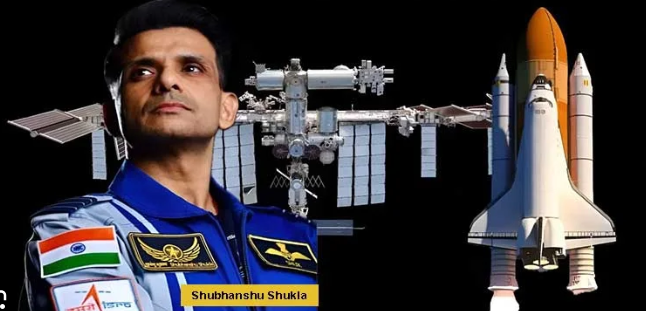
Space: NASA to telecast Shukla-piloted Ax-4 mission’s return from ISS on July 14








Virendra Pandit
New Delhi: The USA’s National Aeronautics and Space Administration (NASA) will provide live coverage of the undocking and departure of the Axiom Mission 4 (Ax-4) private astronaut mission from the International Space Station (ISS), scheduled for approximately 7:05 am EDT (4:30 PM IST) on Monday, July 14.
Indian Air Force (IAF) Group Captain Shubhanshu Shukla, 39, the first Indian to visit the ISS and pilot the mission, is part of the four-member crew that will conclude their mission aboard the SpaceX Dragon spacecraft, which will undock from the space-facing port of the ISS’ Harmony module, the media reported on Saturday.
The crew also includes veteran NASA astronaut Commander Peggy Whitson, European Space Agency (ESA) project astronaut Slawosz Uznanski-Wisniewski of Poland and Hungarian to Orbit (HUNOR) astronaut Tibor Kapu.
In a statement on Friday, NASA said its coverage, to be telecast on NASA+, will end about 30 minutes after undocking. The coverage will continue by Axiom Space and SpaceX via axiom.space/live and SpaceX’s website, which will show the Dragon spacecraft’s re-entry into Earth’s atmosphere and subsequent splashdown off the coast of California, USA.
The coverage of the departure operations will begin with hatch closing at 4:30 am EDT (2:00 PM IST), with the crew entering the spacecraft at 4:55 am EDT (2:25 PM IST) followed by hatch closing.
From there, undocking coverage will begin at 6:45 am EDT (4:15 PM IST) on Axiom Space and SpaceX channels, with the actual undocking at 7:05 am EDT (4:30 PM IST). NASA’s coverage will end approximately 30 minutes after the undocking. The Dragon spacecraft will return with more than 580 pounds of cargo, including NASA hardware and data from more than 60 experiments conducted during the mission that started on June 25.
Over the past 17 days, the Ax-4 crew remained intensely focused on research aboard the ISS as they start to wrap up ahead of their departure. On flight day 17, Group Captain Shukla performed centrifugation and freezing of microalgae samples to study their potential in supporting life on long-duration missions. The crew continued the Voyager Displays study, investigating eye movement and coordination in microgravity, and gathered data for the Voice in Space project, analysing vocal performance changes.
Besides, they participated in a cognitive study called the Acquired Equivalence Test (AET), which examined how astronauts learn and adjust to life in microgravity. The group concluded the day by collecting samples for more human health research, such as Human Gut Microbiota, Immune Multiomics, Muscular Stimulation and Microbiome Profiling. To ensure astronaut health on upcoming long-duration missions, these studies seek to expand human knowledge of how our body reacts to living in space.
After a few delays, Axiom Mission 4 was launched on June 25 aboard a SpaceX Falcon 9 rocket from Launch Complex 39A at NASA’s Kennedy Space Centre in Florida. The Dragon spacecraft successfully docked with the ISS on June 26 at 4:05 pm IST, ahead of schedule, connecting to the space-facing port of the station’s Harmony module.
Rehabilitation
Shukla and others will undergo a seven-day rehabilitation programme after their splashdown off the California coast on July 15 as they return to Earth from an 18-day sojourn at the ISS, the media reported.
According to the Indian Space Research Organization (ISRO), following a series of orbital manoeuvres after undocking Crew Dragon spacecraft is expected to splash down near the coast of California on July 15, 2025, at 3 p.m. IST.
“Post splashdown, the Gaganyatri will undergo a rehabilitation program (about 7 days) under supervision of the Flight Surgeon to adapt back to Earth’s gravity,” the ISRO said in an update on the Axiom-4 mission.
ISRO paid about Rs 550 crore for Shukla’s travel to the ISS — an experience that will help the Indian space agency in planning and execution of its human spaceflight programme, Gaganyaan, set to take to orbit in 2027.
“ISRO’s flight surgeons are continuously monitoring and ensuring the overall health and fitness of the Gaganyatri through participation in private medical/psychological conferences. Gaganyatri Shubhanshu is in good health and in high spirit,” ISRO said.
Shukla and the three other astronauts are expected to board the spacecraft at 2.25 p.m. IST, wear their space suits and carry out the necessary tests before they begin their return journey to the Earth.
The ISS is orbiting Earth at a speed of 28,000 km per hour. The spacecraft will initiate the autonomous undocking process to gradually slow down and re-enter the planet’s atmosphere for a splashdown off the coast of California.
Axiom-4 mission commander Peggy Whitson said in a post on X: “Enjoying our last few days on the @Space_Station with rehydrated shrimp cocktails and good company! #Ax4.”
Shukla had brought carrot halwa and mango nectar (aamras) to the party.
On the experiment front, Shukla worked on the microalgae experiment, deploying and stowing samples that could one day provide food, oxygen and biofuels for deep-space missions, Axiom Space said in a statement.
The resilience of the microalgae makes them a promising asset to sustain life beyond the Earth, it added.
“Exercise research and spacesuit maintenance topped the schedule for the Expedition 73 and Axiom Mission 4 (Ax-4) crews on Thursday,” the NASA statement said.
The crew collected data for a study to explore how astronauts perceive and interact with their environment in orbit, which is critical for designing mentally supportive habitats for long-duration missions.
Another study focused on cerebral blood flow, investigating how microgravity and elevated carbon dioxide levels affect cardiovascular function, which could later benefit both astronauts and patients on Earth.
Radiation exposure was monitored using the compact Rad Nano Dosimeter, a tool for assessing astronaut safety.
The crew took part in the Acquired Equivalence Test, a cognitive experiment that measures learning and adaptability in space, and supported the PhotonGrav study by collecting brain-activity data to explore neuroadaptive technologies for space and medical applications.