


Virendra Pandit
New Delhi: After facing multiple court cases during the Joe Biden presidency, and still winning the election in November 2024, US President Donald Trump, in his second, non-consecutive term, has now trained his guns on America’s elite educational institutions to flush out the vestiges of the Liberal-Democrat politico-economic “Deep State” that infested the US’ intellectual spectrum for decades.
Over 60 institutions have so far received warnings or are being probed for DEI initiatives or antisemitism-related complaints, the media reported on Wednesday.
As part of this cleanup exercise, Trump is taking steps even against the elite, Ivy League institutions, which, he believes, influenced American and world politics at the expense of the US taxpayer, rather than focusing on genuine academics or research. He is particularly targeting left-leaning and politically-correct segments infesting the academia.
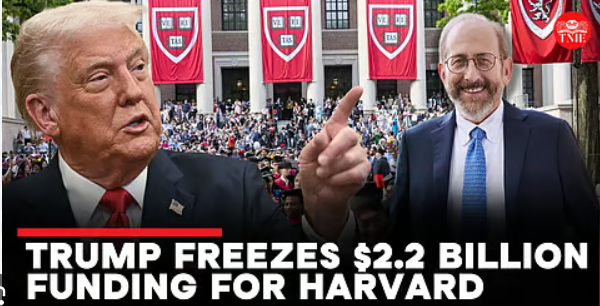
In recent days, the Trump administration froze more than USD 2.3 billion in federal funding to Harvard University, escalating a broader campaign against elite American universities. Predictably, some claimed it was an attack on academic freedom. The decision, made by a Justice Department-backed antisemitism task, marks the most aggressive action yet in a months-long effort to enforce ideological reforms across higher education.
More than 60 institutions — from Harvard to Columbia to Cornell, Princeton to the University of Pennsylvania — are facing federal investigations, funding suspensions, or intense scrutiny. The administration’s stated goal is to crack down on antisemitism, restore “intellectual rigour,” and root out “ideological capture,” the media reported.
The backlash has also been swift. University leaders, civil liberties groups, and legal scholars argue the government is overreaching and weaponizing civil rights law to impose Republican political control on academia.
On April 14, the antisemitism task force announced it was suspending USD 2.2 billion in grants and USD 60 million in contracts to Harvard University because of its refusal to comply with a series of sweeping federal demands
These demands, outlined in a five-page letter to Harvard President Alan Garber, included: Eliminating Diversity, Equity, and Inclusion (DEI) programmes, banning face coverings during campus protests, implementing merit-based hiring and admissions, cooperating fully with immigration enforcement, denying recognition to student groups accused of illegal activity or harassment, and submitting to an external audit of departments suspected of ideological bias.
The Harvard chief responded sharply, calling the demands politically motivated and “an infringement on academic freedom.”
While the administration insists the crackdown is based on civil rights enforcement, its scope has extended far beyond antisemitism. In practice, universities are being asked to overhaul hiring practices, protest policies, curriculum oversight, and immigration cooperation.
Many targeted institutions are located in traditionally liberal states or Democratic strongholds. The list of federal demands frequently mirrors broader Republican policy goals: eliminating DEI programmes, limiting student protests, and promoting merit-based systems over affirmative action-style admissions.
The clash is rapidly becoming a rallying point against what critics describe as Trump’s heavy-handed approach to governance. Former President Barack Obama backed Harvard’s stance, calling it a model for defending academic independence. However, others warn the university may be exposing itself to considerable risk.
President Trump has also launched a ‘war’ on wokeism. Addressing the House of Representatives in March, he argued that professions such as doctors, accountants, lawyers, and air traffic controllers should see hiring and promotion decisions based on skills and competence, rather than on race or gender. Wokeness caused problems and was harmful, he said, claiming that its removal had left the country feeling “so much better.”
Throughout his campaign trail and the initial weeks of his presidency, Trump held firm in his opposition to so-called woke ideology. He swiftly moved to dismantle a series of Diversity, Equity and Inclusion (DEI) initiatives that had been embedded across educational institutions and various industries.
His predecessor, Joe Biden, since 2016, had consistently supported campaigns opposing such frameworks in schools, businesses, and the military — many of which have been labelled by sections of the conservative public as discriminatory against white Americans.
So, Harvard University, already short of USD 2.3 billion, now risks an overall funding of USD 9 billion. For now, it has tried to raise funds worth USD 750 million via bonds to enhance financial flexibility.
Columbia University, however, quickly complied with federal directives to avoid funding loss of USD 400 million, made changes in the oversight of Middle Eastern studies, framed stricter protest rules, and enhanced campus security. But its Interim President Katrina Armstrong resigned in April.
Brown University, risking USD 510 million for its alleged failure to address antisemitism, has not publicly disclosed its response.
Cornel University, risking USD 1 billion, has made no official comment, saying discussions are going on with federal agencies.
The Northwestern University, risking USD 790 million, has claimed that existing antisemitism measures were in place.
University of Pennsylvania has found its USD 175 million of funds suspended because of a 2022 controversy involving a transgender athlete, not antisemitism. Research in seven of its departments, including drug testing and quantum computing, have disrupted.
Princeton University is risking USD 210 million and dozens of grants have been suspended.
The Cornell and Johns Hopkins Universities have reported fund-cuts or freezes.
Other key institutions, including UC Berkeley, UCLA, NYU, USC, George Washington University are currently under investigation.
Legal experts argue the Trump administration is testing the limits of federal control over universities. Civil liberties organisations and academic bodies have filed lawsuits, asserting that Title VI of the Civil Rights Act — meant to prevent discrimination in federally-funded institutions — is being used to advance political objectives.
Despite growing legal challenges, however, the Trump administration has shown no signs of slowing down. More than 60 universities remain under active review, and officials say they will continue using federal funding as leverage to push ideological reforms.
With billions of dollars at stake, institutions now face a stark choice: comply or risk severe financial strain. But behind the legal and financial battles lies a deeper ideological conflict — whether American higher education should remain a space for open inquiry, or be reshaped by federal mandate.