


Virendra Pandit
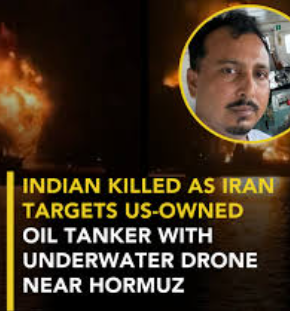
New Delhi: An Indian sailor was killed and several others injured after their wooden dhow caught fire near the Strait of Hormuz, the media, quoting government sources, said on Saturday.
Seventeen other Indian crew members were rescued after the incident on Friday, they said, adding the exact cause of the blaze is still being ascertained. They were rescued by a vessel passing by in the area.
The incident came amid increasing hostilities between Iran and the US in the Strait of Hormuz, a vital maritime chokepoint between the Persian Gulf and the Gulf of Oman through which a fifth portion of the world’s oil supply passed before the war broke out.
“A wooden dhow, carrying general cargo, with 18 Indian crew capsized yesterday close to the Strait of Hormuz after it caught fire,” the report said.
In this incident, one Indian on the dhow died while four received burn injuries. The injured are receiving medical treatment in Dubai and are safe. Officials from the Indian Consulate in Dubai met the rescued Indian nationals last night. The consulate is also in touch with the dhow owner and is extending all possible assistance, the sources said.
The Iran war
Despite multiple efforts, and amid an uneasy ‘ceasefire’ violated several times, the US and Iran failed to end their ongoing 70-day-long war. They continued to trade fires intermittently.
A US intelligence analysis concluded Tehran could withstand a naval blockade for months. The US had imposed this naval blockade on April 8 to prevent the export of Iranian oil; on its part, even Iran has ‘blocked’ the passage of vessels through the Strait of Hormuz, although some ships were allowed with permission and others after paying a toll.
The US has been awaiting Iran’s response to an American proposal that would formally end the war before talks on more contentious issues, including Iran’s nuclear program. Speaking in Rome on Friday, Secretary of State Marco Rubio said the US was expecting a response that day, although an Iranian foreign ministry spokesperson said Tehran was still weighing its response.
Sporadic clashes continued on Friday between Iranian forces and US vessels in the Strait of Hormuz, Iran’s semi-official Fars news agency reported. Another news outlet, Tasnim news agency later cited an Iranian military source saying the situation had calmed but warned that more clashes were possible.
The US military said it struck two Iran-linked vessels attempting to enter an Iranian port, with a US fighter jet hitting their smokestacks and forcing them to turn back.
Blockade
Despite a US naval blockade, a CIA assessment indicated Iran would not suffer severe economic pressure from a US blockade of Iranian ports for about another four months.
A senior intelligence official characterised as false the “claims” about the CIA analysis, first reported by the Washington Post.
Clashes extended beyond the waterway. The UAE said its air defences engaged with two ballistic missiles and three drones from Iran on Friday, with three people sustaining moderate injuries.
Iran has repeatedly targeted the UAE and other Gulf states that host US military bases. In what the UAE called a major escalation, Iran stepped up attacks this week in response to Trump’s announcement of “Project Freedom” to escort ships in the strait, which he paused after 48 hours under pressure from Saudi Arabia and others, fearing more Iranian attacks.
Trump claimed on Thursday that the ceasefire, announced on April 7, was still holding despite repeated flare-ups, while Iran accused the US of breaching it.
“Every time a diplomatic solution is on the table, the US opts for a reckless military adventure,” Foreign Minister Abbas Araqchi said on Friday. Iran’s Mehr news agency reported that one crew member was killed, 10 wounded and six missing after a US Navy attack on an Iranian commercial ship late on Thursday.
The US has found little international support in the conflict. After meeting with Italian Prime Minister Giorgia Meloni, Rubio questioned why Italy and other allies were not backing Washington’s efforts to reopen the strait, warning of a dangerous precedent if Tehran were allowed to control an international waterway.
While pursuing diplomacy, the US also ratcheted up sanctions to pressure Iran.
Trump-Xi summit
Days before Trump travels to China to meet President Xi Jinping on May 14 and 15, the US Treasury on Friday announced sanctions against 10 individuals and companies, including several in China and Hong Kong, for aiding efforts by Iran’s military to secure weapons and raw materials used to build Tehran’s Shahed drones.
Treasury said it was prepared to act against any foreign company supporting illicit Iranian commerce and could impose secondary sanctions on foreign financial institutions including those connected to China’s independent oil refineries.
Internet blackout
Iran’s record internet blackout is taking a heavy toll on private businesses, with owners and industry officials warning that it could lead to mass layoffs and closures, the media reported on Saturday.
The Islamic Republic imposed heavy restrictions on the internet after Israel and the US started their war on the country on February 28, having earlier blocked online access during nationwide protests the previous month. That move helped obscure international visibility of a violent crackdown in which thousands of civilians were reported killed.
Now more than 70 days long, the ongoing Internet outage represents “the longest recorded national internet shutdown in a connected society,” according to global internet monitor, Netblocks, which estimates that the restrictions have cost Iran’s economy more than USD 2.6 billion.
“The wave of job cuts, the economic shock and the recession that we’re now seeing is mainly because of the digital siege, not the bombs,” said the owner of a Tehran clothing business which employs nearly 60 people.
Iran’s leading financial newspaper, Donya-e Eqtesad, likened the damage to a “silent earthquake” that’s crippling the economy as much as the US and Israeli airstrikes. It put the cost to the Iranian economy at more than four quadrillion rials, nearly USD 2.5 billion, according to open-market currency prices.
“There is a great impact, not just to Iran’s digital economy but also more widely, including irregular segments of the economy, independent trade and off-the-books business,” Alp Toker, the founder of Netblocks, said.
Iran has been gripped by successive economic crises since US President Donald Trump initiated a policy of severe sanctions during his first term, to force the Islamic Republic into concessions over its nuclear, foreign and domestic policies. A major collapse in the rial triggered the recent demonstrations and the subsequent near-total internet ban has played havoc with people’s lives, disrupting work and study and effectively isolating a population of 90 million people with a smartphone penetration rate of 134 per cent.
The ban is driving a “huge wave” of unemployment. Industry officials warned last month that the outage is costing Iranian businesses up to USD 40 million a day.
Iranian internet users have lived with online restrictions for years and virtual proxy networks, which are used to bypass the bans, are ubiquitous throughout the population, including among government officials. State institutions promote the use of so-called official VPNs to bypass those that are downloaded from servers outside the country.
Bans on popular social-media sites have been in force since the 2009 re-election of hardline populist Mahmoud Ahmadinejad, which triggered widespread protests that were violently shut down by security forces. Restrictions on applications like WhatsApp, Instagram and Telegram have also been imposed, particularly when there’s unrest or during crises like the current war.