


Virendra Pandit
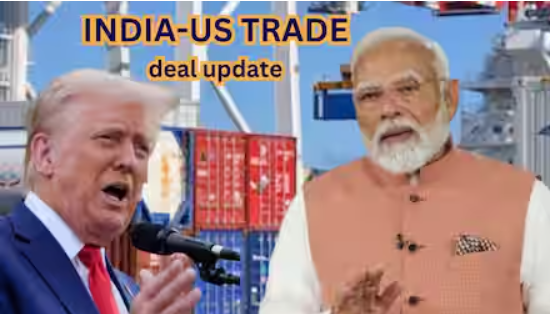
New Delhi: With President Donald Trump and Prime Minister Narendra Modi reaffirming their commitment to a mutually beneficial, balanced trade relationship, ensuring benefits for exporters and workers, the US and India are heading to ink an interim government soon, the media reported on Tuesday.
Under the bilateral deal, India will reduce tariffs on US industrial and select agricultural products, including pulses, soybean oil, wine, and spirits. Both countries aim to increase trade, with India committing to purchase over USD 500 billion in US goods, including energy and technology products, the White House was quoted as saying.
In the coming weeks, the two countries will work toward finalising the interim agreement on trade with a view to concluding a mutually beneficial Bilateral Trade Agreement (BTA), it said.
They will also continue negotiations to address the remaining issues, including services and investment, labour and government procurement.
Days after India and the US announced in a joint statement the framework for an Interim Agreement regarding reciprocal and mutually beneficial trade, the White House issued a factsheet on ‘The United States and India Announce Historic Trade Deal (Interim Agreement).’
Tariff reductions
It highlights key terms of the agreement, including that India will eliminate or reduce tariffs on all US industrial goods and a wide range of US food and agricultural products.
This includes dried distillers’ grains, red sorghum, tree nuts, and fresh and processed fruit. certain pulses, soybean oil, wine and spirits, and additional products and that India has committed to buy more American products and purchase over USD 500 billion worth of US energy, information and communication technology, agricultural, coal, and other products.
The path ahead
On the ‘Prosperous Path Forward’, the factsheet said that President Trump continues to advance the interests of the American people, enhancing market access for American exporters and lowering tariff and non-tariff barriers to protect our economic and national security.
“India has maintained some of the highest tariffs on the United States of any major world economy, with tariffs as high as an average of 37 percent for agricultural goods and more than 100 percent on certain autos. India also has a history of imposing highly protectionist non-tariff barriers that have banned and prohibited many US exports to India,” the factsheet said.
The framework
“In the coming weeks, the United States and India will promptly implement this framework and work toward finalising the Interim Agreement with a view to concluding a mutually beneficial BTA to lock in benefits for American workers and businesses,” it said.
The announcement provides a “tangible path forward” with India that underscores the President’s dedication to realising balanced, reciprocal trade with an important trading partner.
Remaining issues
Besides, it added that in line with the roadmap set out in the terms of reference for the BTA, the two countries will “continue negotiations to address the remaining tariff barriers, additional non-tariff barriers, technical barriers to trade, customs and trade facilitation, good regulatory practices, trade remedies, services and investment, intellectual property, labour, environment, government procurement, and trade-distorting or unfair practices of state-owned enterprises.”
It said India will address non-tariff barriers that affect bilateral trade in priority areas.
The US and India will negotiate rules of origin that ensure that the agreed benefits accrue predominantly to the two countries.
India will remove its digital services taxes and has committed to negotiate a robust set of bilateral digital trade rules that address discriminatory or burdensome practices and other barriers to digital trade, including rules that prohibit the imposition of customs duties on electronic transmissions.
Tech cooperation
The US and India committed to strengthening economic security alignment to enhance supply chain resilience and innovation through complementary actions to address non-market policies of third parties as well as cooperating on inbound and outbound investment reviews and export controls, it said, adding that the two countries will significantly increase bilateral trade in technology products and expand joint technology cooperation.
It noted that last Friday (February 6), Trump announced the trade deal with India that will open up the country’s market of over 1.4 billion people to American products.
Leaders’ consultations
The joint statement follows a call between Trump and Prime Minister Narendra Modi last week, “in which the two leaders reached a framework for an Interim Agreement on reciprocal trade and reaffirmed their commitment to broader US-India Bilateral Trade Agreement (BTA) negotiations.”
It noted that Trump agreed to remove the additional 25 percent tariff on imports from India in “recognition of India’s commitment to stop purchasing” Russian oil. Accordingly, the President signed an Executive Order last Friday removing that additional 25 percent tariff.
“Given India’s willingness to align with the United States to confront systemic imbalances in the bilateral trade relationship and shared national security challenges, the United States will lower the Reciprocal Tariff on India from 25 percent to 18 percent.