


Virendra Pandit
New Delhi: Aggressively expanding its global trade footprint and weeks after signing trade deals with the UK, the UAE, and New Zealand, the Narendra Modi government on Tuesday successfully inked the “Mother of All (Trade) Deals” with the European Union (EU) that may prompt the long-awaited bilateral trade agreement (BTA) with the USA also this year.
After nearly two decades of on-and-off negotiations, India and the EU finally clinched a landmark Free Trade Agreement (FTA) — hailed by leaders as the “Mother of All Trade Deals” — which will boost exports of labour-intensive Indian goods with tariff elimination or reduction on 99.5 percent of exports, the media reported.
In return, the deal opens the vast Indian markets to a wide range of goods from the 27-nation EU, including high-end automobiles, wines, chocolates, medical equipment and pharmaceuticals.
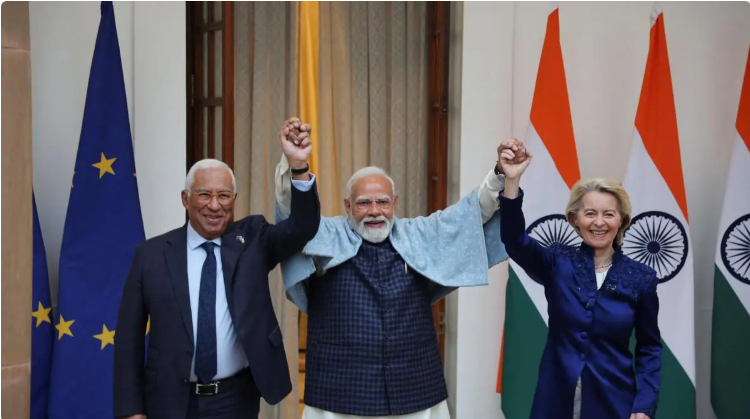
“We did it. We delivered the mother of all deals. This is a tale of two giants that sealed a partnership in a true win-win manner …it will build on natural complementarities,” said EU President Ursula von der Leyen after the India-EU Summit with Prime Minister Narendra Modi on Tuesday.
By combining mutual strengths, strategic dependencies were being reduced when trade was increasingly weaponised, she remarked.
European Council President Antonio Costa also participated in the high-stakes meeting.
The deal came through a day after the two European leaders participated in India’s 77th Republic Day Parade in New Delhi as chief guests.
PM Modi hailed the pact as the biggest FTA in India’s history. “This will boost investments, form new innovation partnerships and strengthen supply chains at the global level. This is not just a trade agreement; it is a blueprint for shared prosperity,” he said.
Highlighting the scale of the deal, he said it represented 25 percent of global GDP and one-third of global trade.
Mobility, security deals
Two other significant documents signed at the Tuesday summit include the conclusion of the India‑EU Comprehensive Framework of Cooperation on Mobility and the India–EU Security and Defence Partnership.
The mobility deal will ease movement of students, high-skilled workers and researchers. The security and defence partnership strengthens dialogue and cooperation in security and defence, including maritime security, defence industry and technology, cyber and hybrid threats, space and counterterrorism, according to an EU statement.
Market access
The EU has offered “unprecedented” market access to India on 99.5 percent of goods, including textiles, garments, footwear, chemicals, gems and jewellery, furniture, toys and sports goods, based on trade value, with zero tariffs on 90 percent of goods. Zero duties will be extended to 93 percent of goods from India in seven years and another 6 percent will face reduced tariffs or tariff rate quotas.
India, too, will open up its vast market for EU members for about 97 percent of goods (based on trade value) including a range of products such as automobiles, wines, chocolates, biscuits, iron and steel, medical equipment and pharmaceuticals. “We start with zero duties on 30 percent of trade value on day one and go down to 93 percent on tenth year. We also give quota reduction in 3.7 percent,” an official said.
India secured a big win in the services sector with a future-ready mobility framework that will help expand global opportunities for skilled Indian professionals, Union Commerce and Industry Minister Piyush Goyal said.
As part of the FTA, the EU has promised student visas without any caps and some flexibilities in post-work visas.
“This deal is a gateway to the future, enabling India to create high-value jobs, drive innovation, and firmly cement its position as a globally competitive hub for talent and sustainable economic growth,” Goyal said.
There has been, however, no concessions or flexibilities on the imposition of the EU’s carbon tax legislation–Comprehensive Border Adjustment Mechanism–on affected Indian goods, including steel and aluminium.
“The EU position is that it offers no flexibilities to any country on the CBAM legislation. In case flexibilities are offered to other countries in the future, the same may be extended to India,” an official explained.