


Virendra Pandit
New Delhi: Before annexing a “pro-China” Venezuela in January 2026 and capturing its President Nicolas Maduro and his wife, Donald Trump plotted meticulously against the Latin American strongman, indicting him in alleged narco-terrorism cases, running covert operations against him, and more.
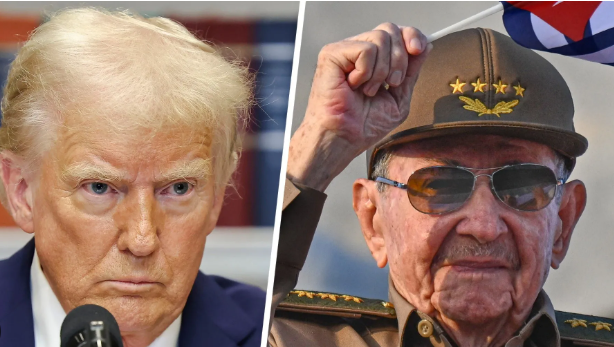
Now, following the same script, the Trump administration has accused former Cuban leader Raúl Castro, a nonagenarian, with “conspiracy to kill” US nationals and other crimes over the 1996 downing of two planes between Cuba and Florida, the media reported on Thursday.
Trump appears to be currently focusing on Cuba, the ‘low-hanging fruit,’ to make it the USA’s 51st state, instead of Canada which has, for now, been put on the backburner, in the broader Washington geopolitical strategy to shield the Western Hemisphere from China.
He also blocked the flow of Venezuelan energy flow to the Communist-run Cuba to force it to surrender to the US. Cuban strongman Fidel Castro’s younger brother, Raul also served as Cuba’s President from 2008 to 2018.
On Wednesday, the US Department of Justice unsealed an indictment charging Raúl Castro with murder, destruction of aircraft, and conspiracy to kill US nationals. This stems from the February 1996 incident where Cuban military jets shot down two unarmed civilian planes operated by the exile group Brothers to the Rescue. Raul Castro then headed Cuban armed forces and faced international condemnation over the February 1996 crash.
As the US seeks to exert increasing pressure on Cuba’s Communist rule, current President Miguel Díaz-Canel called the charges “a political manoeuvre, devoid of any legal foundation.”
The US Justice Department’s new charges take aim at a key figurehead of Cuba’s communist leadership when it is facing intense US pressure to make significant political and economic reforms to its one-party rule there.
Washington issued sanctions on Havana and imposed a blockade on oil to Cuba that has resulted in blackouts and food shortages.
Marco Rubio
Trump has for months been dropping broad hints that he would send his Secretary of State Marco Rubio, whose parents immigrated from Cuba to the USA in 1956, as the next Cuban leader. He has repeatedly discussed US’s Cuban strategy, stating that he will send Rubio to handle negotiations with the island nation, for a potential “friendly takeover,” and claimed that Cuba’s Communist regime is collapsing due to profound economic hardships.
Earlier on Wednesday, Rubio issued a message to the Cuban people timed to the country’s “Independence Day.” “President Trump is offering a new path between the US and a new Cuba,” he said.
He told citizens of the island that a Cuban military-run conglomerate known as GAESA is primarily responsible for the blackouts and food shortages that the country continues to endure. Like the Pakistan Army, GAESA owns or operates most of the lucrative parts of the Cuban economy from the ports to the petrol pumps to five-star hotels.
In response to Rubio’s message, Díaz-Canel accused the US of lying and imposing a collective punishment on the Cuban people.
The Cuban President also said that the indictment of Raul Castro was being used to “justify the folly of a military aggression against Cuba” and accused the US of distorting the facts around the downing of the plane, the BBC reported.
He claimed that Cuba’s 1996 act was in “legitimate self-defence within its jurisdictional waters.”
In January, the US staged a quiet, midnight ‘military operation’ to seize former Venezuelan President Nicolás Maduro and bring him to the US, after the justice department indicted him.
Nearly 95 years old, Raul, the brother of late charismatic Cuban leader Fidel Castro, remains an influential figure, acknowledged on the island as the surviving “leader of the Cuban Revolution.”
He has relinquished his active government and party roles, but during his 2008-2018 presidency, he and former US president Barack Obama presided over a short-lived thaw in Washington-Havana relations.
The Cuban Americans
The Miami centre where US officials announced the indictment of Raúl Castro was full of Cuban Americans, mostly representing Cuban exile organisations that have for decades led opposition of the Cuban government from within the United States.
US and Cuban representatives, including Raúl Castro’s grandson Raúl Guillermo Rodriguez Castro, have held “conversations” in recent months, but US charges against the former president are unlikely to smooth these contacts.
On the contrary, the Cuban side showed signs of further entrenching into its “no surrender, no concessions” position against US pressure, with Cuban state media outlets blasting what they called the “false accusations”.