


Virendra Pandit
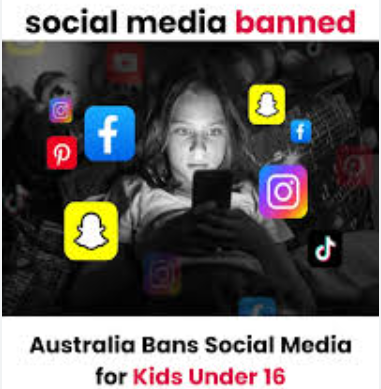
New Delhi: Australia has become the world’s first country to legally ban use of social media for children under 16 years of age from Wednesday, blocking access to platforms including TikTok, Alphabet’s YouTube and Meta’s Instagram and Facebook.
Ten of the biggest platforms were ordered to block children from midnight (1300 GMT on Tuesday) or face fines of up to A$49.5 million (USD 33 million) under the new law, which drew criticism from major technology companies and free speech advocates, but was welcomed by parents and child advocates, the media reported on Wednesday.
Prime Minister Anthony Albanese called it “a proud day” for families and cast the new law as proof that policymakers can curb online harms that have outpaced traditional safeguards.
Following in Australia’s footsteps, many countries from Denmark to New Zealand to Malaysia have signalled they may study or emulate the Australian model, making the country a test case for how far governments can push age-gating without stifling speech or innovation.
“This is the day when Australian families are taking back power from these big tech companies,” he told a media outlet.
“New technology can do wonderful things but we need to make sure that humans are in control of our own destiny and that is what this is about,” Albanese said.
In a video message Albanese will urge school children to “start a new sport, new instrument, or read that book that has been sitting there for some time on your shelf,” ahead of Australia’s summer school break starting later this month.
The rollout caps a year of debate over whether any country could practically stop children from using platforms embedded in daily life, and begins a live test for governments worldwide frustrated that social media firms have been slow to implement harm-reduction measures.
“It’s not our choice – it’s what the Australian law requires,” X said on its website.
“X automatically offboards anyone who does not meet our age requirements.”
Australia said the initial list of covered platforms would change as new products emerge and young users migrate.
Social media firms have told Canberra they will deploy a mix of age inference – estimating a user’s age from their behaviour – and age estimation based on a selfie, alongside checks that could include uploaded identification documents or linked bank account details.
For social media businesses, the implementation marks a new era of structural stagnation as user numbers flatline and time spent on platforms shrinks, studies show.
Platforms say they earn little from advertising to under-16s, but warn the ban disrupts a pipeline of future users. Just before the ban took effect, 86 percent of Australians aged eight to 15 years used social media, the government said.
Australia’s ban, which came into effect from midnight local time, targets 10 major services, including Alphabet’s YouTube, Meta’s Instagram, ByteDance’s TikTok, Reddit, Snapchat, and Elon Musk’s X.
The controversial rule requires these platforms to take “reasonable steps” to prevent underage access, using age–verification methods such as inference from online activity, facial estimation via selfies, uploaded IDs, or linked bank details.
All targeted platforms had agreed to comply with the policy to some extent. Elon Musk’s X had been one of the last holdouts, but signalled on Wednesday that it would comply.
The policy means millions of Australian children are expected to have lost access to their social accounts.
However, the impact of the policy could be even wider, as it will set a benchmark for other governments considering teen social media bans, including Denmark, Norway, France, Spain, Malaysia and New Zealand.
Ahead of the legislation’s passage last year, a YouGov survey found that 77 percent of Australians backed the under-16 social media ban. Still, the rollout has faced some resistance since becoming law.
Supporters of the bill have argued it safeguards children from social media-linked harms, including cyberbullying, mental health issues, and exposure to predators and pornography.
Among those welcoming the official ban on Wednesday was Jonathan Haidt, social psychologist and author of The Anxious Generation, a 2024 best-selling book that linked a growing mental health crisis to smartphone and social media usage, especially for the young.
In a post on social media platform X, he hailed policymakers in Australia for “freeing kids under 16 from the social media trap.”
“There will surely be difficulties in the early months, but the world is rooting for your success, and many other nations will follow,” he added.
On the other hand, opponents contend that the ban infringes on freedoms of expression and access to information, raises privacy concerns through invasive age verification, and represents excessive government intervention that undermines parental responsibility.
Those critics include groups like Amnesty Tech, which said on Tuesday that the ban was an ineffective fix that ignored the rights and realities of younger generations.
“The most effective way to protect children and young people online is by protecting all social media users through better regulation, stronger data protection laws and better platform design,” said Amnesty Tech Programme Director Damini Satija.
Meanwhile, David Inserra, a fellow for free expression and technology at the Cato Institute, warned that children would evade the new policy by shifting to new platforms, private apps like Telegram, or VPNs, driving them to “more isolated communities and platforms with fewer protections” where monitoring is harder.
Tech companies like Google also warned that the policy could be extremely difficult to enforce, while government-commissioned reports have pointed to inaccuracies in age–verification technology, such as selfie-based age–guessing software.
On Wednesday, local reports in Australia indicated that many children had already bypassed the ban, with age-assurance tools misclassifying users, and workarounds such as VPNs proving effective.
However, Prime Minister Albanese had attempted to pre-empt these issues, acknowledging in an opinion piece on Sunday that the system would not work flawlessly from the start, likening it to liquor laws.
“The fact that teenagers occasionally find a way to have a drink doesn’t diminish the value of having a clear national standard,” he added.
The rollout is expected to face challenges and that regulators would need to take a trial-and-error approach.
The policy rollout will be closely watched by tech firms and lawmakers worldwide, as other countries consider their own moves to ban or restrict teen social media usage.
The European Parliament passed a non-binding resolution in November advocating a minimum age of 16 for social media access, allowing parental consent for 13 to 15-year-olds.
The bloc has also proposed banning addictive features such as infinite scrolling and auto-play for minors, which could lead to EU-wide enforcement against non-compliant platforms.
Outside Europe, Malaysia and New Zealand have also been advancing proposals to ban social media for children under 16.
However, laws elsewhere are expected to differ from Australia’s, whether that be regarding age restrictions or age verification processes.