


Virendra Pandit
New Delhi: Watching France, Britain, Italy and other European countries’ changed demography because of a huge influx of Muslims from West Asia and other areas, Denmark, which has already banned the burqa, is planning to ban azaan, the morning Islamic call to prayers in the mosques, the media reported on Friday.
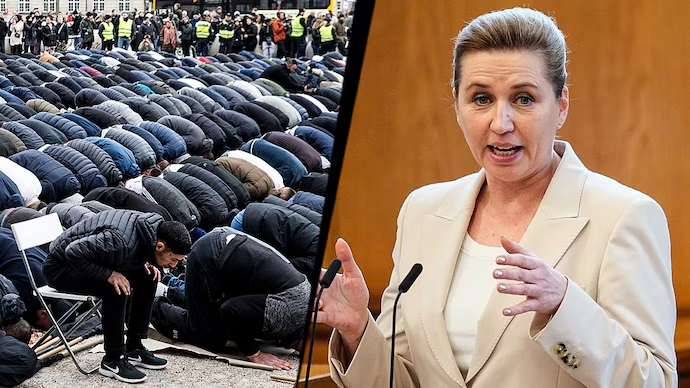
Fearing that parts of Denmark could turn into a “suburb of Islamabad,” the North European country has revived plans for a nationwide ban on the Islamic call to prayer. The move comes months after it outlawed the Islamic full-face veil in public spaces. The proposal comes amid concerns over growing Islamisation in Denmark.
Denmark has been pursuing some of Europe’s toughest immigration policies under Prime Minister Mette Frederiksen,
According to The Daily Mail, amid growing anxieties over ‘Islamisation’ in the country, Denmark’s hardline immigration minister Morten Bodskov emphasised that parts of the country have come to feel like “a suburb of Islamabad.”
In unusually blunt remarks, Bodskov told Danish news agency Ritzau that creeping “Islamization” in Denmark was taking up too much public space. Muslims account for around 5 per cent of Denmark’s population, making them the largest minority community. “The call to prayer should not be heard over Danish rooftops,” the Leftist leader of the Social Democrats party said.
Earlier this year, Denmark passed a law banning burqa, the Islamic full-face veil, in public spaces, and also directed educational institutions to remove prayer rooms.
“It has no place in Denmark, and you shouldn’t be in any doubt whether you have ended up in a suburb of Islamabad when you walk around Denmark,” Bodskov further said.
Such a proposal, however, is not new. Denmark has previously tried, in 2020 and 2025, to enact a law banning the azaan in public places. However, the proposal never moved to the Parliament stage.
However, parts of the European country already restrict public calls to prayer. For example, in Copenhagen, strict noise regulations prevent mosques from broadcasting the azaan through loudspeakers. The Grand Mosque of Copenhagen does not conduct an outdoor call to prayer.
However, a nationwide ban on a religious practice outright is likely to invite legal challenges. Denmark’s Constitution protects the right to public worship, and such a move is bound to raise concerns of violation of fundamental protections.
Bodskov said the government would first investigate whether the Muslim call to prayer can be outlawed nationwide, while remaining compatible with constitutional safeguards for religious freedom.
Critics have argued that the proposal targeted one faith disproportionately and warned that it could infringe on religious liberty. In recent years, anti-immigrant sentiment across Europe has reached an alarming high. Islamic practices like azaan and the wearing of hijab have also drawn scrutiny.
In fact, for the past few years, Islamophobia has become a polarising topic in Denmark, often intertwining with narratives and policies on immigration.
In 2023, anti-Islam activists in Denmark burned and damaged several copies of the Quran, the Muslim holy book, triggering international uproar. Amid global pressure, Denmark brought in a law banning the burning of religious scriptures.