


Virendra Pandit
New Delhi: A day after Pakistan ruled out joining the “Abraham Accords 2.0”, US Senator Lindsey Graham, a close President Donald Trump ally, questioned the South Asian country’s commitment to brokering peace between the United States and Iran.
Islamabad, which Trump asked to mediate between Washington and Tehran, unambiguously rejected the US President’s fresh demand that it, along with some other Muslim nations, sign the Abraham Accords, and formally recognize as a precondition to take the potential US-Iran peace deal forward.
Pakistan’s Defence Minister Khawaja Asif said that he was against Islamabad joining the Trump-brokered Abraham Accords, which deal with establishing diplomatic, economic and security ties between Israel and Muslim nations.
Despite being in the tricky position of staying in the US’s good books and refusal to recognise Israel since its inception, Asif made it clear that compromising on Pakistan’s “fundamental ideologies” was unacceptable.
“How will you sit down with those people whose word cannot be trusted even for a single day?” he asked in an interview with Samaa TV, taking a swipe at Israel.
In response, Graham pointed out that, given Islamabad’s “long-standing animosity” for Israel, it was less than wise to trust it with mediating an end to hostilities in West Asia.
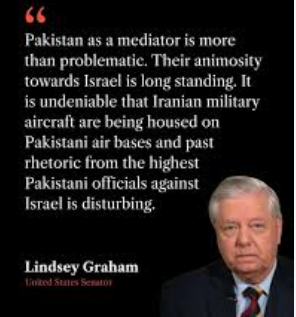
“It has been apparent to me for quite a while that Pakistan as a mediator is more than problematic. Their animosity towards Israel is long-standing,” he wrote on X.
“As to the defence minister’s comments about the Abraham Accords, saying that Pakistan would never join because they don’t trust Israel: The clip may be a year old, but I fear the sentiment is fresh,” the South Carolina senator said.
Amid doubts about Pakistan’s neutrality, Graham pushed it to clarify its stance on the Abraham Accords.
“In that regard, it is imperative that Pakistan give an answer now to President Trump’s call to join the Abraham Accords,” he added.
He said it is undeniable that Iranian military aircraft were being housed on Pakistani air bases and past rhetoric from the highest Pakistani officials against Israel was disturbing.
Graham was alluding to a recent CBS report revealing that Iranian military aircraft had quietly landed inside Pakistan during the conflict. According to report, several Iranian aircraft arrived at Nur Khan Airbase in Rawalpindi shortly after Trump announced a ceasefire on April 8.
One of the aircraft was reportedly an Iranian Air Force RC-130 reconnaissance plane used for intelligence and surveillance missions. The report suggested the aircraft may have been kept on Pakistani soil to reduce the risk of being targeted in potential US or Israeli strikes during the war.
After the report came out, Graham had taken aim at Pakistan, saying there was a need for “a complete re-evaluation” of its role as mediator in the peace talks.
Islamabad had denied this exposure as “misleading and sensationalised,” and reaffirmed its commitment to facilitating dialogue and de-escalation between the US and Iran.