ONOE: Former CJIs Raise Concern over giving Unbridled Powers to ECI to Hold Simultaneous Elections

Manas Dasgupta
NEW DELHI, July 11: At least two former chief justices of India have voiced concern over giving unbridled powers to the Election Commission of India in implementing the One Nation, One Election (ONOE) system.
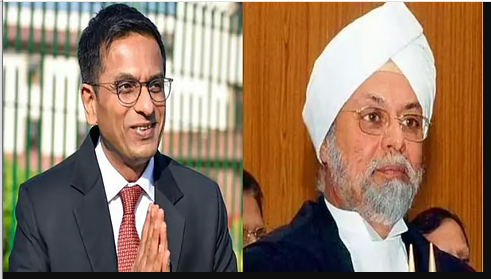
Official sources on Friday said former CJIs DY Chandrachud and JS Khehar told a Joint Parliamentary Committee (JPC) tasked with reviewing the One Nation, One Election (ONOE) Bill that the Election Commission (EC) should not be given unbridled powers proposed in the constitutional amendment law. They also suggested a “system of checks and balances.”
Both jurists urged the committee to reconsider the proposal to expand the ECI’s authority, warning that unchecked powers could disturb the institutional balance and require more robust safeguards. Earlier, another former Chief Justice Ranjan Gogoi had also questioned the “sweeping powers” granted to the poll body in the proposed constitutional amendment law.
Justices Chandrachud and Khehar appeared as key witnesses before the JPC and offered detailed insights into the legal and constitutional aspects of the proposed legislation. The panel, chaired by senior BJP MP and former Union Minister PP Chaudhary, heard from the two former CJIs, both of whom acknowledged the bill’s overall constitutional validity in principle, but raised concerns about certain provisions that they said warranted further scrutiny and refinement.
Both the former Chief Justices shared their observations and gave a presentation on the simultaneous elections at the meeting of the JPC, which is examining the Constitution (One Hundred and Twenty-Ninth Amendment) Bill, 2024 and the Union Territories Laws (Amendment) Bill, 2024. The Joint Committee of Parliament has been speaking to jurists and legal experts as it prepares its recommendation on the bill that aims to conduct simultaneous elections to the legislative assemblies in the states and the Parliament.
Sources said both Justices Chandrachud and Khehar suggested to the committee that there should be an “oversight mechanism” on the conduct of elections. One of the judges also said a five-year term for an elected government was important for Good Governance and that “this (five-year term) should not be curtailed under any circumstances.” Justice Chandrachud had said in the past that the ability of the government to take on any meaningful project would be minimised if its tenure was only a year or less, as the Model Code of Conduct will come into force around six months before the next polls.
“As far as the provision of the Election Commission is concerned, if we feel that the bill needs amendment, we will amend it,” said Mr Chaudhary on the former Chief Justices’ suggestions, adding, “We will send our report to the Parliament only after making amendments in the national interest.” He also insisted that “One Nation, One Election system is necessary for nation-building.
“It is important that the constitutionality of the bill remains intact so that this system continues for the next hundreds of years,” Mr Chaudhary added. Two other former Chief Justices of India, UU Lalit and Ranjan Gogoi, have appeared before the committee in past. Friday was the committee’s eighth sitting.
Several opposition leaders have criticised the proposed bill, saying the synchronisation of Lok Sabha and state assembly polls violates the Constitution’s basic structure. However, the jurists who have appeared before the committee have dismissed this criticism, saying the Constitution never mandated holding national and state elections separately.
Sources said the former judges pointed out that several clauses in the bill were vaguely worded and open to multiple interpretations. Justice Khehar reportedly emphasised that such ambiguities should not be left to the courts to resolve, but must instead be clarified by Parliament through precise legislative language.
Justice Khehar further elaborated on the technical elements of the bill. He noted that the primary objective of the ONOE proposal was to synchronise Lok Sabha and State Assembly elections and that this did not, in itself, disturb the constitutional framework. Citing Article 82A(1), he clarified that it merely set the date for constituting a new Lok Sabha and did not interfere with the conduct or duration of elections. Addressing concerns around curtailed tenures of state assemblies in cases of early dissolution, he explained that the bill ensured voter transparency by mandating the Election Commission to notify the exact term of the House being elected, making the electorate fully aware of the shortened tenure.
Justice Khehar also highlighted that Article 83(2) of the Constitution contains the phrase “unless sooner dissolved,” which makes it clear that the five-year tenure of legislatures was not sacrosanct. In this context, he argued that a shortened or even extended term would not violate the Constitution’s basic structure. He suggested that the bill’s language be refined to minimise legal ambiguity and avoid potential judicial misinterpretation. On the question of whether the ONOE proposal would reduce state legislatures to a subordinate status in relation to Parliament, Khehar firmly rejected the notion, asserting that the bill did not infringe upon the distinct powers and responsibilities of state assemblies and the central legislature.
Justice Chandrachud expressed support for the concept of simultaneous elections, clarifying that asynchronous (non-simultaneous) elections are not a criterion for free and fair elections, and therefore did not form part of the Constitution’s basic structure. He noted that the original constitutional framework envisioned simultaneous elections in the early years of the Republic. He further stated that the right of voters to choose their representatives was not compromised even if the tenure of a House or Assembly was less than five years.
Addressing concerns that simultaneous elections might dilute local issues, he argued the opposite — citing the language issue as an example of a regional matter that has, in the past, influenced national electoral agendas. Justice Chandrachud emphasised that the Constitution stipulates only a maximum term of five years for legislatures, with no minimum guarantee. In a parliamentary democracy, he noted, a government must continuously prove its majority, subject to no-confidence motions throughout its tenure.
Additionally, he proposed placing certain constraints on the no-confidence motion to promote political stability — a change he believed could be achieved through a simple amendment to the rules of the House, without requiring a constitutional amendment.
Friday’s meeting saw attendance from key opposition members including Supriya Sule (NCP), Mukul Wasnik, Randeep Surjewala, and Priyanka Gandhi Vadra (Congress), Anil Desai (Shiv Sena UBT), and Kalyan Banerjee (TMC). Representing the ruling alliance were Anurag Thakur, Sambit Patra, Bhartruhari Mahtab and Harish Balayogi (TDP), among others.
The JPC was constituted during the last winter session of Parliament after the Centre agreed to subject the ONOE Bill to detailed legislative scrutiny. Initially tabled by Law Minister Arjun Ram Meghwal, the committee’s membership was later expanded to 39, accommodating demands from the opposition. The panel also includes legal minds like Manish Tewari, P. Wilson, and Kalyan Banerjee, whose contributions are expected to shape the final report.
Dr EM Sudarsana Natchiappan, who chaired the Committee on Law and Justice, had highlighted in its 79th report submitted in 2015 that a clear mechanism for conducting simultaneous elections had already been laid out back then. He also deposed before the JPC on Friday. He said implementing simultaneous elections did not require a constitutional amendment; rather, a simple amendment to Articles 14 and 15 of the Representation of the People Act would suffice.
Emphasising the maturity of Indian democracy, he pointed out that the frequency of premature dissolution of assemblies and Parliament has significantly declined — with every Lok Sabha since 1999 completing its full term. Given this political stability, he asserted that the time was now right to move towards simultaneous elections without the fear of legislative disruptions.