



Manas Dasgupta
NEW DELHI, July 13: Nepal is on the broil once again with hundreds of people back on the streets of Kathmandu against the government of the Prime Minister Balendra Shah within months after the country’s Gen Z population catapulted him to power, to protest against the government’s eviction of squatters without a resettlement plan, the first major public challenge for the new government.
The immediate ignition for the current unrest was the death last week of a 25-year-old ride-sharing driver Ganesh Nepali, who set himself on fire after Kathmandu police locked his motorcycle wheel. Nepali youths, largely the country’s Gen Z population, have returned to the Kathmandu streets questioning the authorities over the incident and demanding accountability from the government, which was elected with an overwhelming majority not even a year ago.
Ganesh Nepali was waiting for a client on Kathmandu Street on Thursday when cops approached him and abruptly clamped a wheel lock on his motorcycle, according to local media reports. Eyewitnesses said in a desperate act of protest, Nepali poured petrol over his body and set himself ablaze. He was immediately rushed to a hospital but succumbed to his burn injuries on Friday.
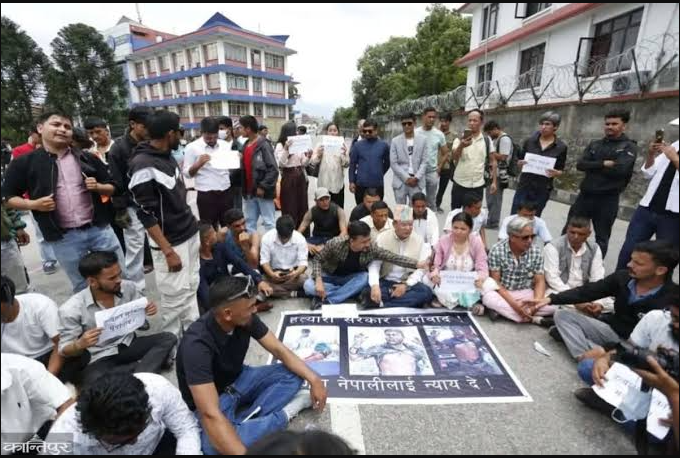
But the tragedy brought long-standing grievances against the government and the administration to a boiling point again. On Sunday, hundreds of people took to the streets outside the Singhdurbar Secretariat, a government office in the capital. Many of them carried placards with slogans like ‘End atrocity against the poor’ and ‘Respect human rights.’ Others also called on the administration to stop illegal arrests and provide shelter to squatters, who are being displaced by the Balen Shah government.
The displacement of the squatters also fuelled the public anger. The demonstrations, which began as protests against the Kathmandu Metropolitan City Police over eviction drives, have intensified in recent days after floods hit a government holding centre in Kirtipur housing around 150 displaced squatters, forcing their evacuation.
Gen-Z activists who visited the site were baton-charged and arrested, drawing criticism from Nepali Congress President Gagan Kumar Thapa, who demanded their immediate release. Police also arrested 26 people during a solidarity protest in Koshi Province.
The unrest follows a nationwide eviction drive launched in April that displaced more than 15,000 people from about 2,600 families. While 325 families were moved to temporary holding centres in Kathmandu, over 60 families remained there even after the government’s July 6 eviction deadline.
According to Nepali media reports, Kathmandu Metropolitan City police’s aggressive posture has intensified since Balendra Shah was elected mayor in 2022. Shah’s tenure as Mayor was defined by his hardline approach to urban management, especially concerning the clearance of pavements and informal street markets. His other move has been to remove riverside squatter settlements.
The media reports noted that criticism of the municipal police has been mounting since Shah was elected Kathmandu mayor as an independent candidate in 2022. His administration adopted an aggressive approach to clearing pavements and informal street markets, resulting in repeated confrontations with street vendors. In March 2024, street vendor Badri Devkota was allegedly beaten by municipal police before being detained, an incident that intensified concerns over the force’s methods.
On numerous instances, these anti-encroachment drives resulted in violent confrontations, stoking anxiety among the public over the lack of compassion for the city’s poorest residents. Quoting legal experts, media reports said the local administration has consistently overstepped its constitutional boundaries, from a regulatory facilitation body to an aggressive force that mimics the tactics of the federal police force, the Nepal Police.
“The legal framework does not envision the municipal police as a force authorised to use physical coercion or riot-control tactics. Their primary mandate is to facilitate administrative functions within the metropolis through persuasion and community engagement,” legal experts said.
“When issues arise regarding traffic or street obstructions, the matter should be referred directly to the traffic police. Instead, we have witnessed municipal officers relentlessly chasing vendors, confiscating private property, and physically assaulting citizens, which is entirely illegal,” the experts said.
Under Nepal’s Constitution, local governments are empowered to establish municipal police forces. The Kathmandu Metropolitan City Municipal Police Act, 2023, enacted during Shah’s mayoral tenure, defines the force’s responsibilities as protecting municipal property, public parks, sanitation and assisting in local events. Ironically, this legislation outlined the duties of the force without granting power to metropolitan police to launch baton charges or detain citizens. As per the act, the primary responsibilities of the force are to safeguard municipal property, protect public parks, monitor sanitation compliance, and assist in the management of local festivals and cultural processions.
Experts point out that there was no legal basis for the municipal police to use force. “They are purely a facilitation mechanism. If a situation escalates into a public disturbance or requires physical intervention, the municipal authorities are legally obligated to call upon the Nepal Police. They cannot independently execute crowd control,” a top retired police officer said.
Despite these legal limitations, protestors are arguing that the municipal police under Shah’s administration have frequently engaged in actions against daily wage vendors. Several videos of such action have gone viral on social media over the years, allowing the model of aggressive urban governance to quickly spread to other municipalities across the country.
The latest demonstrations come against the backdrop of recurring anti-government protests in Kathmandu. In an earlier wave of protests, students had taken to the streets accusing the government of KP Sharma Oli of corruption and inefficiency, particularly over its handling of the COVID-19 pandemic, signalling persistent public dissatisfaction with governance in Nepal.