


Virendra Pandit
New Delhi: Amid ongoing war uncertainties in West Asia, crude price increase, and Prime Minister Narendra Modi cautioning the people on five counts, Indian markets’ benchmark indices lost over 1.4 percent on Monday.
On Sunday, PM Modi appealed to the people to stop buying gold for a year, prioritize working-from-home, reduce fuel usage and utilize public transport, avoid non-essential foreign travel, promote Swadeshi, and natural farming. Together, with these steps, India could potentially save up to Rs. 22 lakh crores. His cautionary note, however, alerted the people and the market alike about likely fallout of the ongoing West Asian war on Indian economy.
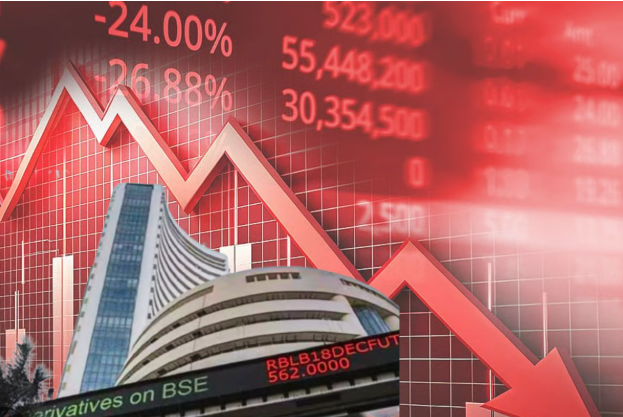
On the Dalal Street, stock markets plunged on Monday as rising crude oil prices and escalating US-Iran tensions triggered heavy selling, after hopes of a diplomatic breakthrough faded. Rising crude oil prices rattled investor sentiment after the US and Iran failed to reach a peace agreement to end the West Asia conflict.
At the closing, the Sensex tanked 1312.91 points (1.70 per cent) to end at 76,015.28, hitting a low of 75,957.40. Nifty 50 fell 360.30 points (1.49 per cent) to 23,815.85.
The Indian rupee crashed 139 paise to 94.90 against the greenback in early trade on Monday after President Donald Trump rejected Iran’s response to the US’s peace proposal, following which crude oil prices surged rapidly.
The Nifty50 and the Sensex slumped as consumer durables and realty stocks weighed on concerns over the impact of the West Asian war.
Titan Company, InterGlobe Aviation, and State Bank of India were the top losers in the Nifty50 index. In the broader markets, the Nifty MidCap and the Nifty SmallCap indices ended 1.05 per cent and 1.13 per cent down, respectively.
Sector-wise, the Nifty Consumer Durables fell nearly 4 per cent and became the top loser among peers. The Nifty Realty, the Nifty PSU Bank, and the Nifty Media also underperformed.
The Nifty FMCG, Nifty Pharma, and Nifty Healthcare outperformed.
The Indian rupee
The rupee crashed 139 paise to 94.90 against the greenback in early trade on Monday after Trump rejected Iran’s response to the US’s peace proposal, which triggered a crude oil price rally.
A strengthening US dollar and steep FPI outflows further pressured the local unit, according to forex traders.
At the interbank foreign exchange, the rupee opened at 94.97 against the US dollar before inching up to 94.90, down 139 paise from its previous close.
On Friday, the rupee pared its losses and ended with a sharp gain of 71 paise at 93.51 against the greenback.
Iran war
The market reaction began after Trump called Iran’s response to Washington’s fresh peace deal as “totally unacceptable,” weakening hopes of an immediate diplomatic resolution, which fanned worries that the geopolitical tension in West Asia may persist longer than expected and weigh on growth and inflation outlook.
Iran has sent its response to the latest US ceasefire proposal via Pakistani mediators and wants negotiations to focus on permanently ending the war, Iran’s state-run media said on Sunday.
Trump rejected Iran’s proposal to end the 70-day-long war, without sharing details even as a key Republican leader urged him to consider the “military option.”
After his rejection, Brent oil and dollar index rose higher, and risky assets lower. Israeli attacks on Lebanon continued while Hezbollah said it struck Israeli army camps with drones as the UAE also intercepted Iranian drones. Thus, the war continues keeping oil prices higher and, accordingly, rupee opened lower than Friday’s close
The dollar index, which gauges the greenback’s strength against a basket of six currencies, was trading at 98.20, up 0.20 per cent.
Brent crude, the global oil benchmark, rose sharply by 4.17 per cent to USD 105.5 per barrel in futures trade.
Foreign Institutional Investors (FIIs) offloaded equities worth Rs 4,110.60 crore on Friday last, according to exchange data.
India’s forex reserves dropped by USD 7.794 billion to USD 690.693 billion during the week ended May 1, the RBI said on Friday. In the previous reporting week ended April 24, the overall reserves declined by USD 4.82 billion to USD 698.487 billion.