



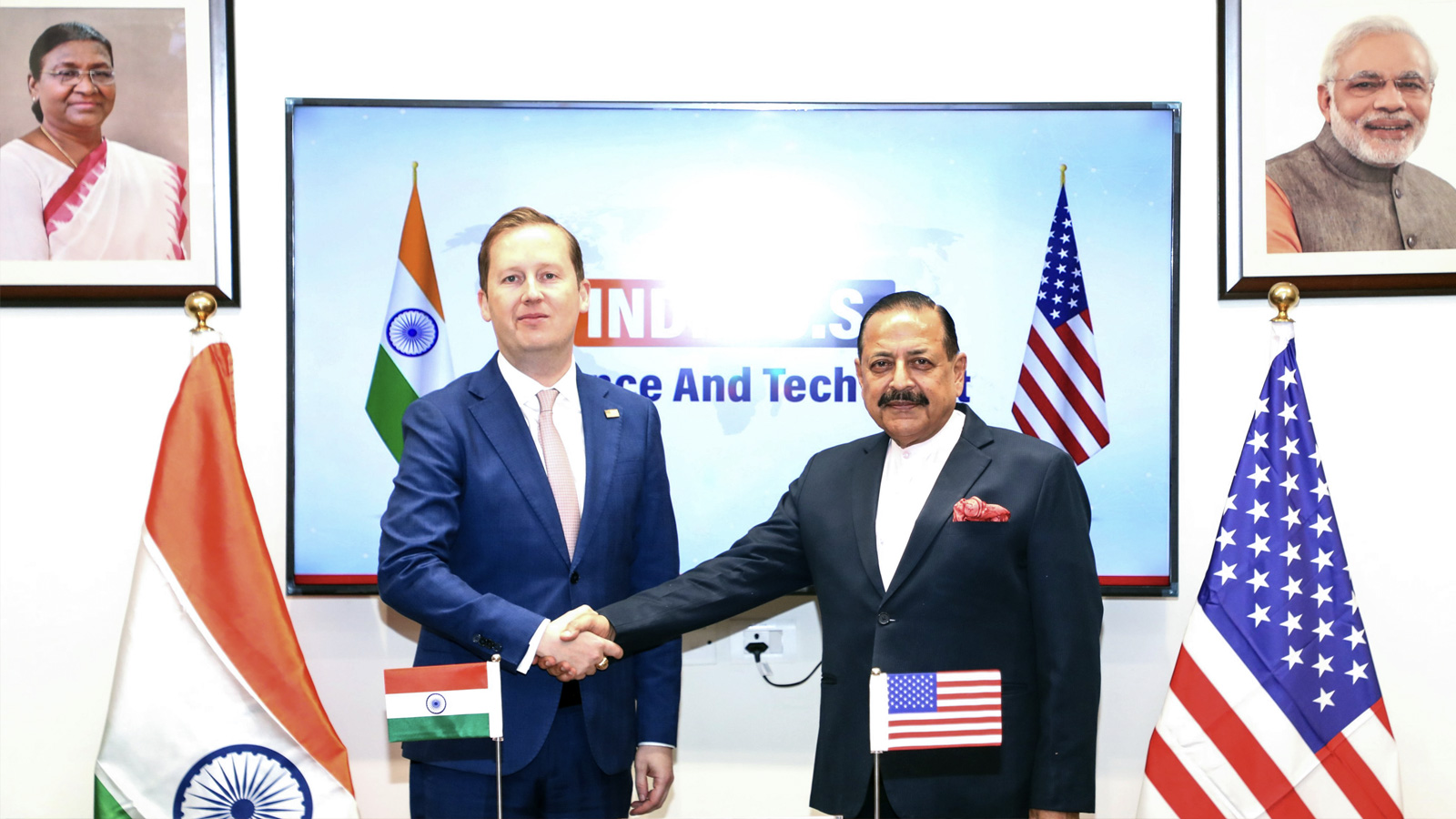

New Delhi (India): Union Minister Dr. Jitendra Singh on Wednesday held discussions with U.S. Ambassador to India Sergio Gor on expanding bilateral collaboration in key emerging sectors including biotechnology, quantum technologies, space, atomic energy, and nuclear medicine.
The meeting focused on strengthening India-U.S. cooperation through investment, skilling, knowledge exchange, research partnerships, and industry-led collaborations in advanced technologies.
During the discussions, Singh highlighted a major policy shift by the Government of India, stating that nuclear research has been opened to private sector participation for the first time. He said the move would create new opportunities for investment, innovation, and international collaboration in advanced cancer care, diagnostics, oncology research, genetic medicine, and nuclear medicine.
The minister said India’s large and diverse genetic data pool offers major advantages for global research in biotechnology, precision medicine, artificial intelligence-enabled diagnostics, and future healthcare solutions. He added that technologies such as AI-enabled diagnostics, sequencing tools, and faster testing methods could significantly reduce delays in healthcare delivery.
The talks were held within the framework of the India-U.S. TRUST initiative, which aims to deepen collaboration between governments, academia, startups, and industry in areas such as artificial intelligence, semiconductors, biotechnology, quantum technologies, advanced materials, energy, critical minerals, and space technologies.
Singh said trusted technology partnerships, resilient supply chains, innovation ecosystems, and protection of sensitive technologies would form the foundation of the next phase of India-U.S. scientific cooperation.
He also highlighted the progress made under India’s National Quantum Mission, noting that four thematic hubs have already been established in quantum computing, communication, sensing and metrology, and quantum materials and devices. The minister said that India has achieved more than half of the mission’s targets within three years of its eight-year framework.
The two sides also discussed biotechnology partnerships, vaccine cooperation, regulatory harmonisation, CAR-T therapy, oncology trials, and AI-driven healthcare technologies. The Biotechnology Industry Research Assistance Council (BIRAC) was identified as a key platform for facilitating industry collaboration in biotechnology.
On research and development investments, Singh referred to the government’s Research, Development and Innovation Fund, which aims to encourage greater private sector participation in scientific research through long-term unsecured financial support at low interest rates.
The minister also proposed the creation of a regular working group involving U.S. investors, companies, and research institutions to advance cooperation in investment, skilling, and institutional partnerships. He suggested that the group could meet monthly to accelerate collaboration and bring technical expertise and private-sector experience into India’s emerging science and technology ecosystem.
Space cooperation, quantum infrastructure, technology transfer in thorium-based nuclear energy, and upcoming space engagements in Bengaluru also featured prominently in the discussions.
Singh said India’s decision to open the space sector to private participation over the last few years has created significant opportunities for collaboration with trusted international partners.
(DD News)