




Manas Dasgupta
NEW DELHI, Apr 15: The opposition INDIA bloc has decided to oppose the bill for the delimitation of the constituencies even while welcoming the move to increase the reservation for women in the Lok Sabha and State Assemblies to 33 per cent.
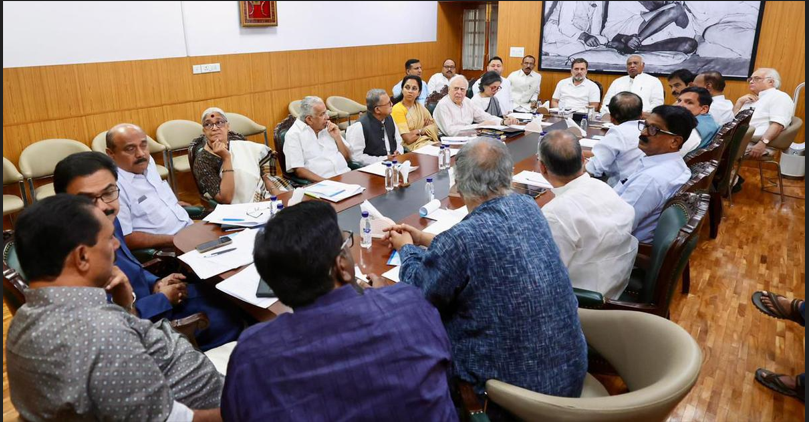
The decision was taken at a meeting of the opposition parties held at the residence of the Congress president and the Leader of the Opposition in the Rajya Sabha Mallikarjun Kharge on Wednesday. Besides Kharge and Rahul Gandhi, a host of Opposition leaders who attended the meeting included DMK’s TR Baalu, RJD’s Tejashwi Yadav, Trinamool’s Sagarika Ghosh, Shiv Sena (UBT) leaders Sanjay Raut and Arvind Sawant, NCP(SP)’s Supriya Sule, CPI leader Annie Raja, CPI-M’s Nilotpal Basu, AAP leader Sanjay Singh, Independent MP Kapil Sibal, IUML’s E T Mohammed Bashir and RSP’s N K Premachandran. Samajwadi Party chief Akhilesh Yadav had joined in virtually.
The government’s plan to link the women’s reservation amendments with the delimitation excise has created a sharp political divide. The Congress said while they approve of the quota bill for women in principle, the way the government was implementing it through delimitation was wrong and politically motivated, and the Opposition parties would fight against it in parliament.
The Constitution amendment bills, which need two-thirds majority to get passed, are expected to be tabled during an extended budget session starting on Thursday.
At a press conference held after the meeting of Opposition parties, Mr Kharge said: “We are in support of the Women’s Reservation Bill but have objection to the government’s approach. The government’s action is politically motivated. Just to gag and suppress opposition parties, the government is doing this.”
The Opposition parties, he reiterated, were not against the Women’s Reservation Bill, which was backed by the Congress in 2010 and in 2023, and was passed unanimously by Parliament. What they objected to was delimitation, he said, claiming there has been “manipulation” in the delimitation.
Congress’s Jairam Ramesh said the manner in which the Delimitation Commission was functioning, “it is clear that it has become a tool to win majority for the ruling party.” “We are totally against the delimitation move. Women’s reservation should be implemented, but we are totally against delimitation,” he said. “We are saying that whatever law is made in 2023 should be implemented. We all Opposition parties will fight in Parliament. We will oppose this bill,” Kharge said.
Mr Ramesh said, “The Bill states that Lok Sabha seats will go up by 50%. The government had also claimed that each State’s strength would be uniformly increased while maintaining the current ratio. However, there are no provisions in these bills to maintain the proportional strength of the State. Many states will lose representation in Lok Sabha.”
Several opposition parties are opposed to the linking of the women’s reservation law with a delimitation exercise and an increase in seats in several State Assemblies as per the 2011 Census, and have accused the ruling NDA of indulging in politics over the law. K.C. Venugopal, Congress general secretary, said, “We are against the Delimitation Bill; we will vote against the Delimitation Bill.”
The BJP government proposes to increase the Lok Sabha seats from the 543 to 816 to ensure women get 273 reserved seats without reducing the current number of seats held by men. Leaders like K. Laxman claims that this “pro-rata” approach protects southern States because every State’s strength increases proportionately, but the opposition disagree.
The Congress has issued a three-line whip to all of its Lok Sabha MPs to be present in the Parliament during the special session planned to discuss it, but it remains highly critical of the delimitation link. The party supports an immediate 33% reservation for women but opposes the delimitation Bill in its current form. Mr Kharge warn that a 50% increase based on population trends of 2011 would widen the gap between the northern and southern States.
The party has demanded a sub-quota for OBC women and has insisted that reservation should be based on a fresh caste census and not on the 2011 census data. The Congress has also labelled the special session a ‘distractionary tactic’ timed to influence the Assembly elections in Tamil Nadu and West Bengal.
Telangana Chief Minister Revanth Reddy has recommended a “hybrid model” proposal that suggests allocating 50% of new seats based on economic performance rather than just the State’s population. Tamil Nadu Chief Minister and party supremo M.K. Stalin has warned of massive protest calling delimitation an “assault on federalism” that penalises states for successful population control. He has described the move as a “sword hanging over our heads that has now reached our necks.”
The CPI(M) has argued that women’s reservation should be implemented without being linked to a new census or delimitation. The party contended that the 2011 Census data was already available and could have been used to provide 33% reservation without expanding the total number of seats. The Bharat Rashtra Samithi (BRS), the primary Opposition party in Telangana, has supported the reservation of women but has opposed any delimitation that reduces the seat share of the country’s southern states.
The opposition reaction came a few days after Prime Minister Narendra Modi wrote to the floor leaders of the House seeking support for the women’s quota bill. A concerted fight by the Opposition can indeed make things difficult for the government in both houses of parliament. Under the Constitution’s Article 368, Constitutional amendments require a special majority in both Houses – meaning a majority of the total membership and two-thirds of members present and voting.
With an effective strength of 540 in the Lok Sabha, the two-thirds mark is approximately 360 votes if all members are present and voting. Any walkout or abstention by the Opposition will bring down the majority mark. The magic number for the Rajya Sabha is 163.
In the Lok Sabha, the ruling alliance, with 293 members falls short by 67 seats. In the Rajya Sabha, the NDA’s strength of 142-plus members leaves it 21 seats shy of the required two-thirds majority. Under the circumstances, without Opposition cooperation, the passage of these bills is virtually impossible.
Adding to the government’s hurdles, neutral parties such as Naveen Patnaik’s Biju Janata Dal and K Chandrasekhar Rao’s Bharat Rashtra Samithi have hardened their stance on delimitation. Unlike previous occasions when they extended support, this time they appear unwilling to come to the government’s rescue.
The government is expected to introduce three bills in this session. While one would deal with the woman’s quota, another is a Delimitation Bill to set up a commission for redrawing constituencies to aid the quota implementation, and a third bill to align laws governing Union Territories with the new framework.
The Opposition is vehemently against the delimitation bill, arguing that the government’s formula for redrawing constituencies based on the 2011 census will only aid the NDA. It would leave south India high and dry. Since the southern states have effectively managed to control their population, their share of seats in parliament will drastically shrink compared to the states in north India’s Hindi belt.
Jammu and Kashmir Chief Minister Omar Abdullah said: “They say that delimitation will prove helpful, but through delimitation, an attempt was made to benefit one party. The way constituencies were drawn here it was to benefit the BJP. If this bill is being brought with the same intention, then it will benefit only the BJP. We have to see all this.”