




Manas Dasgupta
NEW DELHI, July 4: The week-long funeral ceremonies for the deceased Iranian supreme leader Ali Khamenei officially began in Tehran on Saturday, with thousands of Iranians turning up to pay tributes to their 86-year-old leader who was killed in the US and Israeli strikes on Iran on the first day of the US – Iran conflict on February 28.
Khamenei’s coffin was carried into the complex, draped in a flag of the Islamic Republic and with his black turban placed on top. The bodies of his dead relatives were also placed beside him, including the small coffin of his 14-month-old granddaughter.
Khamenei’s coffin will lie in Tehran until Monday, when a procession will pass through the city. It will move to the clerical hub of Qom on Tuesday before moving to holy cities in neighbouring Iraq on Wednesday and then proceeding for burial on Thursday in Khamenei’s home city of Mashhad in north-eastern Iran.
Bihar governor Syed Ata Hasnain and Minister of State for External Affairs Pabitra Margherita are representing India at the ceremony. Top Iranian officials paying their respects included Ahmad Vahidi, who was named chief of Iran’s Revolutionary Guards after his predecessor was killed in the same strikes that killed Khamenei.
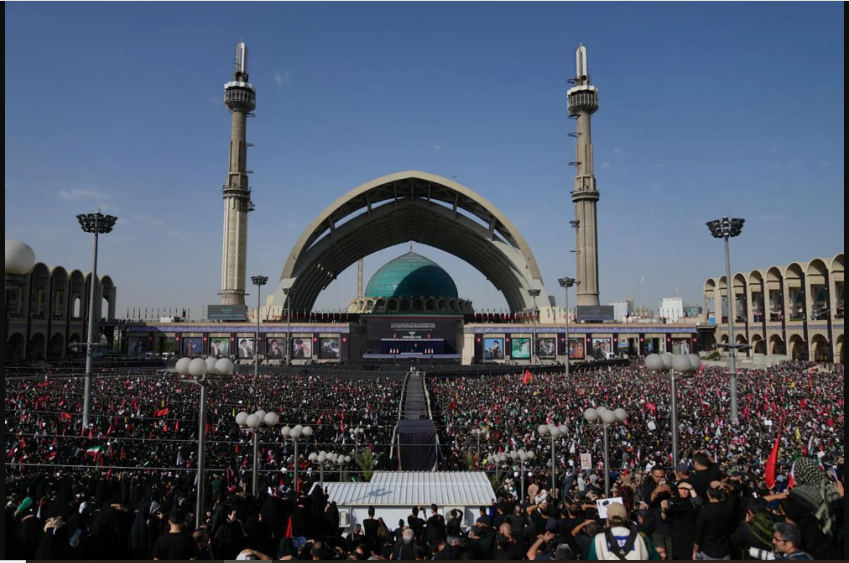
Authorities unveiled the casket containing Khamenei’s body in a glass case at the Grand Mosalla in Tehran, Iran’s capital. Mourners wept at the sight, with some chanting: “Our word is one! Revenge! Revenge!” Some carried banners and flags, while billboards across the city bore Khamenei’s image. Crowds of men rhythmically beat their chests in mourning, a common practice at Shiite funerals.
Khamenei’s remains arrived in Tehran on Friday for six days of public funeral ceremonies. His remains will be carried across cities in Iran and neighbouring Iraq. Hundreds of supporters of the Islamic republic were already waiting on Friday evening outside Tehran’s Grand Mosalla ahead of its opening to the public on Saturday. Authorities said they expect between 15 and 20 million participants in Tehran alone over the next three days.
Once the gates opened on Saturday, thousands of mourners entered the venue, and the main courtyard of the vast complex was filled with people. The mourners carried red banners, a symbol associated with calls for revenge, and chanted “death to America” and “revenge, revenge.” “I am here to say goodbye to my beloved leader Ali Khamenei. I never expected to see such a day. I wish I had died before this tragedy,” a 27-year-old mourner said.
Iranian authorities are preparing for the possibility that the week-long funeral ceremonies could result in between 1,500 and 3,000 deaths. According to media reports, Iranian officials have drawn up contingency plans for a potential mass-casualty incident during the funeral processions, which are expected to draw massive crowds from across the country.
The funeral ceremonies will commemorate Khamenei, who led the Islamic Republic from 1989 until he was killed at the age of 86. The events are expected to be closely watched for any public appearance by Khamenei’s son and successor, Mojtaba Khamenei. He was named Supreme Leader a week after his father’s death but has not yet appeared in public.
His body will lie in state at Tehran’s Grand Mosalla on Saturday and Sunday. On Monday, it will be taken in a funeral procession through the streets of Tehran before being moved to the Shia seminary city of Qom, about 120 kilometres south of the capital. Funeral ceremonies will continue there on Tuesday.
On Wednesday, Khamenei’s body will be taken to Karbala in Iraq, home to the shrine of Imam Hussein, the grandson of the Prophet Muhammad, who is regarded by Shia Muslims as a symbol of resistance. The day also marks the anniversary of the protests against Khamenei’s rule, during which thousands of people were killed by security forces. After the ceremonies in Karbala, Khamenei’s body will be taken to Mashhad, Iran’s second largest city.
US President Donald Trump claimed that Iran was eager to reach an agreement with Washington and said America had dealt a heavy blow to Tehran. He also said Washington had allowed Iran extra time to hold funeral ceremonies. “We knocked the hell out of Iran. They are dying to settle. They want to settle so badly,” he said. “We gave them a week off for a funeral because we’re nice, that’s true,” he added.
Iranian authorities have said Khamenei will be buried at the Imam Reza shrine in Mashhad. Imam Reza was the eighth Imam in Shia Islam. The shrine attracts millions of pilgrims every year, and a hadith, or saying, says that those who visit it seeking relief from sorrow or forgiveness for their sins will find comfort. Several prominent Shia clerics have been buried at the shrine, including former Iranian President Ebrahim Raisi, who died in a helicopter crash in 2024.
Meanwhile, the Lebanese President Joseph Aoun on Saturday urged the United States to stand by Lebanon as it seeks to implement a US-backed framework aimed at permanently ending hostilities with Israel following the latest Israel-Hezbollah war.
The framework, agreed in Washington, proposes the disarmament of the Iran-backed Hezbollah militant group, a phased Israeli withdrawal from southern Lebanon, and the deployment of the Lebanese army in the area, beginning with two designated “pilot” zones. Hezbollah, however, has rejected the proposal, arguing that it did not include a clear timetable for Israel’s withdrawal from southern Lebanon.
Iran’s state broadcaster has described the farewell ceremony for former Supreme Leader Ayatollah Seyyed Ali Khamenei as the beginning of the “Great Khamenei Era.” Speaking on Saturday, President of the Islamic Republic of Iran Broadcasting (IRIB), Payman Jebeli, said extensive arrangements had been made to cover the mourning ceremony live.
Jebeli said more than two dozen satellite news gathering (SNG) units had been deployed at key locations to broadcast the event. He added that over 30 mobile broadcast units, each equipped with six to 12 cameras, had been stationed along the route of the farewell procession to ensure comprehensive coverage.