


Virendra Pandit
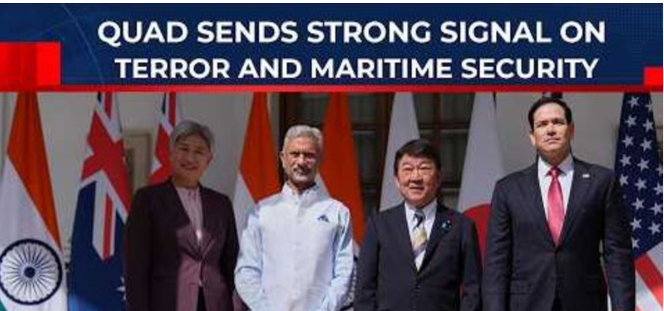
New Delhi: The Quadrilateral Security Dialogue (Quad) on Tuesday declared that the Indo-Pacific will not be held hostage to the energy volatility reshaping the global economy.
The group’s joint statement on Indo-Pacific Energy Security, issued at the close of the Foreign Ministers’ meeting, named the Strait of Hormuz explicitly – an unusually direct diplomatic signal—calling for “unimpeded freedom of navigation” and opposing “any restrictive measures hampering the flow of commercial vessels,” the media reported.
The bloc’s language reflects deepening concern over disruptions stemming from the widening conflict in West Asia, which has unsettled shipping lanes that carry the bulk of the region’s crude oil exports eastward to Asia.
The four-nation group, comprising the US, India, Australia, and Japan, announced the creation of a Quad Fuel Security Forum – a high-level coordination body designed to facilitate crisis response, policy alignment, and market analysis during periods of acute energy stress. Alongside will be a broader Quad Initiative on Indo-Pacific Energy Security, which will develop an engagement plan spanning technology, emergency response exercises, and strategic petroleum system strengthening.
Australia pointed to its USD 2 billion Southeast Asia Investment Financing Facility and AUD 30 million in budget support to Fiji as evidence of its Pacific energy security mandate.
Japan highlighted its POWERR Asia initiative – the Partnership on Wide Energy and Resources Resilience – as a vehicle for regional energy diversification.
The statement also addressed the structural inequity of energy disruptions, acknowledging that the burden falls disproportionately on vulnerable developing nations and small island states in the Pacific, for whom even modest supply shocks can translate into acute economic hardship.
While Quad cooperation has historically centred on maritime security and technology supply chains, Tuesday’s statement represents a meaningful expansion of the grouping’s economic security mandate – one driven, in large part, by the current crisis forcing the issue.
As foreign ministers departed New Delhi, the message from the Quad was unambiguous: the free flow of energy through the world’s most critical chokepoints is not merely a commercial matter. It is, the four nations declared, essential to global economic stability – and they intend to defend it together.
The US stand
In his media statement, US Secretary of State Marco Rubio said the Quad meeting decided to launch an Indo-Pacific Maritime Surveillance Cooperation Initiative. He also announced expansion of the Indo-Pacific Maritime Domain Awareness Initiative among the Quad nations, and that the bloc decided to roll out a new initiative to boost port infrastructure in the Pacific Islands.
China
China, which has for years dubbed the four-nation bloc as the “Asian NATO” against Beijing, on Tuesday reiterated its stance on the Quad group, saying cooperation between countries should contribute to regional peace, stability and prosperity, and should not target any third party.
“We also do not support the formation of exclusive cliques or bloc confrontation. No cooperation should undermine mutual trust and cooperation among regional countries,” China’s foreign ministry spokesperson, Mao Ning, told a daily press conference.