


Virendra Pandit
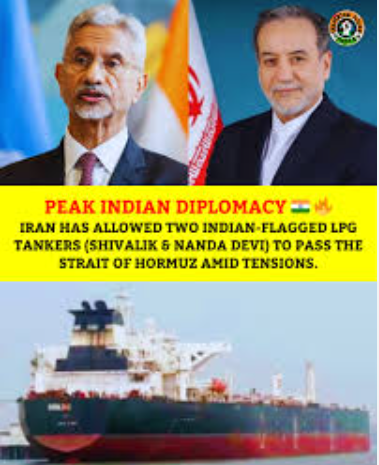
New Delhi: After deft diplomacy between India and Iran this week, two Indian tankers carrying liquefied petroleum gas (LPG) have crossed the embattled Strait of Hormuz and are heading home, the media reported on Saturday.
The LPG carrier Shivalik is carrying approximately 40,000 metric tons of gas, while Nanda Devi is also transporting a significant volume of fuel. Their successful crossing comes just a day after another vessel sailing to India crossed the strategic narrow sea lane between Iran and Oman.
Rajesh Kumar Sinha, Special Secretary in the Ministry of Shipping, confirmed during a media briefing that another Indian-flagged tanker, the Jag Prakash, carrying gasoline from Oman to Africa, has also set sail from the eastern side of the Strait.
After a deal between Tehran and New Delhi, Iran granted safe transit through the Strait, which has been all but closed for nearly two weeks.
Since the start of the US-Israel war against Iran on February 28, India has been suffering shortage of LPG, especially for commercial and industrial purposes, and in petrochemical units to make plastics.
India is the second-largest importer of the fuel, and takes 90 percent of it from the West Asia.
With India’s top leadership’s talks with their Iranian counterparts this week, Tehran agreed to ensure passage of two of the nearly two dozen Indian ships, stranded in the Persian Gulf, through the Strait of Hormuz where Iran has reportedly laid mines to prevent shipping, except with its permission.
As of now, nearly 250 ships from various countries are reportedly stranded in the Persian Gulf, waiting to cross the Strait of Hormuz.
In a huge relief to India, two tankers carrying LPG are now heading home after crossing the Strait of Hormuz, providing some succour to acute shortages as the war in the Persian Gulf continues to disrupt fuel supply worldwide.
The two tankers — Shivalik and Nanda Devi, loaded from Ras Laffan in Qatar — were chartered by state-run Indian Oil Corporation and are expected to arrive in India next week. The vessels are owned by state-run Shipping Corporation of India Ltd.
Both ships have signalled through their AIS systems, used by ships to transmit their whereabouts, that they are Indian government vessels. Ship-tracking data shows that the Shivalik has already sailed through the Strait. The Nanda Devi appears to be in transit, although electronic interference around the waterway complicates accurate monitoring of location.
According to reports, the two Indian-flagged tankers’ transit was a “very careful operation” conducted with coordination between Iran and India, besides cooperation with regional powers.
The passage follows intensive diplomatic efforts between New Delhi and Tehran. External Affairs Minister S. Jaishankar held four rounds of talks with his Iranian counterpart, Seyed Abbas Araghchi, since the crisis began on February 28. On Thursday, Prime Minister Narendra Modi also held high-level discussions with Iranian President Masoud Pezeshkian to secure the safe transit of Indian vessels.
Currently, India is working to secure safe passage for over two dozen other Indian-flagged merchant vessels still stationed on either side of the Strait that links the Gulf of Oman with the Persian Gulf.
During his conversation with Pezeshkian, PM Modi expressed deep concern over escalating hostilities and the loss of civilian lives. “The safety and security of Indian nationals, along with the need for unhindered transit of goods and energy, remain India’s top priority,” he posted on X.
Nearly 23,000 Indian seafarers are working across merchant, harbour and offshore vessels in the wider Gulf region.
Since strikes by the United States and Israel against Iran on February 28 ignited the war, the Islamic Republic of Iran has launched its own attacks against its oil-exporting neighbours.
The Strait of Hormuz is a vital global artery, accounting for nearly a fifth of the world’s oil supplies. However, shipping has been severely disrupted for nearly two weeks after retaliatory strikes from Tehran against its oil-exporting neighbours.
On Wednesday, Iran attacked a Thai-flagged cargo vessel, bound for Kandla port in Gujarat, shortly after departing from a port in the United Arab Emirates.