




By Harsh Pargat
Foreign Minister’s Visit and Impetus on CEPA:
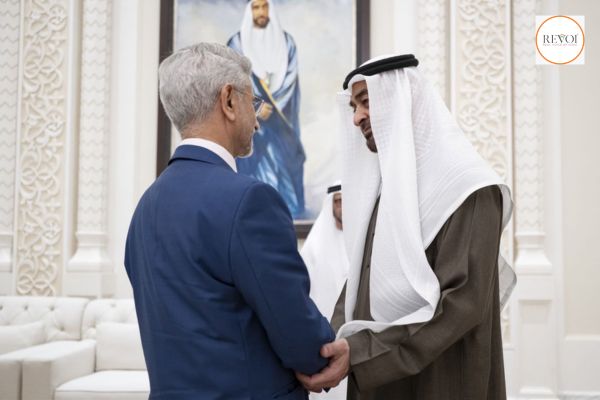
Foreign Minister S. Jaishankar recently visited the UAE and met the president and the Foreign Minister Sheikh Abdullah bin Zayed Al Nahyan. Both sides focused on enhancing energy security cooperation, accelerating the framework of the CEPA, and held deliberations on the current conflict in West Asia, and ensuring the safety of Indian citizens. Impetus was also laid on India’s energy security requirements.
His visit comes as part of India’s broader diplomatic outreach to secure energy supplies from Gulf nations. Petroleum Minister Hardeep Singh Puri simultaneously held talks in Qatar. The UAE remains India’s third-largest trading partner globally. The UAE visit marked the final leg of Dr Jaishankar’s four-day tour, which also included participation in the 9th Indian Ocean Conference in Mauritius. If we try to humanize and analyze this part, we find a very strategic move done by India.
India’s recent diplomatic engagements in the Gulf reflect a carefully calibrated strategy that blends energy security with broader geopolitical and economic priorities. The visit by Subrahmanyam Jaishankar to the United Arab Emirates was not an isolated event, but part of a wider, coordinated outreach aimed at reinforcing India’s ties with key energy partners in West Asia.
At the same time, Petroleum Minister Hardeep Singh Puri was engaged in parallel discussions in Qatar—one of India’s most critical suppliers of liquefied natural gas. This simultaneous diplomacy underscores a dual-track approach: while the Ministry of External Affairs focuses on strategic and political alignment, the energy ministry ensures continuity and diversification of supply chains. In a global environment marked by volatility in oil and gas markets, such synchronized efforts signal India’s intent to hedge risks and maintain stable access to essential resources.
The choice of the United Arab Emirates as a key stop is equally significant. As India’s third-largest trading partner, the UAE is not just an energy supplier but also a vital hub for trade, investment, and the Indian diaspora. Over the past decade, the relationship has evolved into a comprehensive strategic partnership, encompassing sectors such as infrastructure, renewable energy, fintech, and defense cooperation. Jaishankar’s visit, therefore, reflects both continuity and expansion—strengthening traditional energy ties while opening new avenues for collaboration in emerging sectors.
Importantly, the UAE leg marked the culmination of Jaishankar’s four-day diplomatic tour, which began with his participation in the 9th Indian Ocean Conference in Mauritius. This sequencing is telling. It connects India’s maritime strategic vision in the Indian Ocean with its continental outreach to the Gulf. By engaging with island nations and Gulf partners in a single tour, India is effectively linking its Indo-Pacific and West Asia policies into a coherent framework.
From an analytical standpoint, this reflects three key trends in India’s foreign policy. First, energy security remains central, but it is increasingly pursued through diversified and resilient partnerships rather than transactional deals. Second, diplomacy is becoming more integrated across ministries, indicating a whole-of-government approach to external engagement. Third, India is positioning itself as a bridging power—connecting regions like the Indian Ocean and the Gulf, both of which are critical to global trade and energy flows.
The India –UAE partnership has played a pivotal role, acting as a foundation for India’s West Asia policy. The relations between the countries have strengthened over the decades, particularly since 2010. With domains of cooperation expanding from traditional domains of energy to newer domains like AI, security ties, and the growing presence of the Indian diaspora. A major factor in opening new avenues of cooperation in bilateral relations.
PM Modi’s visit:
The meeting between Prime Minister Narendra Modi and Sheikh Mohammed Bin Zayed Bin Nahyan on 19th January 2026 symbolized the upward trajectory of the relations. The Foreign Secretary’s statement can understand the significance of the meeting: “The India-UAE relations have entered into a mega partnership initiative phase.
The signing of the Comprehensive Economic Partnership Agreement (CEPA), which came into effect from May 2022, played a major role in the contemporary trade evolution of the United Arab Emirates. The agreement enabled the UAE to become the fourth largest Foreign Direct Investor for India with an investment of US$18 billion dollars as of 2026.
Comprehending CEPA: The Comprehensive Economic Partnership Agreement emphasized opening multi-sectoral avenues by removing tariff barriers on the products of the two countries. This allowed the UAE to get access to the markets of India and enabled rise of exporters to the region. Trade in sectors like energy (LNG), healthcare to the newer avenues of AI digital technology have laid down the foundation for stability in the partnership in a fragmented and uncertain global world order. The CEPA played a crucial role in acting not just a mechanism for goods and trade mobilization, but also as the mobilizer for the transfer of Digital AI cooperation. This AI digital cooperation laid down the genesis for data sovereignty protection and the creation of Digital Embassies, an evolving process.
Similar Groupings Roadmap for Strategic Connectivity
Both India and the UAE are in the Israel, India, USA, and the UAE grouping(I2U2). This grouping helps the countries in pragmatically navigating and strengthening mutual interests in the region. A pragmatic example was the proposal of the India Middle East Europe Corridor. Proposed during India’s presidency of the G-20. The corridor was a multimodal transport combining networks of rail routes and sea routes. The corridor provides a spine to the logistical, economic, and shared strategic interests of the countries. One of the cornerstones for the project was the firm port connectivity and the logistical infrastructure that India and the UAE provide through ports like Mundra, Kandla, Port Khalifa, Fujairah, Jebel Ali, and Abu Dhabi, serving as important nodal connectivity ports. The pictorial map below shows the nodal points of connectivity.

Source: The Hindu
Post October 7 Trajectory: After the October 7, 2023, outbreak of the Israel-Hamas war both countries emphasized greater acceleration with the solidification of the CEPA. It led to the creation of the India-UAE Growth Corridor, which bypassed the traditional trade routes and enabled greater bilateral trade between the two countries. This enabled both countries to navigate the contours of the war as well as strengthening economic and strategic cooperation between the two countries.
The rapid impetus on strengthening bilateral cooperation and increasing the avenues of cooperation has helped both countries in navigating the testing trial of the contemporary uncertain contours.
In essence, these visits are less about symbolic diplomacy and more about strategic consolidation. They signal India’s recognition that in an era of shifting global alignments and supply chain disruptions, sustained engagement with trusted partners like the UAE and Qatar is indispensable for both economic stability and geopolitical influence.
(The writer is a researcher in international relations & strategic studies with a focus on West Asia)
Please share your views, [email protected]