




Manas Dasgupta
NEW DELHI, June 11: The three Indian seafarers, initially reported missing, have died after a vessel was attacked by US forces off the coast of Oman earlier this week, Shipping Minister Sarbananda Sonowal confirmed on Thursday, even as President Donald Trump warned that the US would hit Iran “very hard tonight” and move to take control of the country’s oil and gas infrastructure and markets.
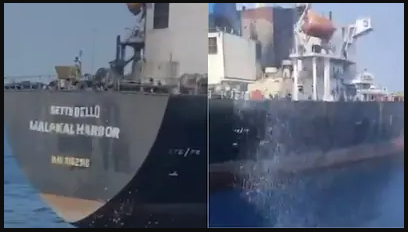
Calling the killing of the three Indian seafarers “tragic” loss, the minister said the bodies of all three missing sailors have been recovered. The Palau-flagged oil tanker, the Settebello, had a total crew of 28 members, including 24 Indian nationals and four foreign nationals– two Pakistanis, one Ukrainian, and one Russian– when it came under the US military’s attack in the Gulf of Oman. The US military said it attacked the vessel after it allegedly failed to follow its instructions and was carrying oil from Iran.
It was initially reported that while 21 Indian sailors were rescued from the ship, three seafarers — identified as deck cadet Aditya Sharma, engine fitter Shivanand Chaurasiya and chief engineer Patnala Suresh — remained missing. “It is deeply unfortunate to learn of the tragic incident aboard the Palau-flagged MT Settebello. Sadly, three Indian seafarers initially reported missing are now confirmed dead after bodies have been located and identified,” Mr Sonowal said in a post on X.
India had summoned the U.S. Deputy Chief of Mission after lodging a “strong protest” against the strike.
However, a day after the U.S. forces attacked tanker Settebello, another vessel MV Jalveer was attacked under similar circumstances near Oman on Thursday. This is the third such incident in four days. MV Jalveer is a Guinea-Bissau flagged asphalt tanker.
India has strongly condemned the attacks on tankers manned by Indian seafarers in the Gulf in the last few days. Terming the attacks “deeply worrisome,” External Affairs Ministry on Thursday called for an immediate end to such attacks. “There have been several incidents involving Indian seafarers in West Asia in the last few days. We attach high importance to the welfare and well-being of our seafarers’ community. We need not re-emphasise this point,” External Affairs Ministry spokesperson Randhir Jaiswal said on Thursday.
“Yesterday, we condemned the attack on a ship off the coast of Oman in which, unfortunately, we lost three Indian nationals. We had summoned the US CDA here to register a strong protest. We expect the US to take due note of our protest,” Jaiswal added.
Calling attacks direct result of the conflict in the region, India has called for these attacks to end and dialogue to take precedence. “The continuing incidents of attacks on shipping in the region are deeply worrisome and a direct result of the ongoing conflict in the region. These attacks must cease and end. We also call for dialogue and diplomacy so that we can have an early return to peace and stability in the region,” Jaiswal said.
Additional Secretary in Shipping Ministry, Mukesh Mangal, giving details of the attacks, informed that three vessels with Indian sailors on board have been attacked since Monday, June 8. According to the government, a fire was reported on vessel Marivex on Monday. All 24 Indian crew on board were safely rescued. Then on Wednesday, vessel MT Settebello was attacked, 24 Indian sailors were on. Of these, 3 Indian sailors lost their lives while 21 were safely evacuated. In the latest attack on Thursday, MT Jalveer was hit. All 20 Indian seafarers on board the vessel are safe.
Mangal further informed that there are 13 Indian flagged vessels in Strait of Hormuz currently with 562 Indian seafarers on board these vessels.
The US Central Command, later, acknowledged the strike on the vessel, saying it violated the ongoing US blockade of the Iranian ports by attempting to transport oil from Iran. It said one of its warplanes had fired on the tanker in the Gulf of Oman, disabling the vessel as it attempted to transport oil from Iran.
US Central Command said in a post on X, identifying the Palau-flagged Settebello, that the “crew repeatedly failed to comply with directions from American forces.” India summoned Washington’s charge d’affaires in New Delhi to lodge a “strong protest” over the attack, a senior Indian government official said.
The attack on the vessels came as the US and Iran traded attacks on Thursday for a second straight day, with President Trump vowing further strikes if Tehran does not immediately agree to a peace deal. Iran’s top joint military command also warned that it would fire on any vessel trying to pass through the Strait of Hormuz which has been largely closed for months. Iranian media said two U.S. ships were fired on. However, U.S. Central Command denied that the strait was closed or any of its ships struck, saying commercial ships were still transiting the strait despite Iran’s threats.
Mr Trump in a post on Truth Social, “At some point in the not too distant future, we will be taking Kharg Island, and other oil infrastructure points, and assume total control of their Oil and Gas Markets, much like we have with Venezuela, which is working out brilliantly for both Venezuela and the United States of America,” he wrote. He also claimed that Iran’s military capabilities had been significantly degraded and warned of imminent action, Trump suggested that Washington would target key Iranian energy infrastructure.
An explosion was heard off the coast of Sirik in Iran’s southern Hormozgan province on Thursday, Iranian state television reported. The cause of the blast was not immediately known, and authorities had yet to provide further details. Sirik lies near the strategically important Strait of Hormuz.
The US Central Command (CENTCOM) said US forces disabled the tanker MT Jalveer in the Gulf of Oman after it allegedly violated the Iran blockade. This was the third commercial vessel carrying Indian crew that was targeted by American forces this week, they said.
A tense, two-month-old ceasefire between the two countries is rapidly deteriorating following a consecutive second night of American airstrikes. On Thursday, the Iranian foreign ministry issued its sharpest rebuke yet, declaring that Washington’s military actions have rendered the hard-fought truce “practically meaningless.”
The recent spike in hostilities follows Washington’s allegations that Iran downed a US Army Apache helicopter over the Strait of Hormuz earlier in the week. The CENTCOM then launched “self-defence strikes” targeting Iranian air defence networks, radar sites, and ground control stations in southern provinces like Hormozgan.
Iran’s Persian Gulf Strait Authority has reportedly instructed vessels that have already received transit permits to remain patient, saying the Strait of Hormuz will stay closed until further notice, according to Iranian state media.
The United States carried out a second wave of airstrikes on Iran into Thursday morning, after President Donald Trump warned that Tehran would “pay the price” for delays in negotiations. The fresh attacks marked another escalation in tensions between the two countries and threatened efforts to preserve a fragile ceasefire.
Iran’s Islamic Revolutionary Guard Corps said on Thursday that it had carried out retaliatory strikes against 18 US military sites located at airbases in Kuwait and Bahrain. Bahrain’s interior ministry said warning sirens had been activated. The strikes mark the latest turn in the growing military confrontation between the two sides, raising fears of a return to full-scale conflict, which had been put on hold in early April after both countries agreed to a fragile ceasefire.
The World Bank on Thursday lowered its global growth forecast to its lowest level since the pandemic, warning of the expanding economic impacts of the war in West Asia on countries around the globe. Worldwide growth is now forecast to drop to 2.5% in 2026, from 2.9% a year earlier, with headline inflation averaging 4%, the multilateral lender said in its Global Economic Prospects report.
The Organization of the Petroleum Exporting Countries (OPEC) also lowered its forecast for world oil demand growth in 2026 to 970,000 barrels per day, a copy of its monthly report showed, marking the second straight downward revision.
The producer group continues to see a smaller impact on consumption since the Iran war started than other forecasters such as the U.S. Energy Information Administration and the International Energy Agency. Both expect demand to decline in 2026. The OPEC also raised its forecast for 2027 oil demand growth, according to the report on OPEC’s website.