



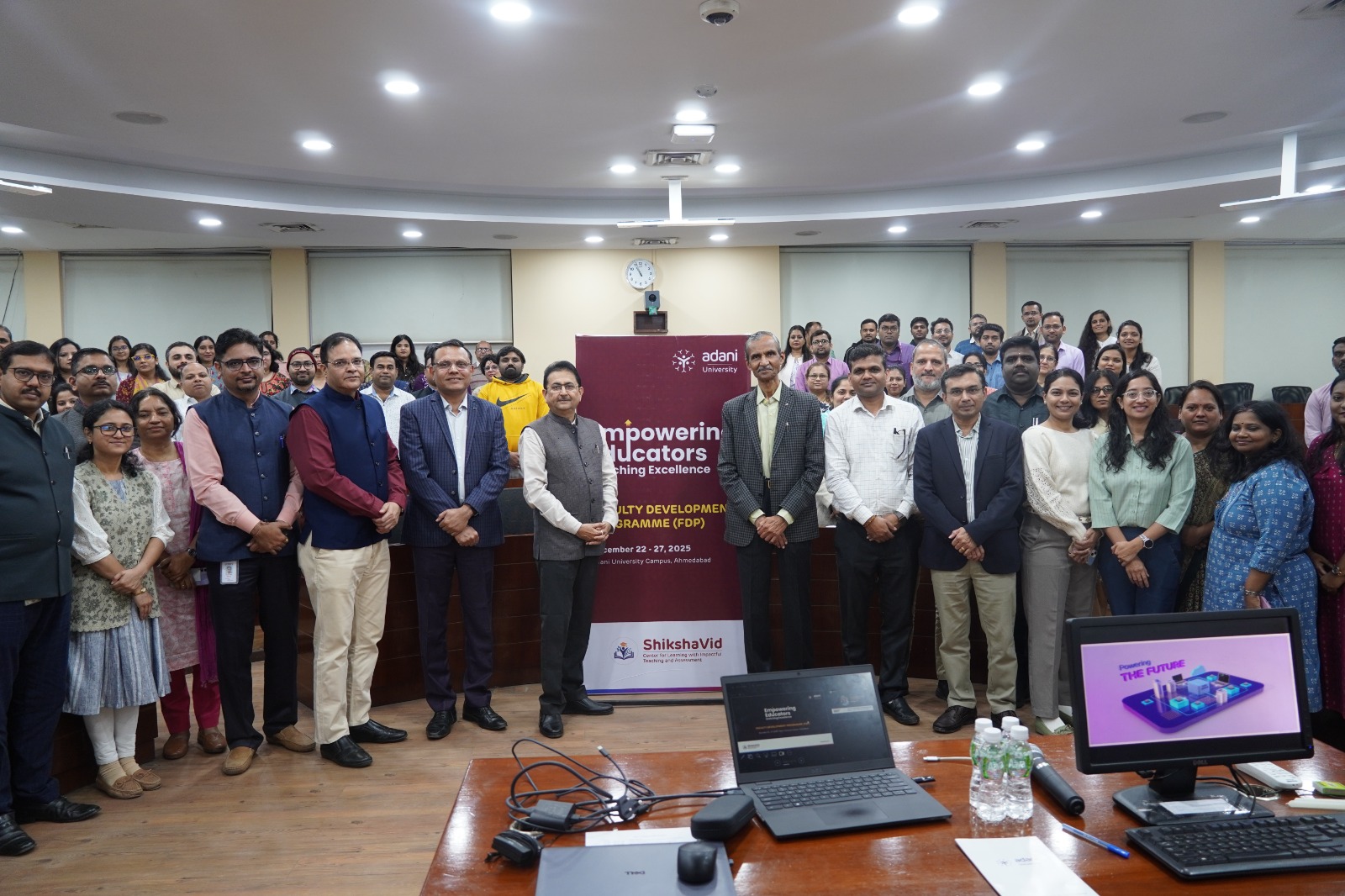

As universities across India respond to the evolving academic framework shaped by the National Education Policy (NEP) 2020, strengthening faculty capability has emerged as a key priority. Against this backdrop, Adani University concluded ShikshaVid, a five-day intensive Faculty Development Programme (FDP) aimed at enhancing pedagogical effectiveness, academic leadership and classroom engagement.
Held from December 22 to 27 at the university’s campus in Shantigram, the programme brought together faculty members from across disciplines for structured engagement with contemporary teaching practices. The initiative was designed to equip educators with practical tools and perspectives to address changing student needs, emerging technologies and increasing expectations from higher education institutions.

The programme opened with an inaugural address by Vasant Gadhavi, Executive Director, Adani Foundation—the social development and community engagement arm of the Adani Group. In his remarks, Gadhavi highlighted the role of empowered teachers in nation-building and sustainable development, emphasising continuous learning, adaptability and leadership as essential qualities for educators navigating a rapidly changing academic environment.
Provost Dr Dhaval Pujara reflected on the evolving role of the “Guru” in today’s education ecosystem. He described a teacher as one who guides students, understands their challenges, continually renews knowledge and uplifts learners beyond academic instruction. His address underscored the growing expectation for faculty members to act as mentors and facilitators of holistic development, rather than limiting their role to content delivery.
Over the five days, ShikshaVid covered a wide range of themes, including pedagogical innovation, active and project-based learning, leadership and mentoring, emotional well-being in academic workplaces, communication skills and the effective implementation of NEP 2020.
Sessions also explored the use of Information and Communication Technologies (ICT), Generative Artificial Intelligence (GenAI) in teaching, case writing and strengthening industry–academia collaboration. Interactive workshops, hands-on activities and participant-led presentations encouraged peer learning and reflective practice.
With the conclusion of ShikshaVid, the programme highlighted the increasing emphasis being placed on faculty development as a cornerstone of higher education reform.
The initiative reflected a broader recognition that sustained investment in teacher capacity-building is critical to improving classroom outcomes, student engagement and institutional readiness for the next phase of India’s higher education journey.