




Virendra Pandit
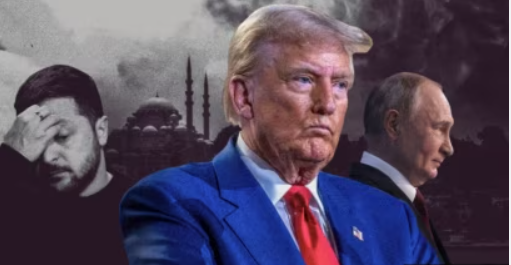
New Delhi: With his high-profile August 15 summit in Alaska with Russian President Vladimir Putin producing zero results, a subdued US President Donald Trump on Friday called on both Russia and Ukraine to “stop where they are” and end their brutal war, the media reported on Saturday.
Even his nearly 150-minute-long telephonic conversation with Putin on Thursday yielded no breakthrough, pushing him to say he planned to meet the Russian leader in Budapest, Hungary.
Trump’s frustration with the ongoing conflict, which started with the Russian invasion of Ukraine on February 24, 2022, has surfaced repeatedly in the nine months since he returned to office on January 20. But with his latest comments, he appeared to be edging back in the direction of pressing Ukraine to give up on retaking land it has lost to Russia.
“Enough blood has been shed, with property lines being defined by War and Guts,” he said in a Truth Social post soon after hosting Ukrainian President Volodymyr Zelenskyy and his team at the White House for more than two hours of talks. This was the two presidents’ fifth face-to-face meeting since Trump returned to the White House in January.
“They should stop where they are. Let both claim Victory, let History decide!”
Later, soon after arriving in Florida for the weekend, Trump urged both sides to “stop the war immediately” and implied that Moscow can keep territory it has taken from Kyiv.
“You go by the battle line wherever it is — otherwise it is too complicated,” he told reporters.
He has been shifting his policy on this protracted war. During the presidential elections in 2024, he claimed he would end the war in “48 hours.” Then, after meeting with Zelenskyy in New York on the sidelines of the annual UN General Assembly in September, he even said he believed the Ukrainians could win back all the territory they had lost to Russia. Then, he insisted that Kyiv would have to concede land lost to Russia to end the war.
On his part, Zelenskyy sidestepped directly answering a question about Trump nudging Ukraine to give up land.
“The US President is right, we have to stop where we are, and then to speak,” he said when reporters asked about Trump’s social media post, which he had not seen.
The US President also signalled to Zelenskyy on Friday that he is leaning against selling him long-range Tomahawk missiles, high-tech weaponry that the Ukrainians believe could be a game changer in helping prod Putin to the negotiating table.
Zelenskyy said he had a “proposition” in which Ukraine could provide the United States with its advanced drones, while Washington would sell Kyiv the Tomahawk cruise missiles.
But Trump said he was hesitant to tap into the existing US supplies, a turnabout after days of suggesting he was seriously weighing sending the missiles to help Ukraine beat back Russia’s invasion.
“I have an obligation also to make sure that we’re completely stocked up as a country, because you never know what’s going to happen in war and peace,” he said. “We’d much rather have them not need Tomahawks. We’d much rather have the war be over to be honest.”
Trump’s latest rhetoric on Tomahawks may have disappointed the Ukrainians. In recent days, he was ready to sell Ukraine the Tomahawks, even as Putin warned that such a move would further strain the US-Russian relationship.
But following Thursday’s call with Putin, Trump began downplaying the prospects of Ukraine getting the missiles, which have a range of about 995 miles (1,600 kilometres).
Zelenskyy wants the Tomahawks to strike deep into Russian territory and target key military sites, energy facilities and critical infrastructure. This could compel Putin to take Trump’s calls for direct negotiations to end the war more seriously.
Putin warned Trump that supplying Kyiv with the Tomahawks “won’t change the situation on the battlefield, but would cause substantial damage to the relationship between our countries,” Yuri Ushakov, the Russian President’s foreign policy adviser, said.
Trump said on Friday it was “to be determined” if Zelenskyy would be involved in the upcoming talks in Hungary–suggesting a “double meeting” with the warring countries’ leaders was likely the most workable option for productive negotiations. “These two leaders do not like each other, and we want to make it comfortable for everybody,” he added.
Despite efforts, Putin has shown no interest in meeting with Zelenskyy and Moscow has only intensified its bombardment of Ukraine.
In a related development, Trump on Friday reiterated his claim that India would no longer buy Russian oil.
He told Zelenskyy that, “India is not going to be buying Russian oil anymore,” adding that the South Asian nation has already reduced its purchases.
“They have more or less stopped; they are pulling back. They bought about 38 percent of the oil, and they won’t be doing it anymore,” he added.
His assertion came despite New Delhi officially rejecting the claim. In a statement on Thursday, Randhir Jaiswal, spokesperson of the Ministry of External Affairs (MEA), said, “India is a significant importer of oil and gas. It has been our consistent priority to safeguard the interests of the Indian consumer in a volatile energy scenario. Our import policies are guided entirely by this objective.”
India’s energy priorities focus on stable prices and secure supplies, alongside broad-basing energy sourcing and diversifying imports to adapt to global market changes.