




Manas Dasgupta
NEW DELHI, May 23: A turbulence-hit IndiGo flight pilot managed to land the plane at the Srinagar airport safely with all the 227 passengers and crew members on-board unharmed after the Pakistan air traffic control refused permission to use its airspace to escape from the stormy weather.
New details indicate that the flight encountered a grave in-flight emergency after flying into an intense storm. These details, announced by the civil aviation watchdog Directorate General of Civil Aviation (DGCA), suggest that the pilots were fighting multiple cockpit warnings and instrument failures after entering a hailstorm. At one stage, the IndiGo A321neo aircraft operating as Flight 6E-2142 dropped 8,500 feet per minute. The normal rate of descent is 1,500 to 3,000 feet per minute.
According to the DGCA on Friday, the pilot of the Delhi-Srinagar IndiGo flight 6E-2142 of May 21 had first sought permission from the northern air traffic control managed by the Indian Air Force for permission to turn towards Pakistan to escape the bad weather conditions but the permission was denied. The pilot then contacted Lahore air traffic control for permission to enter the Pakistani airspace for a brief period but the neighbouring country turned it down, putting the lives of all on-board at risk.
However, Defence sources have refuted a part of this claim and said the IAF-controlled Northern Area Control Centre was not authorised to provide Indian aircraft permission to enter international airspace, which rests with Delhi Air Traffic Control.
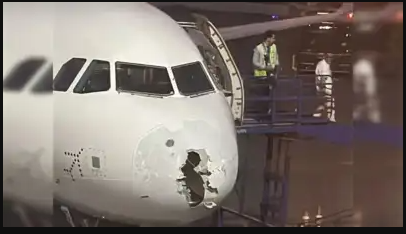
With the pilot left with no other option, he had to continue flying fighting against stormy weather and successfully landed the aircraft in Srinagar despite major damages to the aircraft. The DGCA report said the plane suffered heavy damage on its nose due to the storm.
The journalist and Trinamool Congress leader Sagarika Ghose, who along with four other TMC Members of Parliament were among the 220 passengers in the flight, later described the turmoil as the “near death experience.” A five-member delegation of Trinamool Congress comprising Derek O’Brien, Nadimul Haque, Sagarika Ghose, Manas Bhunia, and Mamata Thakur, was on the Srinagar-bound flight to call on the survivors of Pakistani shelling on the borders.
“It was a near death experience. I thought my life was over. People were screaming, praying and panicking,” Ms Ghose said. “Hats off to the pilot who brought us through that. When we landed we saw the nose of the plane had blown up,” she said, adding, the delegation thanked the pilot after the landing. Videos of the moments of turbulence emerged on social media showing panicked passengers praying for their lives as the plane swayed.
While flying through the thunderstorm, the plane faced strong turbulence and was hit by powerful upward and downward air currents, known as “updrafts and downdrafts.” This caused the autopilot to switch off and led to sudden changes in the aircraft’s speed. As the pilot carried on the onward journey, the aircraft’s rate of descent reached 8,500 ft/min(feet per minute) and had to be flown manually till it exited the storm.
Pakistan has shut its airspace for Indian flights. India closed its airspace for Pakistani carriers after the April 22 Pahalgam terror attack.
According to the DGCA statement, the flight was at an altitude of nearly 36,000 feet near Punjab’s Pathankot when it was struck by a hailstorm followed by severe turbulence.
As trouble rose, the pilot first sought permission from the northern air traffic control to turn towards the international border – where tensions were at their peak during Operation Sindoor between May 7 and 10 – to avoid the storm. However, the request was denied.
“As per crew statement, they requested Northern control (IAF) for deviation towards left (International Border) due to weather on the route, however, it was not approved,” the statement said.
The crew then sought permission to enter the Pakistani airspace, however, they dismissed the request, putting Indian lives in danger. “…Crew contacted Lahore to enter into their airspace to avoid the weather, but the same was refused too,” the statement said.
With limited options and a fast-approaching thunderstorm, the pilots initially considered a return to Delhi. However, by then, the aircraft was already too close to the approaching clouds. Weighing the proximity and potential hazards, the crew decided to penetrate the weather head-on to proceed toward Srinagar.
Once inside the thunderstorm, the aircraft experienced severe hail impact and violent turbulence. Several critical systems began flagging malfunctions. DGCA’s preliminary assessment confirms that the aircraft suffered Angle Of Attack (AOA) fault while alternate law protection was lost. These failures were triggered by the aircraft’s flight control systems as the plane was tossed vertically by intense updrafts and downdrafts. Amid this chaos, the autopilot disengaged. The crew was forced to assume full manual control under rapidly fluctuating airspeed indications and extreme stress.
At one point, the aircraft entered a steep descent, recording a rate of 8,500 feet per minute. Compounding the crisis were multiple stall warnings and alerts indicating the aircraft was nearing its Maximum Operating Speed and Mach number.
The pilots, relying on manual flying skills, kept the jet stable until it emerged from the weather system. The aircraft continued toward Srinagar on the same heading to exit the storm in the shortest possible time. An Angle of Attack (AoA) sensor fault, possibly from hail or ice, can disrupt the stall warning system, which alerts pilots with lights, sounds, or vibrations when the wing’s angle to the airflow risks a stall, where the plane loses lift and control.
In this situation, the Airbus A321’s fly-by-wire system switched to Alternate Law, disabling protections like stall and overspeed safeguards. Alternate Law is a degraded flight control mode in Airbus fly-by-wire systems where certain automated protections, like stall and overspeed safeguards, are disabled, requiring more direct pilot control.
Unreliable airspeed readings, likely from blocked pitot tubes (which measure airspeed), triggered repeated stall and maximum speed warnings. Amid severe turbulence, the A321 descended rapidly at 8,500 feet per minute at one stage, far exceeding the typical 1,500-3,000 feet per minute for a standard approach.
With the autopilot system having tripped, the pilots manually flew the jetliner into Srinagar, declaring an emergency and made a safe landing. Upon stabilisation, the crew completed all Electronic Centralised Aircraft Monitoring (ECAM) checklist actions and declared a “PAN PAN” – the international standard urgency signal that someone aboard a vehicle uses to declare an emergency.
Srinagar ATC guided the flight through its final descent. Despite earlier system malfunctions, the aircraft landed safely in Srinagar without further incident. Following landing, a standard post-flight walk-around inspection revealed significant damage to the aircraft’s nose cone, specifically the radome, which houses weather radar and is vulnerable to hail impact.
There were no injuries reported among passengers or crew. The DGCA has confirmed that the incident is under formal investigation. Technical teams from IndiGo and the regulator are currently assessing both flight data and cockpit voice recordings. IndiGo confirmed in a statement that the aircraft was undergoing mandatory inspections and maintenance before being cleared for further operations.