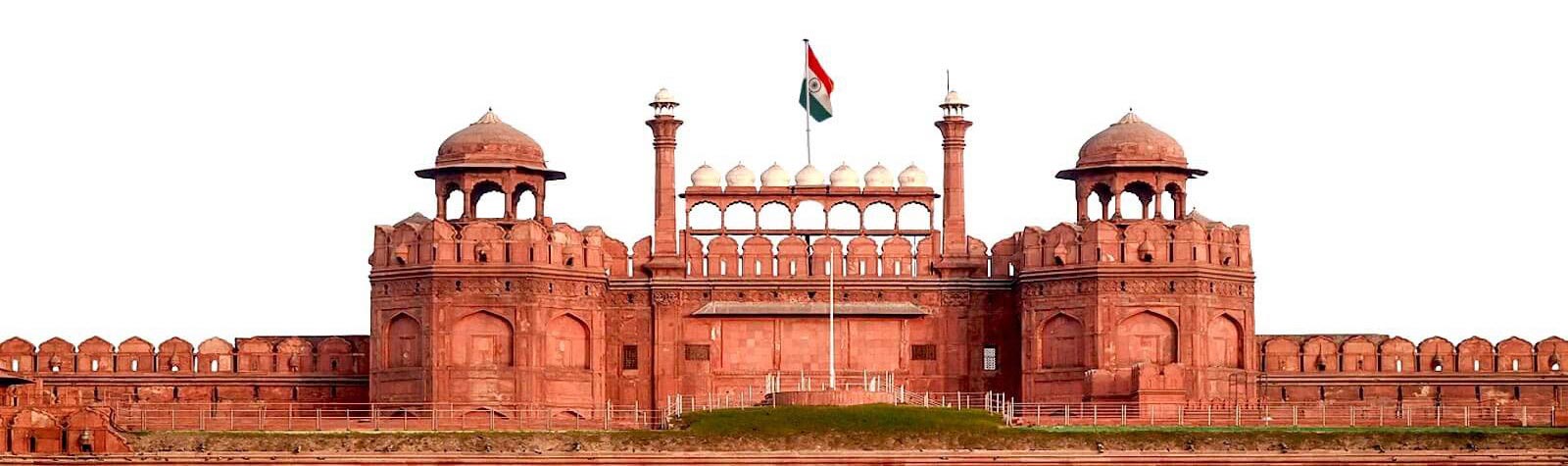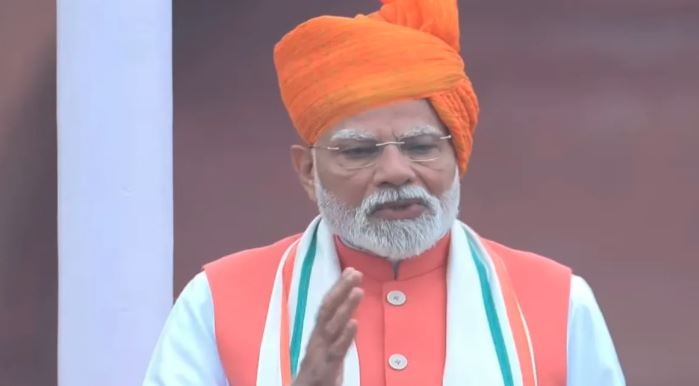


15 August : On our 79th Independence Day, PM Narendra Modi’s speech at the Red Fort didn’t just mark another ceremonial tradition or function, it was a political and strategic manifesto, outlining his vision of power, national resolve, and the shifting position of India in a volatile global context.
PM Modi’s address reveals an underlying recalibration of two things, how India perceives itself? And how it wants to be perceived by the world?
PM Modi began with laying floral tributes at Rajghat, invoking the sacrifices of Mahatma Gandhi, drawing on the emotional strength and continuity of the nation’s freedom struggle, and calling on the “140 crore Indians” to treat Independence Day as a “festival of resolutions.” There was a clear signal that India’s current leadership is intent on redefining what post independence sovereignty means in the geopolitical arena of 2025.
Central to PM Modi’s narrative was the sustained emphasis on “self-reliance” (aatmanirbharta). In PM Modi’s words, self-reliance isn’t just economic policy or a slogan from the pandemic years. Rather, it serves as a defence against dependence on other countries, a point of national pride, and even an evolution of India’s path from “slavery and poverty” to global prominence.
There’s an important shift here: PM Modi isn’t content to keep up a “developing country” attitude, nor to merely chase targets set by others. When he claims that India has met its clean energy targets for 2030 five years ahead of time, or that “Made-in-India” semiconductors will soon enter the global market, the intent is to position India as a rule-setter, not a rule-taker.
This pivot to assertive self reliance gains further depth when viewed against PM Modi’s strong words on security. Recent events like the Pahalgam terror attack and India’s response in form of Operation Sindoor served a platform for PM Modi to articulate a new, less patient doctrine. By explicitly referencing a cross border military operation deep in Pakistan and POK, he was making a direct point: India’s threshold for both terrorism and for what he called “nuclear blackmail” has changed. The linkage to suspending the Indus Water Treaty, coupled with the blunt assertion that “blood and water won’t flow together,” signals a strategic willingness to weaponize even traditionally important areas of bilateral engagement. The broader inference is clear, India is no longer interested in relationships that appear transactional, or in maintaining precedents that no longer advance its interests.
Digging deeper, PM Modi’s vision for “Naya Bharat” looks like a nation ready to challenge the weaknesses of its institutions and economic dependencies. India’s emergence as one of the key voices on critical minerals, renewable energy, and even space exploration signifies a paradigm shift. His mention of the Chenab Bridge as a “symbol of Azad Bharat’s ambition” might sound like a tangent, but it functions as a potent metaphor, India is literally and figuratively building bridges to its own future, emphasizing innovation and risk taking over incrementalism.
Yet, alongside this ambitious, even aggressive stance, there’s a recurring theme of collective memory and national unity. PM Modi’s references to women’s leadership, the contributions of figures like Babasaheb Ambedkar and Pandit Nehru, and his emotional resonance with those affected by recent natural calamities in Uttarakhand and Jammu & Kashmir, suggest a calibrated balance. This narrative aims to blend muscular nationalism with the softer, inclusive ideals enshrined in the Indian Constitution.
The messaging for the youth was explicit and strategic. With India on the cusp of what is being called the “youth dividend,” Modi’s speech doubled down on tech optimism, championing homegrown social media, propelling over 300 space tech startups, and positioning astronaut Shubanshu Shukla as an emblem for aspiration. This is more than recruitment, it’s an attempt to harness optimism as fuel for what he sees as India’s “coming of age” moment. The 2047 vision for a developed India rests heavily on this younger generation, coding, innovating, and dreaming for the world, not just for India.
There is, of course, a deep current of defiance. Modi’s warnings to forces abroad and at home, whether they be terrorists, neighboring states relying on nuclear threats, or lingering remnants of colonial mindset, reflect an India growing impatient with old formulas. This is not so much a pivot to hard power as it is an assertion that economic resilience and technological leadership are as important as military capability.
In total, PM Modi’s 79th Independence Day speech is best read as a statement of India’s intent: a self aware, assertive nation, unwilling to be cast in roles written elsewhere, and eager to redraw boundaries on its own terms. For India’s neighbors, this was a warning; for its youth, a call to build; for global powers, a declaration that India has arrived at the high table and doesn’t intend to leave soon. The challenge, as always, will be how these ambitions are converted into sustainable policy, and whether the underlying message finds its translation on the ground, from the bridges in distant valleys to the circuitry of the world’s next generation of chips.
Dr. Jay Desai
Dr. Hitesh Patel