US Planning Blockade of Strait of Hormuz, UK Refuses Support to US









Manas Dasgupta
NEW DELHI, Apr 13: The United States President Donald Trump and his senior advisers are learnt to be examining the possibility of resuming limited military strikes against targets in Iran, alongside the naval blockade of the Strait of Hormuz even as the United Kingdom made it clear that it would not support the US move to impose a blockade near Iran even amid rising global tensions.
The US has already ordered the blockade and the additional measures come as options to break the current impasse in efforts to reach a lasting agreement with Tehran, following the collapse of direct negotiations in Pakistan over the weekend. The US and Iran had held 21 hours of face-to-face talks in Islamabad on Sunday. The negotiations ended without a deal, leaving the status of a fragile two-week ceasefire uncertain. The talks were led on the US side by Vice President JD Vance, along with special envoy Steve Witkoff and Jared Kushner and ended without a deal after Iran declined to accept core American demands, particularly regarding its nuclear programme.
Trump spent much of Sunday at his resort in Doral in Florida in the Miami suburbs. He appeared on a Fox News programme, played golf, and consulted with advisers. Aides said he continues to leave open the path to a diplomatic resolution, even as he has maintained the blockade and reiterated threats to strike Iranian infrastructure.
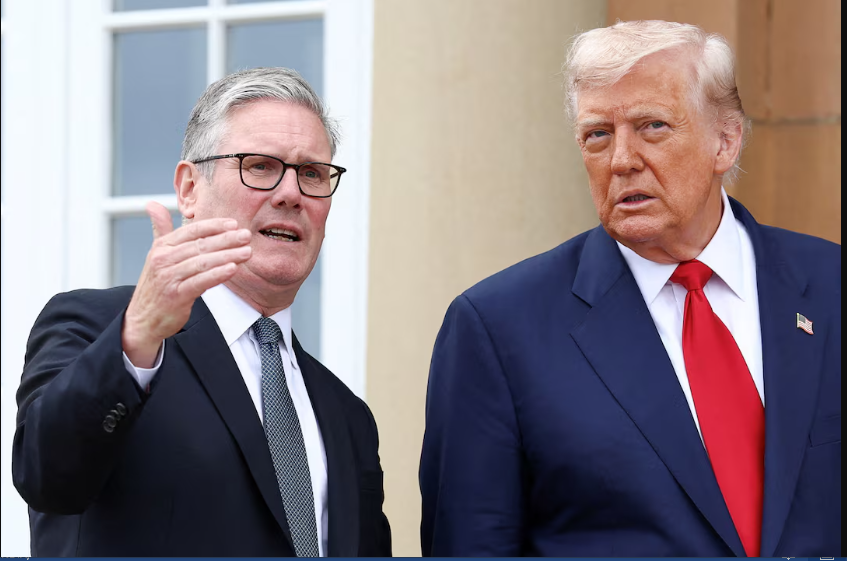
The UK Prime Minister Keir Starmer has made it clear that the UK would not support the US move to blockade and stressed that Britain’s priority was not escalation, but ensuring stability and safe passage through one of the world’s most crucial shipping routes. Starmer firmly stated that despite growing international pressure, the UK will not get involved in the Iran conflict without strong legal grounds and a clear plan. He underlined that his government’s position was to avoid being pulled into a wider war, making it clear that Britain would act cautiously and independently in the situation.
Taking to Truth Social network, Mr Trump said the U.S. forces would destroy any Iranian “fast attack ships” that approach the American naval blockade of Iranian ports that came into effect on Monday. “Warning: If any of these ships come anywhere close to our BLOCKADE, they will be immediately ELIMINATED,” Mr Trump said on his Truth Social network, adding that the rest of Iran’s navy had been “completely obliterated.”
The U.S. military would be “using the same system of kill that we use against the drug dealers on boats at Sea,” the President said, referring to air strikes on alleged narcotics boats off the coast of Venezuela. In his Fox News appearance, Trump said, “I would hate to do it, but it’s their water, their desalination plants, their electric-generating plants, which are very easy to hit.”
A full-scale resumption of the bombing campaign that formed part of the earlier phase of the conflict is also under review, though officials indicated it was viewed as less probable because of the risk of further regional instability and Trump’s stated reluctance to become entangled in extended military engagements abroad.
Another possibility involves maintaining a shorter-term blockade while pressing US allies to assume responsibility for ensuring secure passage through the strait over the longer term. A White House spokeswoman, Olivia Wales, declined to detail the specific options under consideration. “The President has already ordered a naval blockade on the Strait of Hormuz, ending the Iranian extortion, and wisely keeps all additional options on the table,” she said.
Wales added that any claims about the president’s next steps amounted to speculation. Trump has asserted that Iran was interested in returning to negotiations, and an official close to the US team confirmed that an offer from Washington remained available.
Reza Amiri Moghadam, a senior Iranian delegation member in Islamabad, described the talks as an initial step. In a social media post, he wrote that the Islamabad discussions “laid the foundation for a diplomatic process that, if trust and will are strengthened, can create a sustainable framework for the interests of all parties.”
US officials have set out clear conditions for any further talks. These include Iran opening the Strait of Hormuz to all traffic without the imposition of tolls, the complete cessation of uranium enrichment activities and the dismantling of related facilities, the transfer of its stockpile of highly enriched uranium, agreement to a wider regional security arrangement involving US allies, and an end to financial and material support for proxy groups, including Hezbollah in Lebanon and the Houthi rebels in Yemen.
The negotiations in Islamabad broke down over Iran’s refusal to relinquish its nuclear programme, Trump claimed. In two separate Truth Social posts issued after the negotiations in Islamabad concluded, Trump said the discussions had lasted close to 20 hours and that most points had been agreed upon. The sole exception, he said, was the nuclear question. Effective immediately, he said, the United States Navy — which he described as the finest in the world — would begin the process of blockading any and all ships trying to enter or leave the Strait of Hormuz.
“So, there you have it, the meeting went well, most points were agreed to, but the only point that really mattered, NUCLEAR, was not. Effective immediately, the United States Navy, the Finest in the World, will begin the process of BLOCKADING any and all Ships trying to enter, or leave, the Strait of Hormuz,” Trump wrote.
Trump called the situation “WORLD EXTORTION” and stated that leaders of countries, especially the United States, would never be extorted. He said he had instructed the Navy to seek and interdict every vessel in international waters that had paid a toll to Iran. “No one who pays an illegal toll will have safe passage on the high seas,” he wrote. American forces would also begin destroying the mines the Iranians had laid in the strait. He warned that any Iranian who fired at US forces or at peaceful vessels would be “BLOWN TO HELL.”
Pakistan’s Prime Minister Shehbaz Sharif said on Monday a ceasefire between the United States and Iran was “holding” and that efforts were underway to reach an agreement after weekend talks failed to do so. “The ceasefire is still holding and, as I speak, full efforts are underway to resolve the outstanding issues,” Sharif told a cabinet meeting in brief televised remarks.
The head of the U.N. maritime agency said Monday no country had a legal right to block shipping in the Strait of Hormuz, a trade passage paralysed by the U.S.-Iran war. “In accordance to international law, no countries have the right to prohibit the right of innocent passage or the freedom of navigation through international straits that are used for international transit,” the International Maritime Organization’s Secretary General Arsenio Dominguez told a news conference.