



Manas Dasgupta
NEW DELHI, Dec 12: The Union Cabinet on Friday approved an allocation of Rs 11,718 crores against the proposal for conducting Census operations in 2027 to enumerate the population in the country.
A statement issued by the government to this effect, however, did not mention a separate budgetary allocation for updating the National Population Register (NPR), which is the first step for the creation of a countrywide National Register of Citizens.
In 2019, the Union Cabinet chaired by Prime Minister Narendra Modi approved ₹3,941.35 crore for updating the NPR and ₹8,754.23 crore for conducting the Census of India 2021, which could not be conducted due to the COVID-19 pandemic. NPR, which was first collected in 2010 and updated in 2015 and already has a database of 119 crore residents, was to be updated with the first phase of Census in 2020.
While NPR data, which is maintained family-wise, can be shared with State governments and government agencies, the Census Act, 1948 prohibits sharing of such data and only aggregate data up to the village level is provided to government departments and private users.
The government’s statement on Friday said the “largest administrative and statistical exercise in the world” will ensure that data was provided to ministries in a “clean, machine-readable and actionable format” as part of the “Census-as-a-Service (CaaS)” initiative.
“Data dissemination will be much better and in a user friendly way so that all the queries on required parameters for policy making will be made available on the click of a button,” it said. This will be the first digital Census and the first to enumerate caste in independent India.
“The current endeavour would be to make available the coming Census data at the shortest possible time across the country. Efforts will also be made to disseminate Census Results with more customised visualisation tools,” the statement said.
Briefing the media in New Delhi on Friday, the Information and Broadcasting Minister Ashwini Vaishnaw said Census 2027 would be conducted in two phases – Phase I and Phase II.
The Minister of State in the Ministry of Home Affairs Nityanand Rai had in a written reply told the Lok Sabha that the 2027 Census would be conducted through digital means. It is planned to collect data through Mobile Apps. Respondents may also self-enumerate through web-portal. The Census process is to be managed and monitored through a dedicated portal.
In Census, information of every individual is collected at the place where they are found during the entire period of enumeration. Further, Migration data is collected for each and every individual based on their place of birth and place of last residence. The census also collects information on the duration of stay at the current residence and the reason for migration. Questionnaire for Census is notified before conducting field work by the Central Government through Official Gazette.
The government said around 18,600 technical manpower would be engaged for about 550 days at the local level. “In another words, around 1.02 crore man-days employment would be generated. Further, the provision of technical manpower at Charge/ District/ State level will also result in capacity building as the nature of job will be related to digital data handling, monitoring and coordination. This will also help in future employment prospects of these persons,” it said.
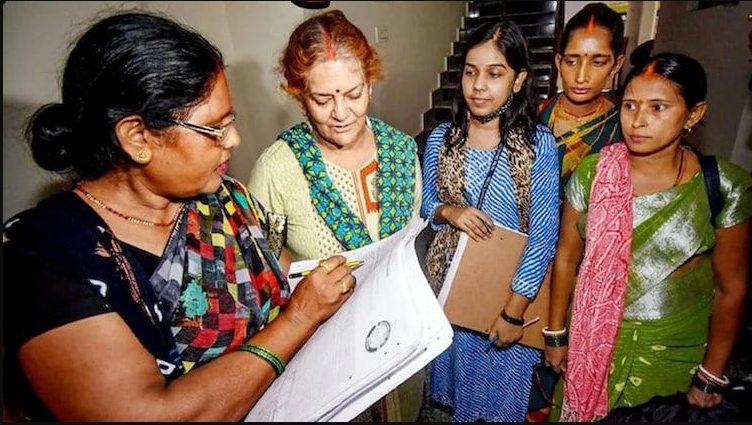
According to the Census Act, 1948 and the Census Rules, 1990, enumerators who would record the data are all government officials, mostly school teachers. The government said that the Census process involves visiting each household and canvassing separate questionnaires for House-listing and Housing Census and Population Enumeration.
“The enumerators, generally government teachers and appointed by the State Governments, will be doing the field work of Census in addition to their regular duties. Other Census functionaries at Sub-district, District and State levels will also be appointed by the State/District Administration,” it said.
Data will be collected using mobile applications that will be available for both Android and iOS versions and a dedicated portal, namely Census Management and Monitoring System (CMMS), has been developed for managing and monitoring the entire Census process in real time.
“Another innovation for Census 2027 is House-listing Block (HLB) Creator web map application to be used by the Charge Officers. Option to self-enumerate will be provided to the public. Suitable security features have been provisioned for this mammoth digital operation,” it said. The Census of India will be conducted in two phases: House-listing and Housing Census from April to September 2026 and Population Enumeration in February 2027. For the Union Territory of Ladakh and snow bound non-synchronous areas of the Union Territory of Jammu and Kashmir and the States of Himachal Pradesh and Uttarakhand, Population Enumeration will be conducted in September 2026.
About 30 lakh field functionaries including enumerators, supervisors, master trainers, charge officers and Principal and District Census Officers will be deployed for data collection, monitoring and supervision of Census operations. All the Census functionaries will be paid suitable honorarium as they will be doing this work in addition to their regular duties.
Census 2027 will have a focused and wider publicity campaign for nationwide awareness, inclusive participation, last-mile engagement and support for field operations.
The Cabinet Committee on Political Affairs, in its meeting on April 30 had decided to include caste enumeration in the upcoming Census. “With the huge social and demographic diversity in our country and related challenges, the Census 2027 will also capture caste data electronically in second phase, i.e. Population Enumeration (PE),” it said.
Census 2027 will be the 16th Census in the country and the 8th after Independence. Census is the biggest source of primary data at village, town and ward level, providing micro level data on various parameters including Housing Condition, Amenities and Assets, Demography, Religion, Scheduled Caste and Scheduled Tribe, Language, Literacy and Education, Economic Activity, Migration and Fertility. The Census Act, 1948 and the Census Rules, 1990 provide the legal framework for conduct of Census.