


Virendra Pandit
New Delhi: With US President Donald Trump’s August 15 meeting in Alaska with his Russian counterpart Vladimir Putin bearing no fruits so far, Europe and India have, in their own ways, are refreshing efforts to end the biggest European conflict after the Second World War (1939-45) that has created fresh challenges to geopolitics and world economy.
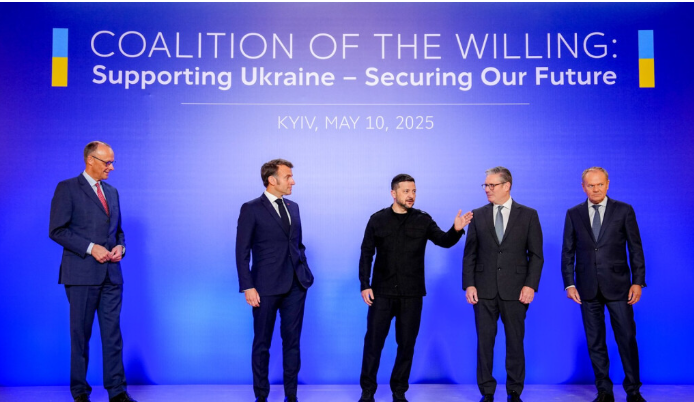
A concerned Europe—because the fires are burning its borders with Russia—has started peace efforts afresh. Although no ceasefire is in sight, 26 European nations have pledged to provide postwar security guarantees to Ukraine, including an international force on land and sea and in the air, French President Emmanuel Macron said after a summit meeting of Kyiv’s allies on Thursday.
After the summit, he, fellow European leaders and Ukrainian President Volodymyr Zelenskiy held a call with President Donald Trump, and US contributions to the guarantees would be finalised in the coming days, the media reported on Friday.
The US President asked Europe to stop buying Russian oil, and pressurize China as well for an early end of the war. Ironically, he did not refer to the 50 percent tariff levied against India for buying Russian crude, nor did he say why the US has not done the same against China which buys even larger quantities of Russian oil.
The meeting of 35 leaders from the “Coalition of the Willing” — of mainly European countries – was intended to finalise security guarantees and ask Trump for the backing that Europeans say is vital to make such guarantees viable.
Security guarantees are intended to reassure Ukraine and deter Russia, which launched a full-scale invasion of Ukraine on February 24, 2022, from attacking its neighbour again.
“The day the conflict stops, the security guarantees will be deployed,” Macron told a press conference at the Elysee Palace in Paris, standing alongside Zelenskiy.
European officials say peace still looks a distant prospect for now but they want to be ready whenever the war ends. They also see the planning of security guarantees as a way to reassure Kyiv of their support and hope Trump will join their efforts.
The lack of unanimity even among the European Union members are stark. Macron initially said the 26 nations – which he did not name – would deploy to Ukraine. But he later said some countries would provide guarantees while remaining outside Ukraine, for example by helping to train and equip Kyiv’s forces. He did not say how many troops would be involved in the guarantees.
Germany said it would decide on a military commitment only when conditions were clear, including the extent of US involvement in security guarantees.
Italian Prime Minister Giorgia Meloni made clear she would not send troops to Ukraine but said Rome was open to monitoring a ceasefire and training Ukrainian troops outside the country.
France and Britain, which co-chair the coalition, indicated they are open to deploying troops to Ukraine after the war ends.
“We are working out which countries will take part in which security component,” Zelenskiy said, adding “Twenty-six countries agreed to provide security guarantees.”
“Today, for the first time in a long time, this is the first such serious, very specific substance.”
On his call with the coalition leaders, Trump said Europe must stop purchasing Russian oil that he said is helping Moscow fund its war against Ukraine, a White House official said.
“The President also emphasized that European leaders must place economic pressure on China for funding Russia’s war efforts,” the official said.
Macron said the coalition and the US had agreed to work more closely on future sanctions, notably on Russia’s oil and gas sector, and on China.
European governments have said their forces in Ukraine would need their own US security guarantees as a “backstop.”
However, Trump has made no explicit commitment to go that far.
His special envoy, Steve Witkoff, met French, British, German, Italian and Ukrainian senior diplomats ahead of the Thursday summit, before briefly attending the opening session.
Having rolled out the red carpet in Alaska, Trump on Wednesday accused Putin of “conspiring” with China and North Korea after the three countries’ leaders staged a show of unity in Beijing at a lavish commemoration of the end of the Second World War.
Putin told Kyiv on Wednesday there was a chance to end the war in Ukraine via negotiations “if common sense prevails,” an option he said he preferred, although he was ready to end it by force if that was the only way.
He also ruled out the deployment of troops from NATO nations to Ukraine as part of a peace settlement. But NATO Secretary-General Mark Rutte dismissed his objections.
“Why are we interested in what Russia thinks about troops in Ukraine? It’s a sovereign country,” he said in Prague before joining the Paris summit by video link. “Russia has nothing to do with this,” he said. “I think we really have to stop making Putin too powerful.”
Meanwhile, India has regretted the Ukraine conflict’s collateral consequences, including high prices of fuel, saying countries of the Global South have been left to fend for themselves, as New Delhi underscored that diplomatic efforts hold the promise to end the war and bring lasting peace.
As early as in September 2022, Prime Minister Narendra Modi had told Russian President Vladimir Putin that “Now is not an era of war.” India has since tried to persuade both the sides to use diplomacy and dialogue to end the war. Recently, India also sent humanitarian aid to Ukraine.
“We maintain that the loss of innocent lives is unacceptable, and no solution can be found on the battlefield,” India’s Permanent Representative to the UN, Ambassador Parvathaneni Harish, said on Thursday.
Addressing the UN General Assembly debate on ‘the situation in the temporarily occupied territories of Ukraine’, he underscored that the wholehearted participation and commitment of all stakeholders are critical for lasting peace. India welcomes the “recent positive developments” in this direction.
Harish said New Delhi endorsed the Alaska summit of August 15 between US President Donald Trump and Russian President Vladimir Putin, and appreciated the progress made there.
“We also note the subsequent diplomatic efforts by the US President in engaging with Ukrainian President and European leaders in Washington.”
“We believe all these diplomatic efforts hold the promise of bringing to an end the ongoing conflict in Ukraine and opening up prospects for a lasting peace.”
Three days after rolling out the red carpet for Putin in Alaska, Trump hosted Ukrainian President Volodymyr Zelensky and seven other European leaders – German Chancellor Friedrich Merz, French President Emmanuel Macron, United Kingdom Prime Minister Keir Starmer, Italian Prime Minister Giorgia Meloni, Finnish President Alexander Stubb, President of the European Commission Ursula von der Leyen and NATO Secretary-General Mark Rutte – in the White House.
Harish said PM Modi remains in touch with Putin, Zelensky and the European leadership on the evolving situation.
Underlining that an early end to the Ukraine conflict is in everyone’s interest, Harish referred to PM Modi’s message that this is “not an era of war” and emphasised that New Delhi stands ready to support diplomatic efforts for an early end to the conflict.
Hours before India’s statement at the UNGA, PM Modi spoke with European Council President Antonio Costa and von der Leyen.
“Exchanged views on issues of mutual interest and efforts for bringing an early end to the conflict in Ukraine,” he said in a post on X.
Earlier on Thursday, External Affairs Minister S Jaishankar also spoke with Ukrainian Foreign Minister Andrii Sybiha and discussed bilateral cooperation as well as the Ukraine conflict.
India supports an early end to this conflict and the establishment of an enduring peace, Dr. Jaishankar said.
Sybiha said he informed Dr. Jaishankar about the current battlefield situation and Ukraine’s efforts to achieve a just peace.
“We rely on India’s authoritative voice and active role in supporting the full cessation of hostilities and broader international peace efforts,” Sybiha said, adding that he and Dr. Jaishankar agreed to meet during the upcoming high-level UN General Assembly session this month.
PM Modi met Putin on the sidelines of the Shanghai Cooperation Organisation (SCO) Summit in Tianjin, China, earlier this week, where they exchanged views on regional and global developments, including the peaceful resolution of the conflict in Ukraine.
Last week, PM Modi and Zelensky spoke over phone and exchanged views on the ongoing conflict, its humanitarian aspect, and efforts to restore peace and stability”.
Harish stressed that India has consistently advocated that the path of dialogue and diplomacy is the only way forward to end the ongoing conflict in Ukraine, no matter how insurmountable such a course may appear.
He said India’s approach to the Ukraine conflict continues to be people-centric, providing humanitarian assistance to Ukraine and economic support to friends and partners in the Global South, including some of India’s neighbours who are facing economic distress.