


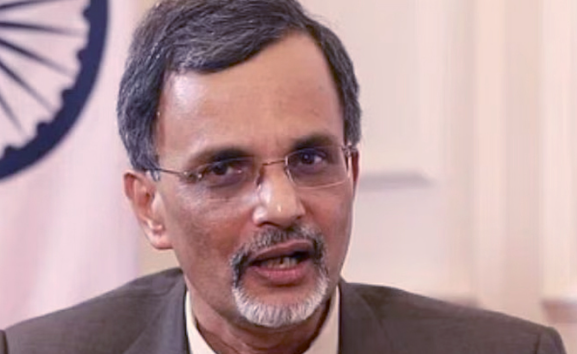
Virendra Pandit
New Delhi: If prolonged, US President Donald Trump’s 50 percent tariffs, which became effective on August 27, may shrink India’s GDP by 0.5 percent in the current financial year (2025-26), according to Dr. V. Anantha Nageswaran, Chief Economic Advisor to the government.
“I hope the additional penal tariff is a short-lived phenomenon,” a media report quoted him as saying on Monday.
“Depending upon how long it lasts even in this financial year, it may translate into a GDP impact of somewhere between 0.5 percent to 0.6 percent,” he said.
However, if the tariff uncertainty extends into the next financial year (FY27), the impact will be “larger,” resulting in a major “risk” for India, Dr. Nageswaran said.
Piqued at India not signing on his dotted lines, Trump doubled the tariff on Indian goods to 50 percent in August, half of it (25 percent) as a “penalty” for buying Russian oil. India, which termed it as “unjust,” has, however, continued to buy crude from Russia for its energy security. Trump has not, ironically, levied any such penalty against China, the biggest buyer of Russian oil, nor against Europe, which purchased Russian oil refined in India. Even Ukraine is buying refined Russian diesel from India!
The US tariffs against India are the highest in Asia, making Indian goods uncompetitive compared with manufacturing rivals like Bangladesh and Vietnam.
America is India’s biggest export market, and the tariffs are expected to hurt labour-intensive businesses like textiles, leather goods, and jewellery the most.
Dr. Nageswaran said he will stick to the government’s growth forecast of 6.3-6.8 percent for the fiscal year ending March 2026, citing strong expansion in the April -June quarter. India’s economy accelerated 7.8 percent during the period, the fastest pace in more than a year.
The recent cuts in consumption and direct taxes, along with inflation at an eight-year low, are key tailwinds for the economy, as they will boost disposable incomes and spending.
Last week, India reformed Goods and Services Tax (GST) by cutting it on most items of everyday use to spur domestic demand. Dr. Nageswaran expects the tax overhaul will boost the GDP by 0.2 percent-0.3 percent.
India is expected to meet its fiscal deficit target of 4.4 percent this year, with a bumper central bank pay-out and asset sales helping cushion any revenue shortfall, he said.