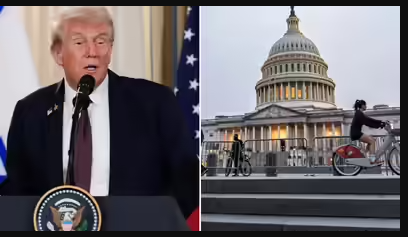
Trump Government is under Shut Down as Democrats Stop Budget










Manas Dasgupta
NEW DELHI, Oct 1: The US government has officially shut down that began from 12:01 am on Wednesday after Democrats blocked a Republican stopgap funding package that didn’t address their demands.
As part of the measure, the government funding expired as the clock struck midnight, and no one inside the Capitol knows what will happen next. As the Democrats and Republicans in Congress remained at an impasse risking furlough or possible permanent layoff of thousands of federal employees.
The current US government shutdown marks the first in nearly seven years. The last time US government experienced a ‘partial’ shutdown, was during Donald Trump’s first term in 2018.
A shutdown would see all non-essential services are grinding to a halt. Excepted employees, i.e. those who perform work to protect life and property – stay on the job and continue to work, but do not get their pay until after the shutdown has ended. Essential workers, including military personnel, will have to work without pay, while non-essential federal employees will be sent on furlough. Per nonpartisan Congressional Budget Office estimates, as many as 750,000 federal workers could be temporarily furloughed, even if Trump doesn’t proceed with permanent dismissals.
Trump showed little willingness to consider Democrats’ demands on health care, despite agreeing to attend a meeting on Monday with senator Chuck Schumer and Rep. Hakeem Jeffries, Senate Majority Leader John Thune, R-S.D., House Speaker Mike Johnson, R-La., and House Democratic leader Hakeem Jeffries, D-N.Y.
The president raised the stakes in the fight, telling reporters Tuesday his administration may permanently fire “a lot” of federal workers in the event of a shutdown. The federal government typically temporarily furloughs non-essential workers during a funding lapse and later gives them back pay when the shutdown ends.
When a lapse in funding occurs, the law requires federal agencies to cease activity and furlough their “non-excepted” employees. “Excepted employees” include those who perform work to protect life and property. Therefore, in-hospital medical care, border protection, law enforcement and air-traffic control are likely to continue during the stoppage. Social security and Medicare cheques will also be sent out, but benefit verification and card issuance could stop.
Government functions, like NASA’s space missions, President Donald Trump’s immigration crackdown and certain public health work at the Food and Drug Administration and the United States Department of Agriculture, would also continue during a shutdown. But there could be travel delays if the congressional standoff drags on and unpaid workers stop showing up.
Generally, during shutdowns, essential workers continue their work normally, some even without regular pay cheques – but federal employees deemed non-essential are sent on temporary unpaid leave. In the past, these workers have then been paid retrospectively.
That means that services like the federally funded food assistance programme, food inspections, government pre-schools, the issuing of student loans, immigration hearings, and operations at national parks may be curtailed or closed. While the larger economy may not feel the impacts right away, a prolonged closure could slow economic growth, disrupt markets, and erode public confidence.
Per a BBC report, this shutdown is likely to be bigger than the one in late 2018 during Trump’s first term as president, when Congress had passed some funding bills. Analysts have estimated this shutdown could shave around 0.1 to 0.2 percentage points off economic growth for each week that it lasts.
US budget stand-offs have become routine as the nation’s politics have grown more dysfunctional. This time around, Democrats have insisted that any spending bill must include additional healthcare subsidies, while Republicans have insisted that the two issues should be dealt with separately.
Trump has added fuel to the fire. Ahead of Tuesday’s vote, he threatened to cancel programs favoured by Democrats and fire more federal workers if the government shuts down. “We’ll be laying off a lot of people,” he told reporters. “They’re going to be Democrats.”
Such layoffs would lead to further brain drain for the government. More than 150,000 workers are due to leave federal payrolls this week after taking a buyout, the biggest exodus in 80 years. Tens of thousands more have already been fired this year. Trump has also refused to spend billions of dollars approved by Congress, prompting some Democrats to question why they should vote for any spending bills at all.
With no sign of compromise on Capitol Hill, it was unclear how long a shutdown would play out. Congress has shut down the government 15 times since 1981, with most lasting a day or two. The most recent, during Trump’s first term, was also the longest.
This time, health care is the sticking point. Democrats say any spending bill must also make permanent Affordable Care Act subsidies that are due to expire at the end of the year. Without a fix, healthcare costs for 24 million Americans will rise sharply, with a disproportionate impact in Republican-controlled states like Florida and Texas that have refused to enact other aspects of the law that provide coverage to low-income people. Democrats have also sought to ensure that Trump will not be able to undo those changes if they are signed into law.
Republicans say they are open to a fix but accuse Democrats of holding the budget hostage to satisfy the demands of their base voters ahead of the 2026 midterm elections, when control of Congress will be at stake.
Earlier in the day, White House had confirmed the shutdown with a graphic, and labelled the funding lapse as ‘Democrat’ shutdown. It is unclear how long a shutdown could last. Economists have warned that pressure would mount to reopen the government if a stoppage lasted for two weeks. As per the US Embassy, all scheduled passport and visa services at all consulates will continue.
Buzz about a border closure spiked after the shutdown. So far, there has been no official communication about the border between US and Canada being closed. The closure of the federal government will curtail or halt some US climate disaster preparedness and environmental programs — and even potentially delay real estate transactions within the nation’s flood zones.